

Chenda, Thayambaka, Nadaswaram, Odakkuzhal, Chendamelam and Panchavadyam sit on almost every senior kalolsavam schedule, but almost nothing online tells a judging panel how to score them — most guides stop at classical vocal and dance items and leave temple percussion and wind instruments as an afterthought. This guide gives real, usable rubrics for Kerala’s traditional percussion and wind-instrument competitions — a solo scheme and a separate ensemble scheme — a printable score sheet, and the verified time limits and class structure straight from the kalolsavam item-code data, so organisers can set the item up correctly and judges can score it consistently on eTalenter.
What these items are
These are Kerala’s classical temple percussion and wind instruments, entered as kalolsavam competitions in their own right, separate from the melodic instrumental items (violin, veena, keyboard) covered in our instrumental music judging criteria guide:
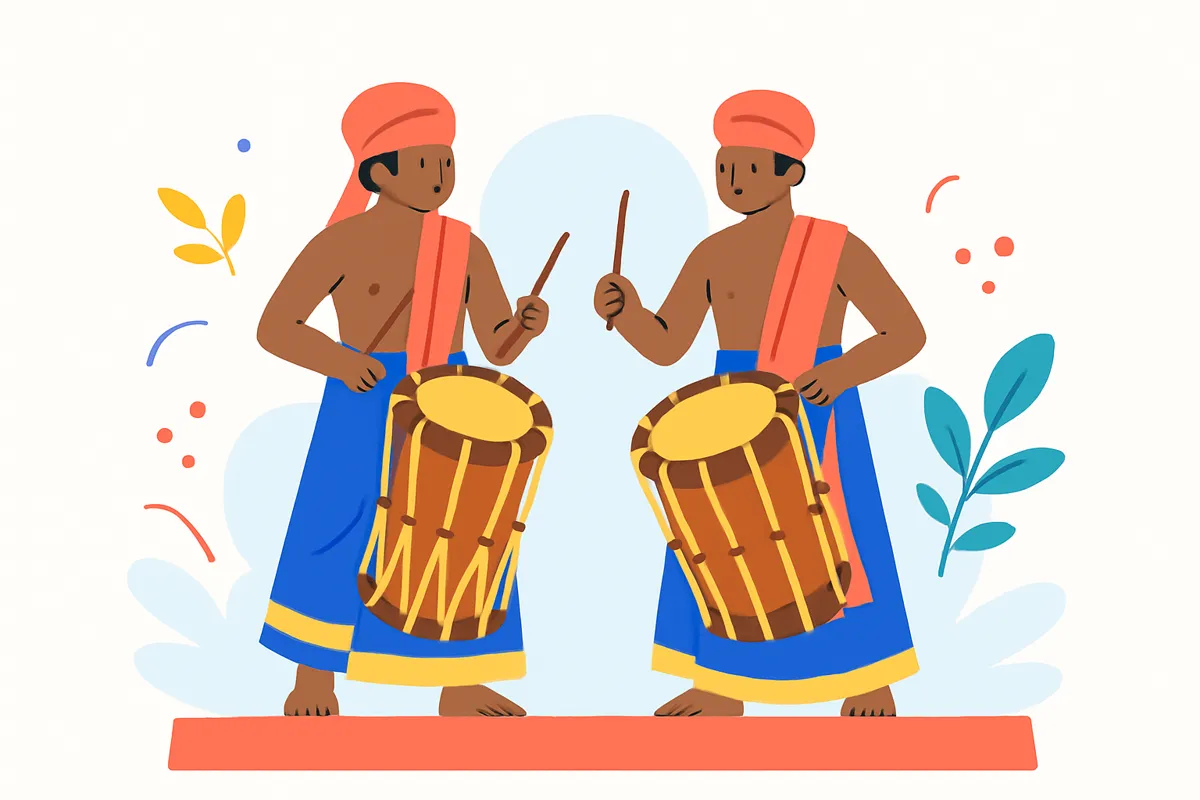
- Chenda / Thayambaka — solo or small-ensemble drumming on the chenda, built around Thayambaka’s characteristic improvised build in tempo and complexity
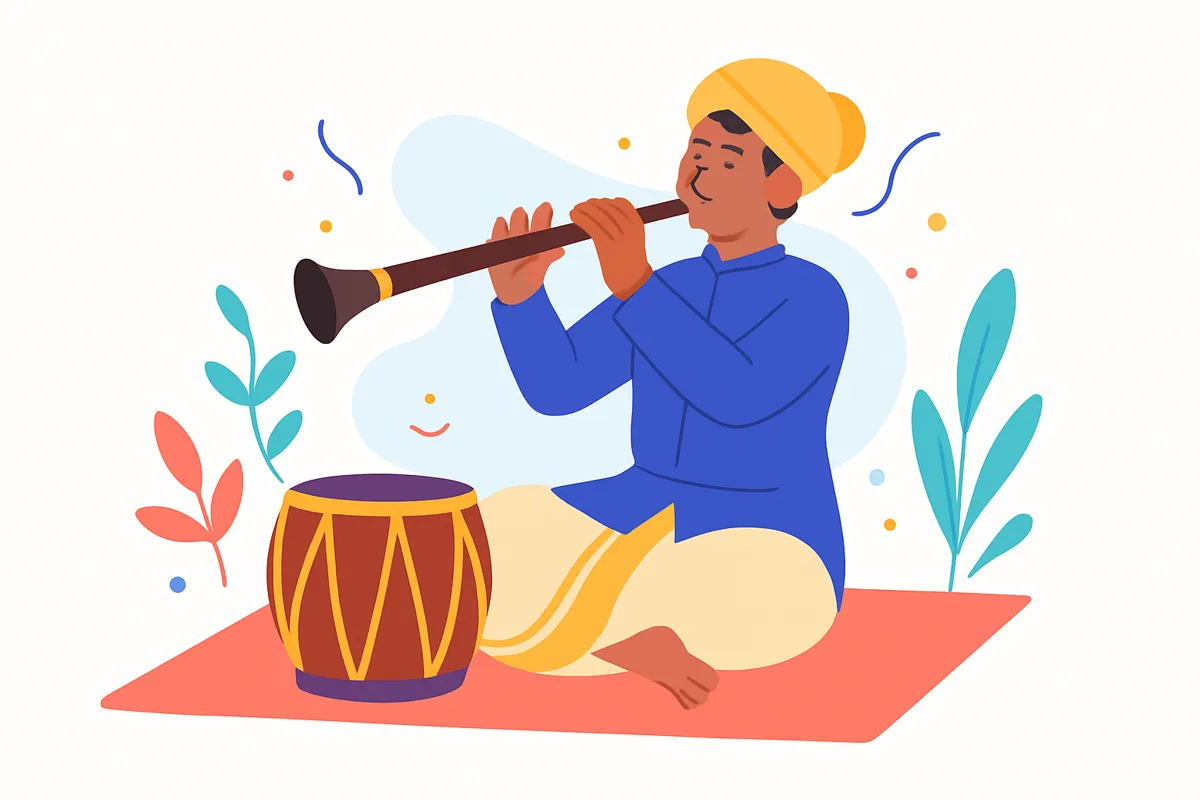
- Nadaswaram — a double-reed wind instrument, played solo, traditionally associated with temple processions and auspicious occasions
- Odakkuzhal — a traditional flute, played solo
- Chendamelam — a team chenda drum ensemble, several players performing a coordinated rhythmic composition together
- Panchavadyam — literally “five instruments” (traditionally thimila, maddalam, ilathalam, kombu and kuzhal), a team temple-percussion orchestra built around a long, structured tempo build from a slow opening to a fast climax
The three solo items (Chenda/Thayambaka, Nadaswaram, Odakkuzhal) are set up in eTalenter as Individual competitions; Chendamelam and Panchavadyam are Team competitions, with each unit’s team built during registration through Bulk Participant Management or the public registration form — the same mechanic used for any group item.
Verified time limits and class structure (kalolsavam item-code data)
All five items run only at the two senior class categories — Category III (High School, class 8–10) and Category IV (Higher Secondary, class 11–12) — reflecting the years of training these instruments need; none of the five is offered at Category I (LP) or Category II (UP). Every item is open to both genders, carries a 100-mark ceiling, and the warning bell sounds exactly one minute before time is up.
| Item | Type | Category III | Category IV | Warning bell |
|---|---|---|---|---|
| Chenda / Thayambaka | Individual | 10 min | 10 min | at 9 min |
| Nadaswaram | Individual | 10 min | 10 min | at 9 min |
| Odakkuzhal | Individual | — | 10 min | at 9 min |
| Chendamelam | Team | 10 min | 10 min | at 9 min |
| Panchavadyam | Team | 20 min | 20 min | at 19 min |
Odakkuzhal is offered at Category IV only, not Category III. Panchavadyam’s 20-minute limit — double every other item on this list — reflects the form’s own structure: a genuine tempo build from a slow opening through several stages to a fast climax needs the extra time, not a longer stage slot for its own sake. Every value above is reproduced directly from the kalolsavam item-code data; scoring weightage below is a suggested scheme organisers should adapt and publish, not a rule any specific festival is bound to.
A sample rubric for solo items (Chenda/Thayambaka, Nadaswaram, Odakkuzhal) — 100 marks
| Criterion | What it checks | Marks |
|---|---|---|
| Technique & command over the instrument | Correct hand/stick or breath technique, clean strokes or tone production, control at speed | 30 |
| Rhythm / laya accuracy | Steady tala, clean transitions between speeds, no drift over the performance | 25 |
| Tonal quality & clarity | Clean, well-projected sound; for Thayambaka, clarity even as the pattern gets denser | 20 |
| Repertoire & complexity | Range and difficulty of the patterns attempted, not just correctness of a simple one | 15 |
| Stage presence & time discipline | Composure, a clean finish, performance completed inside the time limit | 10 |
| Total | 100 |
A sample rubric for ensemble items (Chendamelam, Panchavadyam) — 100 marks
| Criterion | What it checks | Marks |
|---|---|---|
| Synchronisation among players | The team plays as one unit — no player audibly ahead or behind | 30 |
| Rhythmic build & complexity | A genuine tempo/complexity build (kalasham) executed cleanly, not just a loud finish | 25 |
| Dynamics & control | Controlled volume through quiet and loud passages; the build is audible, not just faster | 15 |
| Traditional adherence & instrumentation | Correct instruments for the item (Panchavadyam’s five-instrument line-up), correct structure | 15 |
| Ensemble balance & stage presentation | No single instrument dominating the mix; a controlled, deliberate finish | 15 |
| Total | 100 |
Suggested printable score sheet — one row per chest/team number, one column per judge.
| Chest/Team No. | Criterion 1 | Criterion 2 | Criterion 3 | Criterion 4 | Criterion 5 | Total (100) | Judge Signature |
|---|---|---|---|---|---|---|---|
How to judge a percussion or wind-instrument item, step by step
- Confirm the item and line-up before scoring. For Panchavadyam, check the five-instrument line-up is genuine — a substitute instrument changes what you’re judging.
- Listen for the build, not just the peak. Thayambaka and Panchavadyam are structured around a tempo/complexity build; a panel that only reacts to the loud climax misses the technical work in the earlier, slower sections.
- Score technique and rhythm independently of volume. A loud, energetic performance can still drift off tala — don’t let energy substitute for accuracy.
- For ensembles, listen for one out-of-sync player rather than judging the group sound as a single blur — synchronisation is usually where marks are actually lost.
- Publish the panel’s decision only after tabulation — with multiple judges, drop or average outliers rather than letting one score dominate.
Deductions & disqualification
| Issue | Typical deduction |
|---|---|
| Overran the time limit | 1–2 marks per 15–30 seconds over, organiser-defined |
| Wrong or substitute instrument for the named item (e.g. a non-traditional drum standing in for the chenda) | Deduction or disqualification per event rules |
| Panchavadyam missing one of the five instruments or running with extra unlisted instruments | Deduction under traditional adherence, or disqualification per event rules |
| Recorded or pre-programmed backing track for what should be a live acoustic performance | Disqualification |
| Extra players beyond the declared roster (team items) | Deduction or disqualification per event rules |
Set your own thresholds in Scoring Setup — the values above are a starting point.
Rules organisers should publish in advance
- Whether accompaniment (a second player keeping tala) is allowed for the solo items, and if so, whether the accompanist is scored
- Minimum and maximum player count for Chendamelam and Panchavadyam, and whether one unit may enter more than one team
- Sound/amplification rules for an outdoor or open-air stage, since these are acoustically loud instruments by design
- Whether candidates bring their own instruments or the event provides them, and who is responsible for tuning/maintenance on the day
How this differs from other music items on the schedule
Our instrumental music judging criteria guide covers melodic instruments — violin, keyboard, veena — where tone and melodic interpretation carry most of the weight. These five items are a different judging problem: rhythm and technique dominate over melody, two of them are team ensembles rather than solos, and Panchavadyam in particular is judged on a structured tempo build rather than a fixed-length performance. They also sit apart from vocal/dance items like light music or folk dance — no lyrics, no choreography, just instrument and tala. See the full verified time-limit table for every kalolsavam item in our kalolsavam item list guide.
FAQ
Why are these items only offered at Category III and IV?
Chenda, Thayambaka, Nadaswaram, Odakkuzhal, Chendamelam and Panchavadyam all need years of technique before a candidate can perform them competitively, which is why the verified kalolsavam data shows none of the five running at LP or UP level — organisers following the same logic for their own event should consider a similar age floor.
Can a school or club enter these items even if it doesn’t run a full kalolsavam?
Yes — set them up as standalone Arts competitions in eTalenter with whatever age groups and levels suit your event; the time limits and rubric above are a starting point you can adapt.
Is Panchavadyam judged the same way as Chendamelam?
Both use the ensemble rubric above, but Panchavadyam’s judging should weigh the five-instrument line-up and the length of its tempo build more heavily — see “traditional adherence & instrumentation” in the rubric table.
Score it consistently with eTalenter
Set up your percussion and wind-instrument rubric once in Scoring Setup, register solo candidates or build teams through Bulk Participant Management or the public registration form, and let judges score on their own device — eTalenter tabulates every judge’s marks instantly and publishes results the moment the panel is done. See how online judging & tabulation works, or read our guide to publishing results online once scores are finalised.
Questions about setting this up for your event? WhatsApp us at +91 96056 56508 or email support@etalenter.com.

Leave a Reply
You must be logged in to post a comment.