
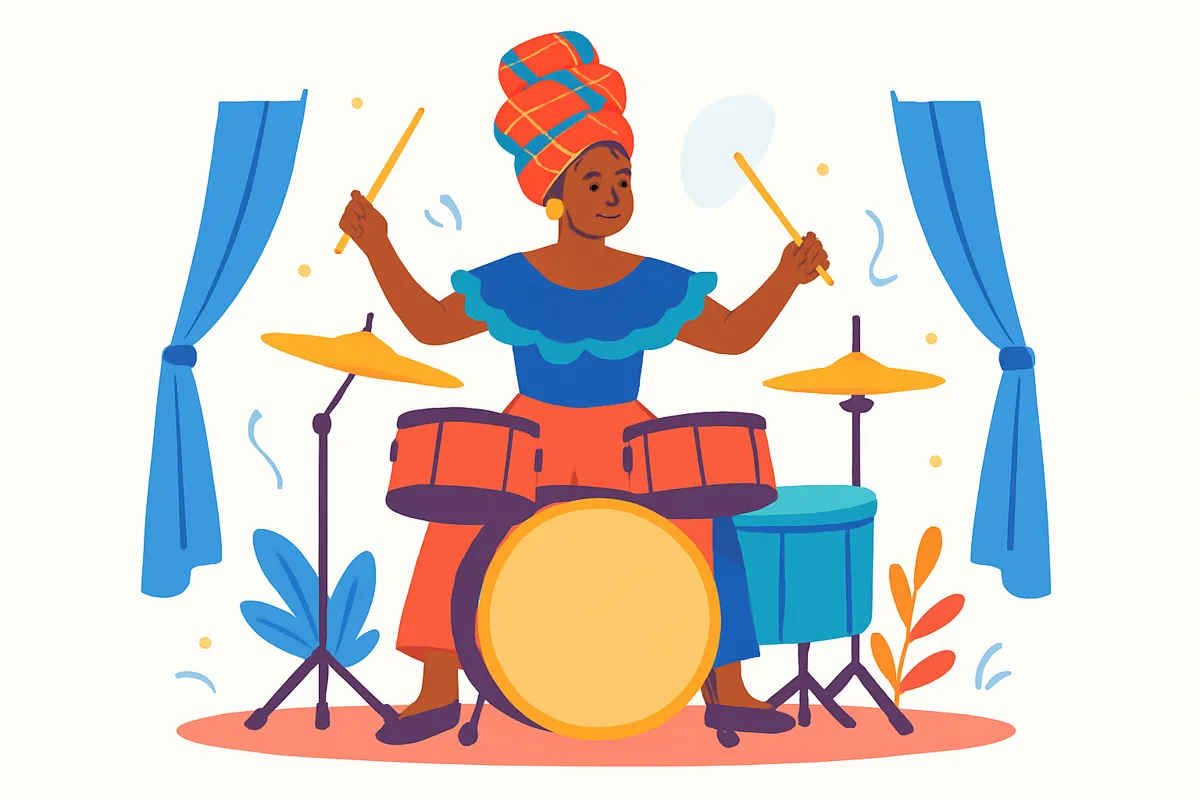
A solo drum-kit category in which one drummer shows rhythmic skill across different genres in a creative arrangement, recorded on the template as an individual entry of up to four minutes, scored out of 100 and offered in all seven classes.
Music – Drum Solo – Trap Set is the fifty-second entry on the Jamaican national performing arts festival template and the twenty-first category of its Music syllabus. It is the first of the festival’s four drumming categories, which run after the vocal classes and before the Speech discipline. The handbook describes it as one drummer demonstrating rhythmic skills and using different genres and their variations in a creative arrangement, played on a trap set, also called a drum set or drum kit.
Two rules shape the whole round. The handbook allows no stems and no accompaniment, so the drummer plays alone: no backing track, no bass or keyboard underneath, and no pre-recorded drum parts to lean on. Whatever the audience hears has to come from one pair of hands and feet. That makes the item a pure test of timing, control and invention, and it is why the marking table treats the pulse of a solo as something the player must hold internally.
A typical round runs like this: the drummer is called, takes the stage in costume, settles at the kit and plays one arrangement through. A good arrangement usually moves between two or three feels, such as a rock or funk groove, a reggae or ska one-drop, a shuffle or a Latin pattern, with fills and breaks to link them and a clear ending. The panel listens for how the kit is balanced as a whole, with bass drum, snare, toms, hi-hat and cymbals each doing a job, not just for speed.
The template records the item as an individual entry, with both genders in one list, English as the language, a four-minute limit with the warning bell at three minutes and a score out of 100, in all seven classes. The handbook differs in two ways: its time limit for a drum solo is two minutes, and it lists the category for classes 1 to 6 only, so the combined class 7 is a template choice. An organiser should decide which limit and which classes apply, say so in the entry notice and set the competition time to match.
Organisers run the class because the drum kit is the instrument that most young players want to try and the one least often heard in a formal solo setting. It gives school bands, church and community players and private students a stage of their own, and it lets the festival reward musicianship in rhythm, dynamics and structure, not only in melody.
Where Music – Drum Solo – Trap Set comes from
The drum kit, or trap set, grew in the late nineteenth and early twentieth centuries as New Orleans-style dance and jazz bands found ways for a single player to handle the bass drum, snare, cymbals and other percussion that had been played by several people. Foot pedals for the bass drum and the hi-hat made it possible, and the kit then became standard in jazz, rock, funk, reggae and popular music generally. Nothing in the source for this template says how this category came to be added to the Jamaican festival or who has won it, so no festival history is claimed here.
Where Music – Drum Solo – Trap Set is run
On eTalenter this item is used in one template, the Jamaican national performing arts festival template, where it is assigned to all seven classes (six age bands from the youngest children to adults aged 20 and over, plus a combined class) inside the Music discipline, between the musical-theatre vocal class and the hand-drum class. It is separate from the festival’s two drum ensemble categories, which are for four to sixteen drummers, and from its steel pan and band classes. Drum-kit solos and rudiment or kit contests also appear in school and music festivals and in drumming championships in other countries, but those are separate events with their own rules, set pieces and time limits.
- Jamaica (the national performing arts festival the template is built from)
Key facts
- An instrumental solo: one drummer on a trap set (drum set), demonstrating rhythmic skills and different genres and their variations in a creative arrangement
- No stems and no accompaniment are permitted in the handbook, so the performance is the drummer alone, with no backing track and no other players
- Offered in all seven classes on the template, from Class 1, the youngest age band, to Class 6 (adults, 20 and over) and the combined Class 7; the handbook lists the category for classes 1 to 6
- The template gives an individual entry, both genders together, English, a four-minute limit with the warning bell at three minutes and a score out of 100; the handbook sets two minutes for a drum solo and stops any entry that passes its limit
- The handbook marks drumming on five criteria: technical proficiency 25, rhythm and timing 20, interpretation and style 20, creativity 20 and presentation, costume and impact 15 at the audition and parish rounds, then 12, 10, 10, 10 and 8 (out of 50) at the national finals
- Medals are awarded against published mark bands rather than first, second and third; all performers must be costumed at the parish and national finals
- Ideas, not rules, for an organiser: ask for the number of kit pieces on the entry form, publish a rule on sticks, brushes and bring-your-own versus house kit, and agree a changeover time between players
On eTalenter, Music – Drum Solo – Trap Set is filed under On Stage and typically scored with Marks. It appears in 1 ready-made event templates — each one can adjust its time limit, age-group assignment and scoring setup independently.
Across the templates that use it, Music – Drum Solo – Trap Set is most often entered as an Individual competition, typically scored out of 100, commonly time-limited to around 4 minutes where a limit is set.
What judges look at in Music – Drum Solo – Trap Set
What a Music – Drum Solo – Trap Set panel is actually weighing up, and where the marks are usually won or lost:
- The handbook prints one marking table for all four drumming categories, solo and ensemble: five criteria totalling 100 at the audition and parish rounds and 50 at the national finals. The points below follow it; the wording is a summary, not a quotation of the rule
- Technical proficiency (25): clean, even strokes, good tuning and tone from each drum and cymbal, stick technique, clear articulation of fast passages and mastery that fits the player’s age class. Rushed fills that smear into noise lose marks here, while a controlled simple groove can score well
- Rhythm and timing (20): steady tempo, clean tempo changes where they are intended, clear rhythmic phrasing and an internal pulse that does not drift when the player is alone. With no accompaniment, a wobble in the pulse is plain to hear, so this is often where marks are won or lost in a solo
- Interpretation and style (20): understanding of the genres on show, expressive dynamics and a sense of musical flow. A reggae feel that sounds like rock, or a rock beat with no change in volume, shows weak understanding of the style
- Creativity (20): making an arrangement out of the genres, with accents, variations, solo passages, improvised moments and smooth transitions, and some originality. A string of unconnected licks scores below a piece that has a beginning, development and ending
- Presentation, costume and impact (15): confidence, posture, costume that suits the performance, movement, eye contact, a tidy entry and exit and a memorable finish. Costume is required at the parish and national finals, so a dress rehearsal is part of preparation
- Time: one complete arrangement inside the limit the organiser sets; an overrunning entry is stopped, so the ending needs to be rehearsed against a clock
Treat these as the judging focus, not a fixed rubric: publish your own weighted criteria for Music – Drum Solo – Trap Set under Scoring Setup, or start from the full instrumental music competition judging criteria guide.
How to prepare for Music – Drum Solo – Trap Set
How entrants and their teachers usually get Music – Drum Solo – Trap Set right on the day:
- Plan the arrangement before practising it: pick two or three genres, decide the order and write out the route in a few lines (groove A, fill, groove B, break, short solo, return, ending). A planned shape reads as creativity; an improvised ramble reads as filler
- Practise with a metronome and then without it. Because no accompaniment is allowed, set the click to an audible beat, play a minute alone, and check the tempo against the click at the end to see how far it drifted
- Choose genres that suit the player, and make each one sound different: change the hi-hat or ride pattern, the snare placement, the dynamics and the feel, not only the speed
- Cut to the clock. Time the piece in full performance dress and keep a margin below the limit; ask the organiser which limit applies to your class, because the template and the handbook differ
- Build the transitions. Practise the two bars that link one feel to the next, and the ending, more than the middle; this is where most solos come apart
- Rehearse dynamics: record a take, then listen for whether the quietest and loudest passages are really different. Judges reward contrast and a balanced kit
- Sort out the kit in advance: confirm whether a house kit is provided, what is on it, and whether your own pedal, throne, sticks or cymbals may be used; practise on a similar kit and leave time for adjusting seat and cymbal height
- Dress rehearse the entry and exit, including sitting down, adjusting and the first count-in, so the first and last ten seconds are as polished as the playing. After a lower result than hoped, ask for the adjudicator comments: timing and a clear structure usually move the score more than extra speed
Ready-made event templates that include Music – Drum Solo – Trap Set
Open any template to preview it in eTalenter and install it as a live, editable event.
| Template | Category | Score label | Competitions |
|---|---|---|---|
| JCDC National Performing Arts Festival (Jamaica) | On Stage | Marks | 7 |
Frequently asked questions
Is Music – Drum Solo – Trap Set judged individually or as a team?
Across eTalenter’s templates it’s most often run as an Individual entry, though an organiser can set either participation type when assigning the item to an age group.
Can I use a backing track or play along to a recording?
No. The handbook says no stems and no accompaniment are permitted for the drum solo categories, so the performance must be the drummer alone. If you want to play with a track, ask the organiser whether another category or event allows it.
How long can the solo be?
The template gives four minutes with the warning bell at three. The handbook sets two minutes for a drum solo and says an entry that passes the limit is stopped and asked to leave the stage. Ask the organiser which limit applies before you cut or lengthen the piece.
Is this the same as the Drum Solo – Hand Drum category?
No. This item is for the drum kit (trap set or drum set) and asks for rhythmic skill across genres. The hand-drum item is for a single drum or several drums plus auxiliary percussion, with rhythms that may be original or based on traditional patterns. They are separate categories with separate entries.
Is a drum ensemble judged the same way?
The handbook uses the same five-criteria table for solo and ensemble drumming, but the ensembles are separate categories for four to sixteen drummers, with their own time limit of four minutes and their own requirements.
Do I have to bring my own kit?
The handbook text used for this template does not say. Ask the organiser in writing whether a house kit is provided, what it contains and whether your own pedals, sticks or cymbals may be used, and keep the reply with your paperwork.
Want the full judging picture? Read the full instrumental music competition judging criteria guide, or browse every on stage competition item.
Try Music – Drum Solo – Trap Set in eTalenter
See every ready-made template that runs Music – Drum Solo – Trap Set, and install one as a live event — age groups, rules and scoring included.


Leave a Reply
You must be logged in to post a comment.