
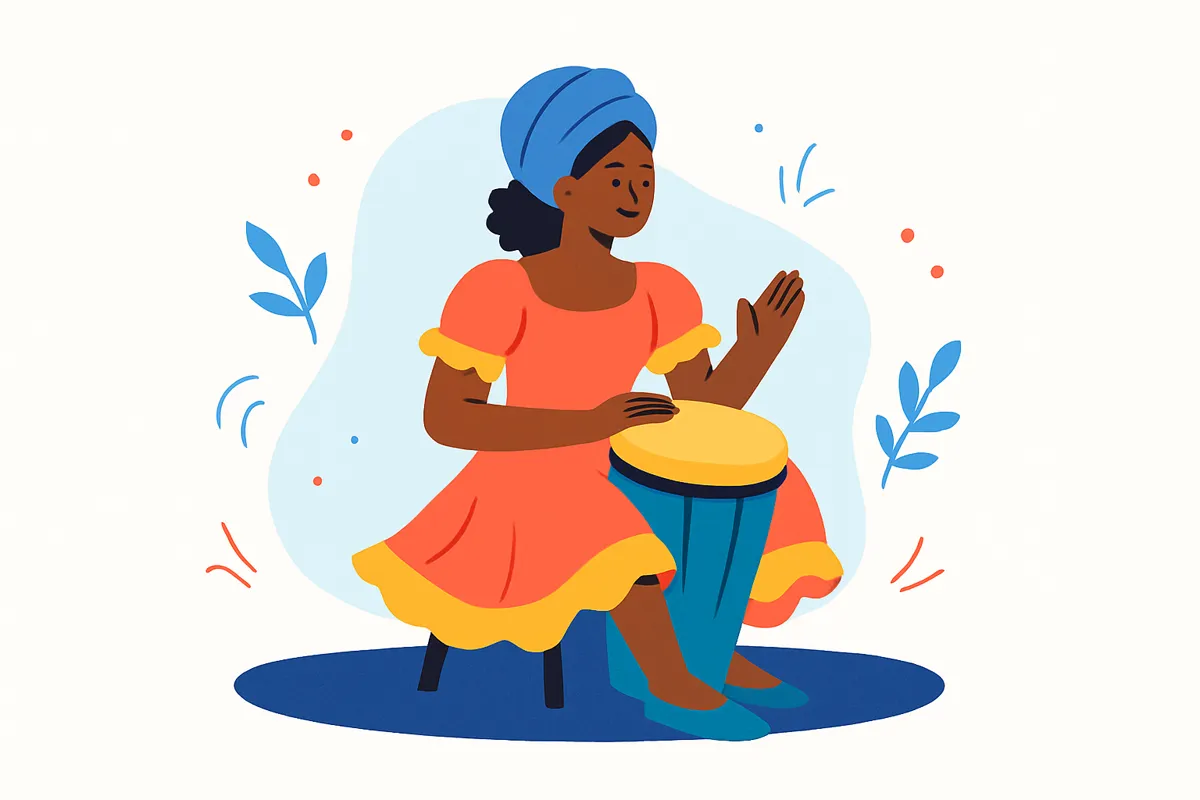
A solo hand-drumming category in which one player works on a single drum or several, with auxiliary percussion if wanted, using original rhythms or traditional patterns, recorded on the template as an individual entry of up to four minutes, scored out of 100 and offered in all seven classes.
Music – Drum Solo – Hand Drum is the fifty-third entry on the Jamaican national performing arts festival template and the twenty-second category of its Music syllabus. It is the second of the festival’s four drumming categories and the counterpart of the drum-kit solo that comes just before it. The handbook describes it as one drummer playing on a single drum or on more drums, with other auxiliary percussion instruments as desired, using rhythms that may be original or based on traditional patterns.
What sets it apart from the kit solo is the choice of instrument. There is no fixed set-up: a player may bring one conga, a pair of bongos, a djembe, a cajón, a small rack of hand drums or a single traditional drum, and add shakers, bells, a woodblock or similar small percussion. The handbook also advises performers to keep to the rhythms of the regions they draw on and to move smoothly between sections, so the arrangement is expected to hang together as one piece instead of a list of patterns.
A typical round runs like this: the player is called, comes on in costume with the drum or drums already chosen, settles into position and plays one arrangement through. Many strong entries start with a quiet statement of a basic pattern, build by adding a second drum or a bell part, open into a short improvised passage and return to the opening pattern for a clear close. The panel listens for tone from the hands, clean slaps and open strokes, and a pulse that stays steady with nothing else playing.
The template records the item as an individual entry, both genders in one list, English as the language, a four-minute limit with the warning bell at three minutes and a score out of 100, in all seven classes. The handbook differs in two ways: its time limit for a drum solo is two minutes, and it lists the category for classes 1 to 6 only, so the combined class 7 is a template choice. An organiser should decide which limit and which classes apply, say so in the entry notice and set the competition time to match.
Organisers run the class because hand drums are the most widely played percussion in community music, and many of the best players have never sat at a kit. It gives drummers from church, school, cultural and community groups a solo stage of their own, and it rewards cultural knowledge and invention as well as technique.
Where Music – Drum Solo – Hand Drum comes from
Drums played with the bare hands are among the oldest instruments known, and hand-drum traditions grew up independently across West Africa, the Caribbean, Latin America, the Middle East and South Asia. In the Caribbean, rhythms and drum types carried from Africa mixed with local and European influences to produce the conga, bongo and other drumming styles heard today. Nothing in the source for this template says how this category came to be added to the Jamaican festival or who has won it, so no festival history is claimed here.
Where Music – Drum Solo – Hand Drum is run
On eTalenter this item is used in one template, the Jamaican national performing arts festival template, where it is assigned to all seven classes (six age bands from the youngest children to adults aged 20 and over, plus a combined class) inside the Music discipline, between the drum-kit solo and the first of the two drum ensemble classes. It is separate from the kit solo, from the drum ensembles for four to sixteen players and from the festival’s Traditional Folk Forms classes, which are staged folk performances rather than a drumming solo. Hand-drum solos also appear in percussion festivals, school music competitions and cultural showcases in other countries, but those events have their own set pieces, instruments and time limits.
- Jamaica (the national performing arts festival the template is built from)
Key facts
- An instrumental solo: one drummer on a single drum or several, with auxiliary percussion allowed, playing original rhythms or traditional patterns
- The handbook advises keeping to the rhythms of the regions the player draws on and moving smoothly between sections; it does not list a set repertoire or name particular drums
- The handbook text for this category does not repeat the no-stems, no-accompaniment wording it gives for the drum-kit solo, so the organiser should state whether any backing is allowed (the safe reading is a solo with none)
- Offered in all seven classes on the template, from Class 1, the youngest age band, to Class 6 (adults, 20 and over) and the combined Class 7; the handbook lists the category for classes 1 to 6
- The template gives an individual entry, both genders together, English, a four-minute limit with the warning bell at three minutes and a score out of 100; the handbook sets two minutes for a drum solo and stops any entry that passes its limit
- Drumming is marked on one five-criteria table: technical proficiency 25, rhythm and timing 20, interpretation and style 20, creativity 20 and presentation, costume and impact 15 at the audition and parish rounds, then 12, 10, 10, 10 and 8 (out of 50) at the national finals; performers must be costumed at the parish and national finals
- Ideas, not rules, for an organiser: ask entrants to list the drums and extras on the entry form, set a rule on how many instruments may be carried on, and allow a short set-up time so a multi-drum arrangement is not rushed
On eTalenter, Music – Drum Solo – Hand Drum is filed under On Stage and typically scored with Marks. It appears in 1 ready-made event templates — each one can adjust its time limit, age-group assignment and scoring setup independently.
Across the templates that use it, Music – Drum Solo – Hand Drum is most often entered as an Individual competition, typically scored out of 100, commonly time-limited to around 4 minutes where a limit is set.
What judges look at in Music – Drum Solo – Hand Drum
What a Music – Drum Solo – Hand Drum panel is actually weighing up, and where the marks are usually won or lost:
- The handbook prints one marking table for all four drumming categories, so a hand-drum solo is scored on the same five criteria as a kit solo; the points below follow it and the wording is a summary, not a quotation of the rule
- Technical proficiency (25): the table names brilliance of tone, tuning, hand technique, clear articulation and precise strokes or slaps. On hand drums that means a clean bass, tone and slap that sound different from each other, correct hand and wrist position and fast passages that stay even. A muddy slap or a drum that is out of tune loses marks here
- Rhythm and timing (20): the table asks for consistency of tempo, clear phrasing and an internal pulse that holds in a solo. With no second player, a drifting tempo is audible at once, and a deliberate speed change must sound planned
- Interpretation and style (20): the table looks for understanding of rhythmic traditions, genres and cultural forms, expressive dynamics and musical flow. A pattern borrowed from a tradition should sound like that tradition, with the right accents and feel, not a generic roll played faster
- Creativity (20): the table rewards call and response, accents, variations, solo passages, improvisation and effective transitions. In a hand-drum solo this can be a conversation between two drums or between the drum and a bell, but the invention has to serve the piece
- Presentation, costume and impact (15): confidence, posture, costume that suits the style, movement, eye contact and entry and exit. Moving a drum, a stand or a stool on stage is part of the entry, so a tidy set-up counts in the player’s favour
- Time: one complete arrangement inside the limit the organiser sets; an overrunning entry is stopped, so the close must be rehearsed against a clock
Treat these as the judging focus, not a fixed rubric: publish your own weighted criteria for Music – Drum Solo – Hand Drum under Scoring Setup, or start from the full instrumental music competition judging criteria guide.
How to prepare for Music – Drum Solo – Hand Drum
How entrants and their teachers usually get Music – Drum Solo – Hand Drum right on the day:
- Choose the instrument for the music, not the other way round: decide first whether the piece is built on one voice, a pair or a small set, then bring only what the arrangement uses. Each extra drum adds a transition that must be rehearsed
- Pick a source for the rhythms and learn it properly. If the piece draws on a traditional pattern, learn its accents and feel from a teacher or player who knows it, and be ready to say where it comes from; if it is original, make sure its shape is clear
- Write the route down: opening pattern, build, second voice or auxiliary part, short solo, return, close. A planned arc reads as creativity, while a long unplanned run of patterns reads as filler
- Work the hands daily. Practise bass, tone and slap separately until each is clean, then join them, and practise at slow speed with a metronome before bringing the piece up to tempo
- Practise without any click or backing as well, and record yourself: listen for tempo drift and for dynamics that are too similar. The pulse has to live in the player
- Time the piece in full dress with the real set-up included, and leave a margin below the limit. Ask the organiser which limit applies to your class, because the template and the handbook differ
- Sort out logistics in advance: whether drums are supplied or must be brought, how you will carry them, whether a stand or seat is available and whether heads can be tuned beforehand. Arrive early enough to check the tuning and room acoustics
- Dress rehearse the entry, the set-up and the exit so the first and last ten seconds are as polished as the playing. After a disappointing result, ask for the adjudicator comments: a clear structure, steady pulse and clean tone usually add more marks than extra speed
Ready-made event templates that include Music – Drum Solo – Hand Drum
Open any template to preview it in eTalenter and install it as a live, editable event.
| Template | Category | Score label | Competitions |
|---|---|---|---|
| JCDC National Performing Arts Festival (Jamaica) | On Stage | Marks | 7 |
Frequently asked questions
Is Music – Drum Solo – Hand Drum judged individually or as a team?
Across eTalenter’s templates it’s most often run as an Individual entry, though an organiser can set either participation type when assigning the item to an age group.
What is the difference between the hand-drum solo and the drum-kit solo?
The kit solo is for one drummer on a trap set, showing rhythmic skill across different genres. The hand-drum solo is for one drummer on a single drum or several drums, with auxiliary percussion if wanted, using original rhythms or traditional patterns. They are separate categories with separate entries, though they are marked on the same five-criteria table.
Which drums am I allowed to use?
The handbook says a single drum or more drums, plus other auxiliary percussion instruments as desired, and does not name particular drums. Ask the organiser in writing whether any instruments are excluded and whether drums are supplied, and keep the reply with your paperwork.
Can I play along with a backing track or another player?
The handbook text for this category does not say, although it bars stems and accompaniment for the drum-kit solo. Treat the hand-drum solo as a solo performance unless the organiser confirms otherwise in writing, and do not rely on a track.
How long can the solo be?
The template gives four minutes with the warning bell at three. The handbook sets two minutes for a drum solo and says an entry that passes the limit is stopped and asked to leave the stage. Ask the organiser which limit applies before you cut or lengthen the piece.
Must the rhythms be traditional?
No. The handbook says rhythms may be original or based on traditional patterns. If you borrow a tradition, the panel looks for an understanding of its style; if you compose your own, it looks for a clear arrangement, variation and smooth transitions.
Want the full judging picture? Read the full instrumental music competition judging criteria guide, or browse every on stage competition item.
Try Music – Drum Solo – Hand Drum in eTalenter
See every ready-made template that runs Music – Drum Solo – Hand Drum, and install one as a live event — age groups, rules and scoring included.

Leave a Reply
You must be logged in to post a comment.