
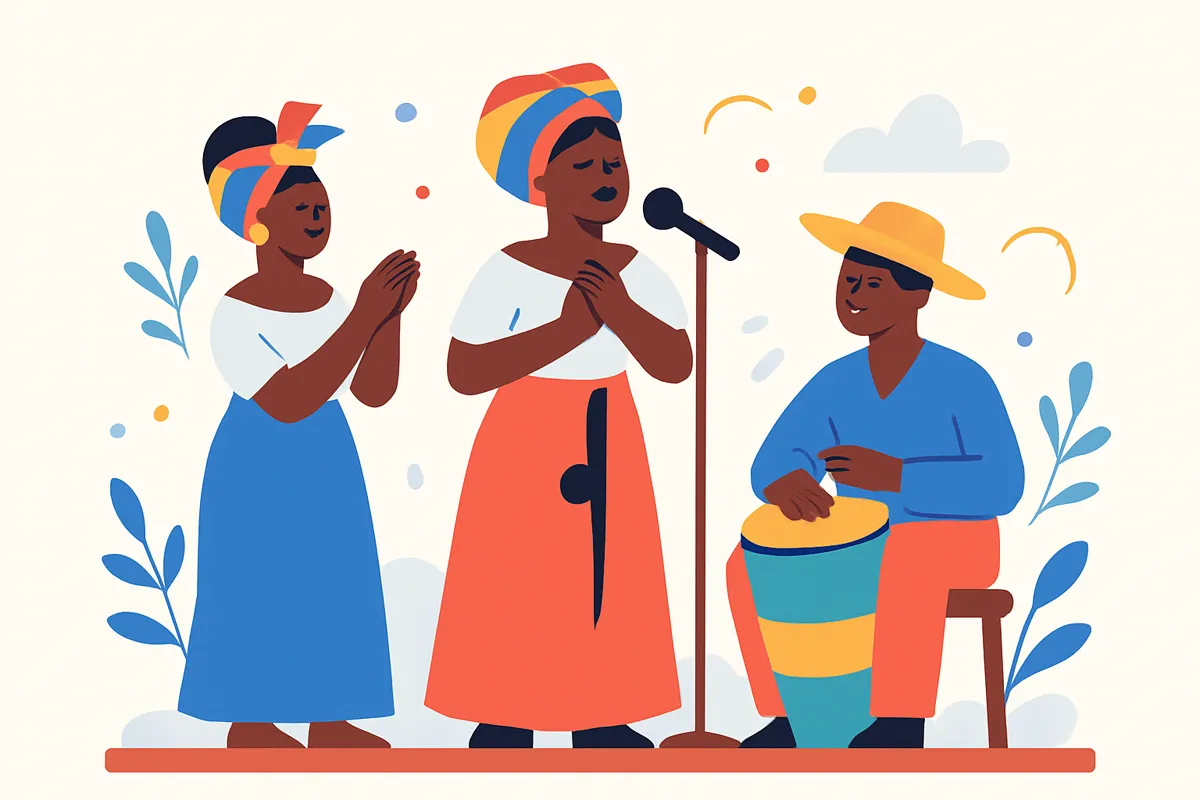
A music category in a national performing arts festival in Jamaica where a vocal group sings a spiritual before a panel in four minutes, scored out of 100 and open to all seven classes from age 3 to adult.
Music – Vocal Spiritual is the eleventh entry in the Music discipline of the Jamaican national performing arts festival list this template is rebuilt from, and it sits straight after the classical and semi-classical class. A spiritual, in ordinary festival usage, is a religious folk song with a strong call-and-response habit, a steady swaying pulse and words that speak plainly of hardship, hope and faith. The class is for vocal groups who bring one such song before a panel, and it is kept apart from the sacred-song class before it and the gospel class after it.
The extract used to build the template gives the category, the classes and the limits only. It prints no group size, no list of accepted songs, no rule on whether a soloist may lead the verses, no rule on clapping, percussion or piano, and no per-criterion marking table. This page therefore describes how classes of this kind are commonly run and does not claim to know the festival requirements. An organiser using the template should publish a short notice before entries open that says what counts as a spiritual for this class, how big a group may be, and what, if anything, may accompany the voices.
A round usually runs like this. The group walks on, takes up its formation and is given its first note or begins unaccompanied. A song leader often sings the opening line and the group answers, with the harmony thickening verse by verse. Spirituals reward a group that breathes together: the panel is listening for an even, warm blend, a rhythm that rocks without rushing and words that carry feeling instead of being shouted. A single verse repeated with growing power can be more affecting than three verses sung at one volume, and four minutes leaves room for a verse, a chorus and a closing refrain.
On the template the item is offered in all seven classes, from Class 1 (ages 3-6) through the age bands up to adults aged 20 and over, plus a combined class for any mix of ages. Every class has the same limits: four minutes with a warning bell at three, a score out of 100, both genders in one list and English as the language. It is recorded as a team entry, so one name stands for the whole group and not for a single singer.
Organisers keep a class like this because it draws on songs that whole communities already know, so even a young or inexperienced group has something familiar to build on, and because the panel can hear at once whether a group is listening to itself. The most helpful piece of planning is the notice that explains what is meant by a spiritual and whether a leader, a drum or hand-clapping may be used, so entrants do not have to guess.
Where Music – Vocal Spiritual comes from
The spiritual is a well-documented form of religious folk song that grew among enslaved African American communities in the southern United States, passed on by ear and sung in fields, homes and worship long before it was written down. Arrangements for concert choirs, and the habit of presenting them at music festivals, came later and spread widely through schools and churches in the twentieth century. Nothing in the source for this template says how the class came to be part of the Jamaican festival, so no local history is claimed here.
Where Music – Vocal Spiritual is run
On eTalenter this item is used in one template, the Jamaican national performing arts festival template, where it is assigned to all seven classes (six age bands from 3-6 up to adults aged 20 and over, plus a combined class) inside the Music discipline, between the Vocal Classical / Semi-Classical class and the Vocal Gospel class. Other templates on the platform carry their own spiritual or religious-song items under different names, often as solo or open choral classes in school and community festivals, but those are separate items with their own rules. Spiritual singing classes are a familiar feature of school, church-hall and community music festivals in North America, the Caribbean and Britain.
- Jamaica (the national performing arts festival the template is built from)
Key facts
- A group performance of a spiritual before a panel, recorded as a team entry on the template, with both genders in one list and the language set to English
- The template does not define a spiritual, give a group size or state an accompaniment rule, so the organiser sets those
- Offered in all seven classes, from Class 1 (ages 3-6) to Class 6 (adults, 20 and over) and the combined class
- Four-minute limit with the warning bell at three minutes, enough for a few verses and a closing refrain
- Scored out of 100 on the template; the festival awards medals against published mark bands rather than first, second and third
- Eleventh in the Music discipline, after Vocal Classical / Semi-Classical and ahead of Vocal Gospel; Vocal Sacred is a separate item earlier in the list
- Ideas, not rules, for an organiser: a notice listing the kinds of song accepted, a line on whether a lead singer may sing the verses alone, a rule on hand-clapping and percussion, and a request that each group names its song on the entry form
On eTalenter, Music – Vocal Spiritual is filed under On Stage and typically scored with Marks. It appears in 1 ready-made event templates — each one can adjust its time limit, age-group assignment and scoring setup independently.
Across the templates that use it, Music – Vocal Spiritual is most often entered as an Team competition, typically scored out of 100, commonly time-limited to around 4 minutes where a limit is set.
What judges look at in Music – Vocal Spiritual
What a Music – Vocal Spiritual panel is actually weighing up, and where the marks are usually won or lost:
- The source does not print this category marking table, so what follows is organiser guidance for agreeing yardsticks with the panel, not rules from the source
- Blend and warmth: voices that melt into one sound, with parts that support the tune and no single singer pushing above the rest
- Rhythm and pulse: a steady, swaying beat that the whole group feels together; spirituals lose their power when the tempo drags or hurries between verses
- Call and response: a leader and answering group who hand the line back and forth cleanly, with the answer arriving on time and at the right strength
- Feeling and sincerity: the words sung as if they mean something, with faces and posture that match the song, instead of a rehearsed smile or a blank stare
- Diction and clarity: the story of the text can be followed from the back of the hall, even when the dialect or phrasing is unfamiliar
- Dynamics: a build from a soft opening to a full close, and a few moments of near silence, rather than one volume throughout
- Choice of song: a piece that suits the age and range of the singers and fits four minutes without a rushed ending
- Discipline: a confident start together, a tidy formation, and an ending the group has agreed on in advance
Treat these as the judging focus, not a fixed rubric: publish your own weighted criteria for Music – Vocal Spiritual under Scoring Setup, or start from the full singing competition judging criteria guide.
How to prepare for Music – Vocal Spiritual
How entrants and their teachers usually get Music – Vocal Spiritual right on the day:
- Ask the organiser in writing what counts as a spiritual for this class, how many voices make a group, whether a lead singer may sing alone, and whether hand-clapping, foot-tapping or a drum is allowed; keep the reply with your entry paperwork
- Choose a song the youngest singers can live with: sing it through at a speaking pace first, and move the starting note if the top of the tune strains the voices
- Plan the shape before the polish: decide who leads each verse, where the group joins, and where the song grows louder, then write those points on one sheet everyone can read
- Teach the response lines first: the answering group is usually the simplest part, and a team that sings it with confidence makes the leader sound stronger
- Practise the sway: stand in the formation you will use and rock gently in time, so the beat sits in the body and not only in the head; check that movement is small enough not to spoil the sound
- Work on one vowel sound per rehearsal: a spiritual has long open notes, and a group that matches how it sings its open vowels will blend more than one working on volume
- Record a run-through and listen back for places where the tempo slips; correct those spots by counting them aloud together
- Time the song with every repeat against the four-minute limit, and agree where the group will stop if the warning bell sounds at three
- If the result falls short of your hopes, ask for the adjudicator comments and fix blend and rhythm first, since steady gains there usually move a score more than a harder arrangement
Ready-made event templates that include Music – Vocal Spiritual
Open any template to preview it in eTalenter and install it as a live, editable event.
| Template | Category | Score label | Competitions |
|---|---|---|---|
| JCDC National Performing Arts Festival (Jamaica) | On Stage | Marks | 7 |
Frequently asked questions
Is Music – Vocal Spiritual judged individually or as a team?
Across eTalenter’s templates it’s most often run as an Team entry, though an organiser can set either participation type when assigning the item to an age group.
What is a spiritual in this class?
The extract used for this template does not define the term. In general use a spiritual is a religious folk song, often sung in call and response with a steady pulse, that was passed on by ear before it was written down. Because the festival text does not fix a song list, ask the organiser which songs are accepted.
What is the difference between Vocal Spiritual and Vocal Sacred?
They are separate items on the template. The extract prints no definition of either, so the organiser should explain where the line falls. In general use, sacred is the wider label for religious music of many kinds, while a spiritual is one particular folk tradition within it.
How many singers make a group in Music – Vocal Spiritual?
The extract does not give a minimum or maximum group size, so ask the organiser. It records the item as a team entry, which means more than one singer, but how many is for the organiser to publish.
Can a soloist lead the verses?
The extract does not say. Call and response is common in spirituals, so many organisers allow a leader to sing the verses while the group answers. Ask the organiser and get the answer in writing before you plan the arrangement.
Is clapping or a drum allowed?
The extract prints no accompaniment rule. Hand-clapping is part of how many spirituals are sung, but whether it, a drum or a piano is permitted is for the organiser to say.
How is it marked?
The template scores out of 100, and the festival awards medals against mark bands rather than first, second and third. The extract prints no per-criterion weights for this category, so an organiser using it should agree and publish their own.
Want the full judging picture? Read the full singing competition judging criteria guide, or browse every on stage competition item.
Try Music – Vocal Spiritual in eTalenter
See every ready-made template that runs Music – Vocal Spiritual, and install one as a live event — age groups, rules and scoring included.



Leave a Reply
You must be logged in to post a comment.