
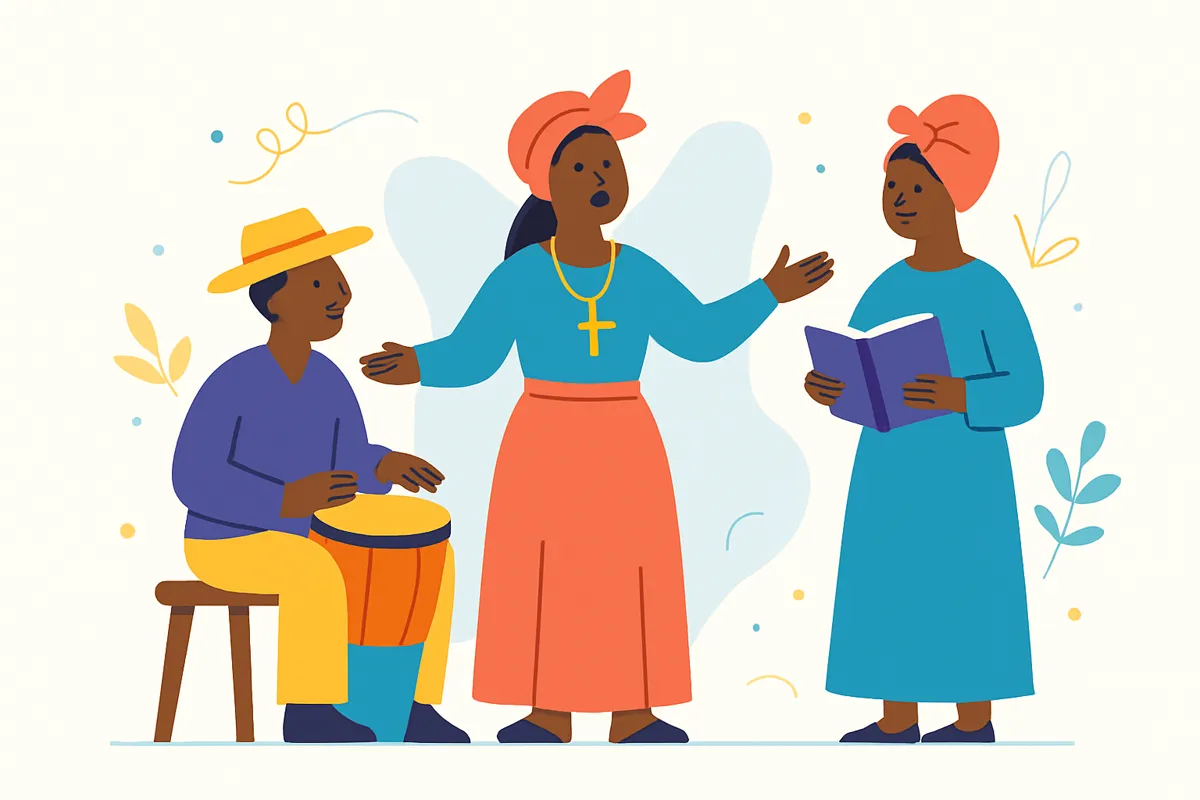
A music category in a national performing arts festival in Jamaica where a vocal group sings sacred music before a panel in four minutes, scored out of 100 and open to all seven classes from age 3 to adult.
Music – Vocal Sacred is the ninth entry in the Music discipline of the Jamaican national performing arts festival list this template is rebuilt from, and it opens the vocal section that follows the instrumental classes. It is the class for sacred song: a vocal group stands before the panel and sings a piece of sacred or devotional music, such as a hymn, an anthem, a chorale or a mass movement. Within the festival it sits alongside separate Spiritual and Gospel vocal items, so this one is best read as the formal, church-music end of that family.
The extract used to build the template gives the category, the classes and the limits only. It prints no group size, no rule on whether the piece must be unaccompanied, no list of acceptable repertoire, no language rule beyond English, no required number of verses and no per-criterion marking table. This page therefore describes how sacred-song classes are commonly run and does not claim to know the festival requirements. An organiser using this template is wise to publish a short notice before entries open that says how many voices make a group, whether a piano or backing is allowed, whether a conductor may stand in front, and whether the piece must be chosen from a set list.
A round usually runs like this. The group is called, files on and takes its place, and a pitch is given from a note or a short chord. If there is a conductor they raise their hands and the group begins together. The panel listens first for pitch and blend, then for diction, then for how well the group shapes the words and the line of the music. A hymn verse, an anthem section or a short chorale fits comfortably inside four minutes; a long cantata movement needs a cut.
On the template the item is offered in all seven classes, from Class 1 (ages 3-6) through the age bands up to adults aged 20 and over, and a combined class for any mix of ages. Every class has the same limits: four minutes with a warning bell at three, a score out of 100, both genders in one list and English as the language. It is recorded as a team entry, so one name stands for the whole group rather than for a single singer.
Because the class is open to every age band and to mixed groups, a single festival day can place a row of small children singing a simple hymn beside an adult choir attempting a four-part anthem. Organisers keep the category because it gives schools, community choirs and youth groups an everyday reason to rehearse together, and because choosing music that suits the voices is itself a skill the panel can reward.
Where Music – Vocal Sacred comes from
Sacred choral singing has a long history in churches and cathedrals, and the competitive music festival movement that grew in Britain and its former colonies in the late nineteenth and twentieth centuries made it a standard class, with entrants singing a prepared piece before an adjudicator. The class has no single founding date, and nothing in the source for this template says where Jamaica took the format from.
Where Music – Vocal Sacred is run
On eTalenter this item is used in one template, the Jamaican national performing arts festival template, where it is assigned to all seven classes (six age bands from 3-6 up to adults aged 20 and over, plus a combined class) inside the Music discipline, between the own-choice instrumental solo and the Classical and Semi-Classical vocal class. Other templates on the platform carry their own sacred-song classes under different names (a sacred solo, a sacred group, a sacred song or aria from an oratorio), mostly in Australian eisteddfod-style festivals, but those are separate items with their own rules. Sacred or hymn classes of this kind are a familiar part of school and community music festivals in many countries.
- Jamaica (the national performing arts festival the template is built from)
Key facts
- A group performance of sacred music by a vocal team before a panel, recorded as a team entry on the template, with both genders in one list and the language set to English
- The template does not give a group size, a repertoire list or an accompaniment rule, so the organiser sets those
- Offered in all seven classes, from Class 1 (ages 3-6) to Class 6 (adults, 20 and over) and the combined class
- Four-minute limit with the warning bell at three minutes, enough for a hymn, an anthem section or a short chorale
- Scored out of 100 on the template; the festival awards medals against published mark bands rather than first, second and third
- Ninth in the Music discipline, after Instrumental Own Choice Solo and ahead of Vocal Classical / Semi-Classical; Vocal Spiritual and Vocal Gospel are separate items
- Ideas, not rules, for an organiser: a notice stating the group size range, a line saying whether a piano or backing may be used, a rule that the group names the piece and composer to the panel, and a note on whether a conductor may stand in front
On eTalenter, Music – Vocal Sacred is filed under On Stage and typically scored with Marks. It appears in 1 ready-made event templates — each one can adjust its time limit, age-group assignment and scoring setup independently.
Across the templates that use it, Music – Vocal Sacred is most often entered as an Team competition, typically scored out of 100, commonly time-limited to around 4 minutes where a limit is set.
What judges look at in Music – Vocal Sacred
What a Music – Vocal Sacred panel is actually weighing up, and where the marks are usually won or lost:
- The source does not print this category marking table, so what follows is organiser guidance for agreeing yardsticks with the panel, not rules from the source
- Pitch and intonation: the group starts on the given note, holds it, and does not drift flat or sharp over the four minutes; unaccompanied groups are most exposed here
- Blend and balance: voices that sound like one group rather than a few strong singers over a quiet crowd, with no part overpowering another
- Diction and words: sacred texts carry meaning, so clear vowels and consonants matter; a panel marks down a piece where the words cannot be understood from the hall
- Musical shaping: phrasing that follows the line of the text, dynamics that rise and fall, and a clear ending rather than a drift out
- Choice of music: a piece that suits the age and range of the voices; a well-sung simple hymn should outscore an ambitious anthem that falls apart
- Unity and discipline: a clean start together, eyes up, steady posture, and a conductor, if allowed, who leads without distracting
- Reverence and presentation: a performance that treats the text with care, with neat entry and exit and a finish inside four minutes
Treat these as the judging focus, not a fixed rubric: publish your own weighted criteria for Music – Vocal Sacred under Scoring Setup, or start from the full singing competition judging criteria guide.
How to prepare for Music – Vocal Sacred
How entrants and their teachers usually get Music – Vocal Sacred right on the day:
- Ask the organiser in writing how many voices make a group, whether a piano or backing is allowed, whether a conductor may lead, and whether the four minutes include the walk on, and keep the reply with your entry paperwork
- Choose music one step below your hardest; a hymn the group can sing in tune on a bad day will score better than an anthem that works only when everything goes right, and for the youngest classes a short unison piece is plenty
- Time the piece with repeats and verses against the four-minute limit, and agree a tidy cut in advance rather than being stopped mid-phrase at the end
- Rehearse the pitch first: have the group hum the starting note, then sing the first phrase, until the whole group finds it together without a lead singer pulling them there
- Work on words before volume: speak the text in rhythm, then sing it, so every singer gives the same vowels and the consonants land together at the end of each phrase
- Balance the parts: stand voices in small mixed clusters so each singer can hear the other parts, and have someone listen from the back of the room for the balance
- Run the piece start to finish at least five times, including the walk on, the pitch and the first entry, so a slip in the middle does not break the group on the day
- Practise recovering: if one section wobbles, the group keeps the beat and rejoins together; a calm recovery shows more control than stopping
- If the result is below what you hoped, ask for the adjudicator comments and work first on starting pitch, blend and diction; steady gains there usually move a score more than a harder piece
Ready-made event templates that include Music – Vocal Sacred
Open any template to preview it in eTalenter and install it as a live, editable event.
| Template | Category | Score label | Competitions |
|---|---|---|---|
| JCDC National Performing Arts Festival (Jamaica) | On Stage | Marks | 7 |
Frequently asked questions
Is Music – Vocal Sacred judged individually or as a team?
Across eTalenter’s templates it’s most often run as an Team entry, though an organiser can set either participation type when assigning the item to an age group.
How many singers make a group in Music – Vocal Sacred?
The extract used for this template does not give a minimum or maximum group size, so ask the organiser. It records the item as a team entry, which means more than one singer, but how many is for the organiser to publish.
Does the piece have to be a hymn?
The template does not list set repertoire. Sacred song can mean a hymn, an anthem, a chorale or another devotional piece, but the organiser may restrict the choice, so ask before you enter.
Is this the same as the Vocal Spiritual or Vocal Gospel classes?
No. Vocal Spiritual and Vocal Gospel are separate items on the same template with their own entries. Check the organiser notice if you are unsure which class a particular piece belongs in.
Can we sing without a piano or backing?
The extract does not say whether accompaniment is allowed. Many sacred-song classes allow a piano and some require unaccompanied singing, so ask the organiser and get the answer in writing.
How long can the performance be?
The template sets four minutes with a warning bell at three minutes. Whether the walk on and the pitch count inside the slot is not stated, so ask. Choose a piece, or a cut of one, that finishes comfortably inside the limit.
How is it marked?
The template scores out of 100, and the festival awards medals against mark bands rather than first, second and third. The extract used for the template prints no per-criterion weights for this category, so an organiser using it should agree and publish their own.
Want the full judging picture? Read the full singing competition judging criteria guide, or browse every on stage competition item.
Try Music – Vocal Sacred in eTalenter
See every ready-made template that runs Music – Vocal Sacred, and install one as a live event — age groups, rules and scoring included.


Leave a Reply
You must be logged in to post a comment.