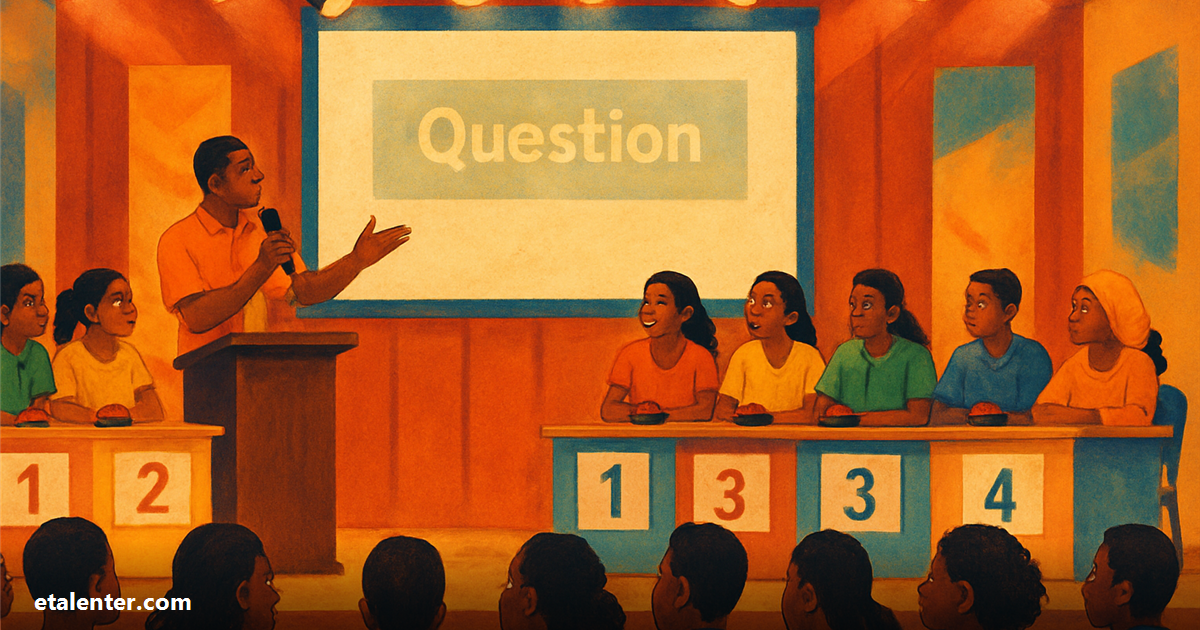
When only a handful of teams turn up, a quiz competition is easy: one quizmaster, a stack of question cards and a whiteboard for scores. The moment you have hundreds of participants — a whole school, an inter-school cluster, a college fest or a church youth festival — the same format collapses. You cannot put 300 students on one stage, and you cannot let a single buzzer round decide everything fairly. This guide explains how to conduct a large-scale quiz competition end to end: how to structure age groups, run written prelims into stage finals, design your rounds, handle buzzers and tie-breaks, and keep scoring transparent when the numbers get big. eTalenter runs a quiz as a judged Arts event, so everything below maps directly onto features you can set up in minutes.
Start with age groups and a two-stage format
The first decision is who competes against whom. A Class 4 student and a Class 12 student should never share a quiz table, so split entrants into age groups before anything else. Typical school-style groupings are LP, UP, HS and HSS; a church or youth setting might use Junior, Intermediate, Senior and Super Senior; a club or association event might simply number them Group 1–5. Set a cut-off date so every child lands in exactly one group.
With big numbers, the proven format is two stages:
- Preliminary round (written): a printed or on-screen objective paper taken by everyone at the same time. 25–40 questions, negative marking optional, strictly timed. This is your filter — it turns 300 hopefuls into a clean shortlist without needing a stage.
- Stage finals (oral/buzzer): the top 4–6 individuals or teams per age group qualify to the stage, where the real contest — rounds, buzzers and an audience — plays out.
This heats-and-finals structure is what keeps a large quiz fair and on schedule. Winners of the prelim are promoted to the finals rather than re-registering, and their results carry forward automatically.
Design your rounds (a sample stage-final structure)
A stage final needs variety so it tests breadth, speed and nerve. A reliable six-round template for finalists:
- Round 1 — General round: each team gets its own set of direct questions; pass to the next team on a miss.
- Round 2 — Visual/audio round: identify images, logos, maps or music clips on the projector.
- Round 3 — Rapid fire: fixed time (e.g. 60 seconds), as many answers as possible, no negatives.
- Round 4 — Buzzer round: open to all finalists; fastest buzzer answers; correct = +10, wrong = −5.
- Round 5 — Connect / theme round: staggered clues, points reducing as more clues are revealed.
- Round 6 — Rapid buzzer finale: a short high-stakes round to settle the podium.
Decide your marking rules before the event and publish them: points per correct answer, whether wrong answers carry a penalty, whether passed questions bounce, and how bonus points work. Clear rules prevent 90% of the disputes that erupt on stage.
Handle buzzers, timing and tie-breaks fairly
Buzzer rounds are where fairness is won or lost. Agree the protocol in advance: a question is “live” only after the quizmaster says “buzz now”; an early buzz forfeits the question; the first valid buzz gets a fixed answer window (say 5 seconds). For tie-breaks, have a bank of sudden-death questions ready — first correct answer wins, and if both miss, move to the next question until the tie breaks. Keep two or three spare tie-break questions per age group; you will need them more often than you expect.
Timing is the other silent killer of big quizzes. Give every finalist a chest number or ID card, run a token system so participants know when their group is called, and put the schedule on a projector so the whole hall follows along. When 200 participants are waiting their turn, visible call sheets and a live display turn chaos into flow.
Score transparently — the part that actually scales
Manual scoreboards break down long before your participant count does. With eTalenter you set up the quiz as an Arts competition, assign it to each age group, and configure the score rules and grades once. Prelim marks feed a shortlist; stage scores tabulate in real time as rounds finish; ties surface automatically so judges know exactly when to run a tie-break. When the last round ends, you move the competition to results review, assign winners, and publish — online, on the podium display, or as shareable social cards — then generate certificates and trophy stickers for winners and participants. No spreadsheet, no recount, no arguments over arithmetic. See how the scoring and tabulation engine works in our judge scoring & tabulation guide, and open entries in minutes with online competition registration. Since eTalenter treats quizzes as judged talent events, the same setup powers a full talent test too.
Frequently asked questions
How do I quiz hundreds of participants without a huge stage?
Run a written preliminary round for everyone at once, then promote only the top few per age group to the oral/buzzer stage finals. The written prelim does the filtering; the stage handles a manageable set of finalists.
Should a quiz be individual or team based?
Both work. eTalenter lets you set each competition’s participant type — a single candidate for individual quizzes, or a named team with a roster for team quizzes. You can even allow a school or unit to enter more than one team in the same quiz.
How are tie-breaks handled in scoring?
Configure your point rules up front. During tabulation, tied finalists are flagged so judges run sudden-death tie-break questions until the tie is broken, then the final ranks and awards are calculated automatically.
Run your next quiz on eTalenter
Whether it is a single-school quiz, an inter-school cluster or a large festival contest, eTalenter handles age groups, prelims, finals, buzzer scoring, tie-breaks, results and certificates in one place. Explore eTalenter’s competition management software, message us on WhatsApp, or email support@etalenter.com and we will help you set up your quiz competition.