
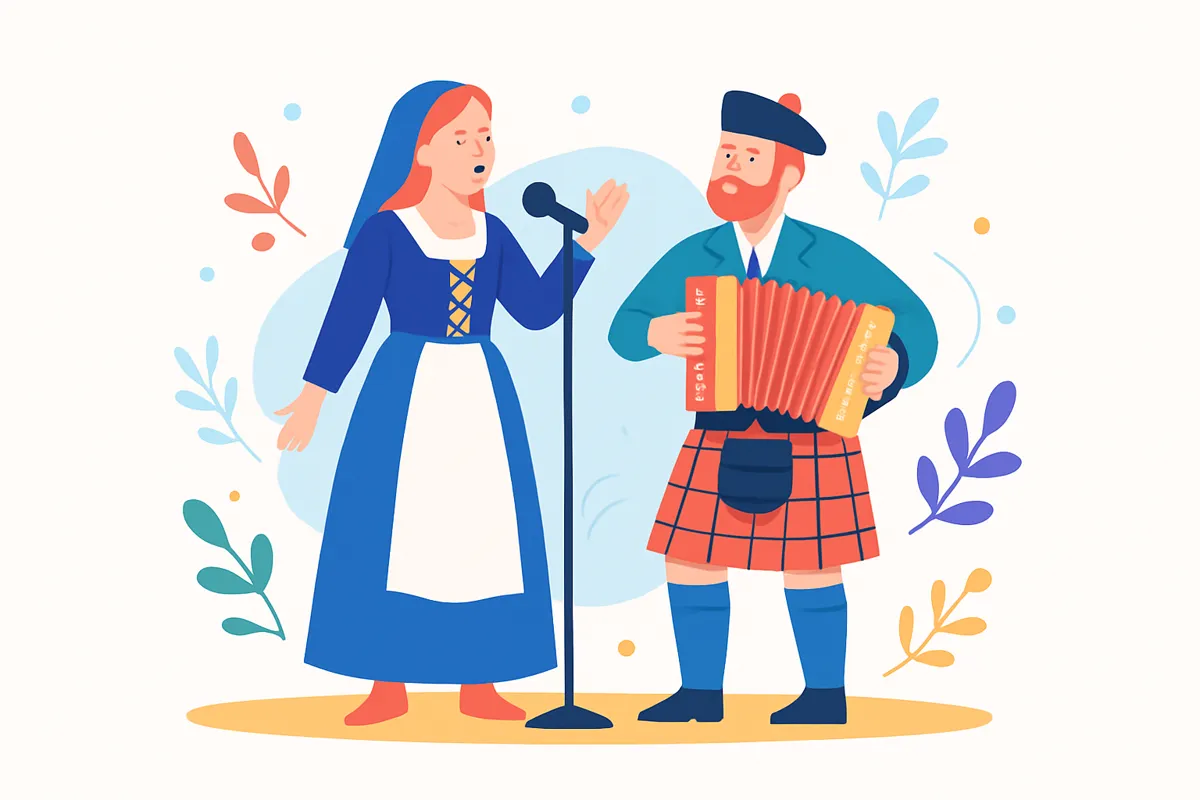
A solo item in which one singer performs a song from their own folk or heritage tradition, in the festival language, and is judged on how faithfully and expressively it is carried.
Traditional Singing is the item that keeps a community’s own songs alive. Instead of choosing any pleasing piece, the singer performs a song that belongs to a folk or heritage tradition, usually learnt by ear from family, neighbours or older singers rather than from a score. The emphasis moves from vocal display to authenticity: the right style, the right ornamentation, the right feeling for the words.
On the eTalenter templates the title appears once, on the Scottish Gaelic festival template. There it is an Individual On Stage item for both genders, open to every junior school-class band from the youngest primary pupils to the 16-18 band, and then to the separate Senior Ladies, Men, Mixed and Open divisions. Every band is fixed to Scottish Gaelic, with a ten-minute ceiling and a score out of 100 shown as a rating out of 10 — those two numbers are the app’s defaults, because the festival’s published rules print no numeric marking scheme for this item.
A round is simple to run. Each singer is called alone, gives the title and, if the rules ask for it, a word about where the song comes from, then sings it in full. Traditional songs in the Gaelic world are commonly sung without instruments, so the voice carries everything: the line of the melody, the small decorations around the notes, and the pacing of a story that may run to many verses. Whether an accompanist or recording is allowed is a matter for the festival notice, not for the template.
Organisers keep the item because it gives the language side of a festival its centre of gravity. Pupils who learn a song from a relative, or from a tradition-bearer invited to a class, take part in something that cannot be bought or copied from a chart, and the panel gets a chance to reward understanding as well as polish.
Where Traditional Singing is run
On the eTalenter templates Traditional Singing is used only in the Scottish Gaelic festival template, a national Gaelic-language cultural festival in Scotland, where it is a solo singing item in Gaelic across the junior school bands and the four senior divisions. Heritage-song classes under names such as folk song, traditional song or sean-nos exist at many language and folk festivals in the British Isles and Ireland, but they are separate competitions with their own rules, and this page only describes the item as the template carries it.
- Scotland, United Kingdom
Key facts
- Individual item: one singer performs alone, male and female entrants together in the junior bands
- Ten age bands: P1-P3, P4-P5, P6-P7, 11-12 (Secondary), 13-15, 16-18, then Senior Ladies, Senior Men, Senior Mixed and Senior Open
- Senior Ladies is a female-only band and Senior Men is male-only; Senior Mixed and Senior Open admit both
- Language is fixed to Scottish Gaelic on every band
- Time ceiling of 10 minutes and a /100 maximum are app defaults, since the published rules print no numeric scheme
- Adjudication sheets are issued to entrants and the adjudicators’ decision is final, as the festival rules state
On eTalenter, Traditional Singing is filed under On Stage and typically scored with Rating out of 10. It appears in 1 ready-made event templates — each one can adjust its time limit, age-group assignment and scoring setup independently.
Across the templates that use it, Traditional Singing is most often entered as an Individual competition, typically scored out of 100, commonly time-limited to around 10 minutes where a limit is set.
What judges look at in Traditional Singing
What a Traditional Singing panel is actually weighing up, and where the marks are usually won or lost:
- Style and authenticity: whether the song is sung in the manner of its tradition, with the shape and ornament a knowledgeable listener expects, not flattened into a pop-style tune
- Language and diction: clear, correct Gaelic with natural stress, where a mispronounced word costs more than a slightly imperfect note
- Understanding of the words: a singer who knows what each verse means shapes the phrasing around it, and the panel hears the difference
- Intonation and steadiness of line: holding pitch without accompaniment to lean on, particularly across a long song with many verses
- Tone and breath: an unforced, natural voice, with breaths placed to keep the phrase and the sense intact
- Presentation: a calm, respectful delivery that lets the song speak, rather than acting it out
Treat these as the judging focus, not a fixed rubric: publish your own weighted criteria for Traditional Singing under Scoring Setup, or start from the full singing competition judging criteria guide.
How to prepare for Traditional Singing
How entrants and their teachers usually get Traditional Singing right on the day:
- Learn the song from a living source if you can — a relative, teacher or tradition-bearer — and ask what the words mean before you ask how it goes
- Check the festival notice for any set-song list or age-band rule before choosing, so you do not prepare a song that cannot be entered
- Write out the words and translate every verse in your own language so that you can sing the sense, not just the sounds
- Sing unaccompanied in rehearsal, in a quiet room, until your pitch holds from first note to last without a backing sound
- Record yourself and compare with a recording from a respected singer, listening for ornament, pace and where the breath falls
- Keep the song inside the time limit by trimming verses only if the tradition allows it, and agree the cuts with your teacher beforehand
- Practise the entrance: say the title clearly, take one settling breath, and begin without fidgeting
Ready-made event templates that include Traditional Singing
Open any template to preview it in eTalenter and install it as a live, editable event.
| Template | Category | Score label | Competitions |
|---|---|---|---|
| Royal National Mod (Scotland) | On Stage | Rating out of 10 | 10 |
Frequently asked questions
Is Traditional Singing judged individually or as a team?
Across eTalenter’s templates it’s most often run as an Individual entry, though an organiser can set either participation type when assigning the item to an age group.
Is Traditional Singing the same as Solo Singing?
No. Solo Singing accepts any prepared song and is judged mainly on vocal quality and delivery. Traditional Singing asks for a song from the folk or heritage tradition and rewards authentic style and language alongside voice.
Does the song have to be in Gaelic?
On this template, yes — every band is set to Scottish Gaelic, so the song should be sung in that language.
Can I use an accompanist or a backing track?
The template does not say. Traditional songs are commonly sung unaccompanied, but check the festival notice or ask the organiser before you rehearse with any accompaniment.
Is the item judged individually or as a team?
Individually. Each singer performs alone and receives their own result.
Want the full judging picture? Read the full singing competition judging criteria guide, or browse every on stage competition item.
Try Traditional Singing in eTalenter
See every ready-made template that runs Traditional Singing, and install one as a live event — age groups, rules and scoring included.

Leave a Reply
You must be logged in to post a comment.