

A solo vocal item in which one singer performs a prepared song alone and is rated on pitch, tone, rhythm, diction and the way the song is delivered.
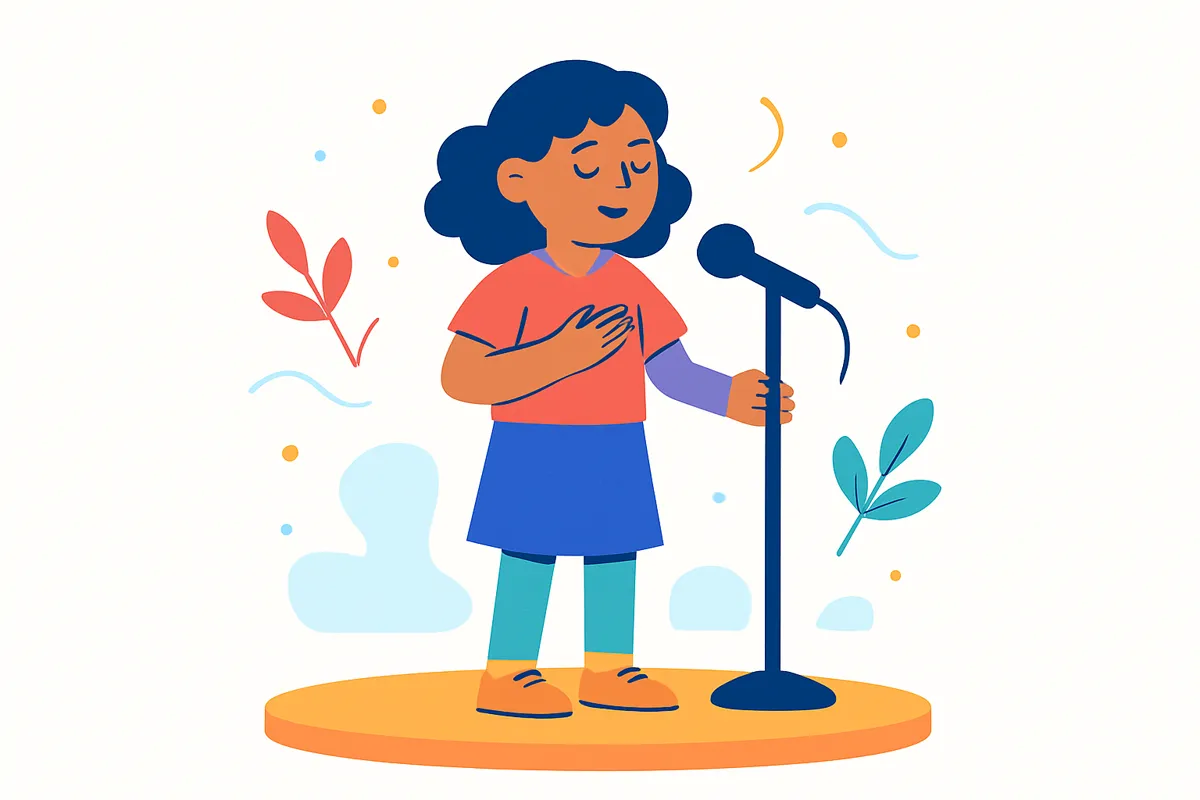
Solo Singing is the plainest vocal item a festival can run: one singer, one song, one panel. There is no choir to hide in and no dance or costume to lean on, so the whole result rests on how well a single voice carries the music and the words. That is why it sits at the front of so many festival programmes, and why entrants from the youngest school year to young adults can all take part in the same item at different age bands.
On the eTalenter templates the title appears three times, and the three tell different stories. A Welsh-language youth festival template carries it as an Individual On Stage item for both genders, split across seven school-year bands from the youngest pupils up to young adults, with the language fixed to Welsh. A Scottish Gaelic festival template carries it for primary-school bands upward, with the language fixed to Scottish Gaelic. A Sunday-school talent test template in India lists it under Music for a run of age bands from nursery upward, with the language left open and marks as the score label.
A round runs the same way everywhere. Each entrant is called up alone, announces or is announced with the title of the song, performs it within the time allowed, and the panel marks it straight away. Where a festival has a set-piece list, the song is chosen from it; where it does not, the entrant brings their own. Accompaniment is a rule for the festival notice to settle: some rounds are unaccompanied, some allow a live accompanist, and some allow a backing track.
Organisers keep the item because it is cheap to run and easy to explain to families. It needs a microphone at most, an accompanist if the rules allow one, and a clear schedule. It also feeds the rest of the programme: many group singing, choir and instrumental entries are built from singers who first tried the stage in a solo slot.
Where Solo Singing is run
On the eTalenter templates, Solo Singing is used in three places: a Welsh-language youth arts festival in Wales, a Scottish Gaelic cultural festival in Scotland, and a church Sunday-school talent test in India. The first two are language-heritage festivals where the song must be sung in the festival’s own language; the third is a talent test with no language rule. Outside these templates, solo singing under many names (solo song, vocal solo) is a staple of school and community festivals in the United Kingdom, Ireland, Australia, Canada, South Africa and India. Those variants are covered on their own pages where they exist.
- Wales
- Scotland
- India
Key facts
- Individual item: one singer performs alone, male and female entrants together
- Welsh template: seven school-year age bands, performed in Welsh
- Scottish Gaelic template: primary-school bands upward, performed in Scottish Gaelic
- Sunday-school template: age bands from nursery upward, language open, scored in marks
- Time and score fields (10 minutes, a /100 maximum) are the app’s defaults on the language-festival templates, because their published rules print no numeric scheme for this item
- Whether accompaniment or a backing track is allowed is not printed on the templates, so confirm it with the organiser
On eTalenter, Solo Singing is filed under Music, On Stage and typically scored with Marks, Rating out of 10. It appears in 3 ready-made event templates — each one can adjust its time limit, age-group assignment and scoring setup independently.
Across the templates that use it, Solo Singing is most often entered as an Individual competition, typically scored out of 100, commonly time-limited to 5–10 minutes where a limit is set.
What judges look at in Solo Singing
What a Solo Singing panel is actually weighing up, and where the marks are usually won or lost:
- Pitch and intonation: staying on the note from the first phrase to the last, especially on held notes and leaps
- Tone and breath control: a steady, supported sound, with breaths placed where the phrase allows rather than mid-word
- Rhythm and tempo: a pulse that stays even, with changes of speed that are chosen and not accidental
- Diction and language: clear words, correct pronunciation and, on the language-festival templates, singing that is genuinely in the festival language
- Interpretation and presence: whether the singer shows the mood of the song through phrasing, dynamics and face, not just correct notes
- Song choice: a piece that suits the singer’s age and range, since a modest song sung cleanly beats an ambitious one that strains
Treat these as the judging focus, not a fixed rubric: publish your own weighted criteria for Solo Singing under Scoring Setup, or start from the full singing competition judging criteria guide.
How to prepare for Solo Singing
How entrants and their teachers usually get Solo Singing right on the day:
- Choose a song that sits comfortably in your range, and check the festival notice for a set list or language rule before you learn anything
- Learn the words first, then the tune, then the performance: a singer who has to think about the next line cannot also think about expression
- Record yourself on a phone and listen back for flat notes, rushed phrases and swallowed words, then fix one thing at a time
- Time the song and keep it under the limit with a little to spare; a verse can usually be trimmed without hurting the piece
- Rehearse the walk on, the first breath and the bow, since the first ten seconds shape how the panel hears the rest
- Practise with the exact accompaniment you will use, and carry a spare copy of any backing track in the format the organiser asks for
- Warm up quietly before your slot and drink water, but avoid anything that coats the throat or leaves it dry
Ready-made event templates that include Solo Singing
Open any template to preview it in eTalenter and install it as a live, editable event.
| Template | Category | Score label | Competitions |
|---|---|---|---|
| Urdd Eisteddfod (Wales) | On Stage | Rating out of 10 | 7 |
| Mar Thoma Sunday School Talent Test | Music | Marks | 11 |
| Royal National Mod (Scotland) | On Stage | Rating out of 10 | 10 |
Frequently asked questions
Is Solo Singing judged individually or as a team?
Across eTalenter’s templates it’s most often run as an Individual entry, though an organiser can set either participation type when assigning the item to an age group.
Is Solo Singing the same as Solo Song?
They describe the same kind of item, one singer performing alone, but the eTalenter catalogue keeps them as separate titles because different templates use different names. The marking ideas are the same: pitch, tone, rhythm, diction and delivery.
How long is a Solo Singing performance?
The templates carry a 10-minute allowance, which on the language-festival templates is the app’s default because the published rules give no figure for this item. Check your festival notice, since most real rounds are far shorter than ten minutes.
Do I have to sing in a particular language?
On the Welsh and Scottish Gaelic templates, yes: the language is fixed to Welsh or Scottish Gaelic. On the Sunday-school template the language is open. Always confirm against your own festival’s rules.
Can I use a backing track or an accompanist?
The templates do not print an accompaniment rule, so it is for the organiser to state. Ask before you rehearse, so that you prepare the arrangement you will actually be allowed to use.
Want the full judging picture? Read the full singing competition judging criteria guide, or browse every music competition item.
Try Solo Singing in eTalenter
See every ready-made template that runs Solo Singing, and install one as a live event — age groups, rules and scoring included.

Leave a Reply
You must be logged in to post a comment.