
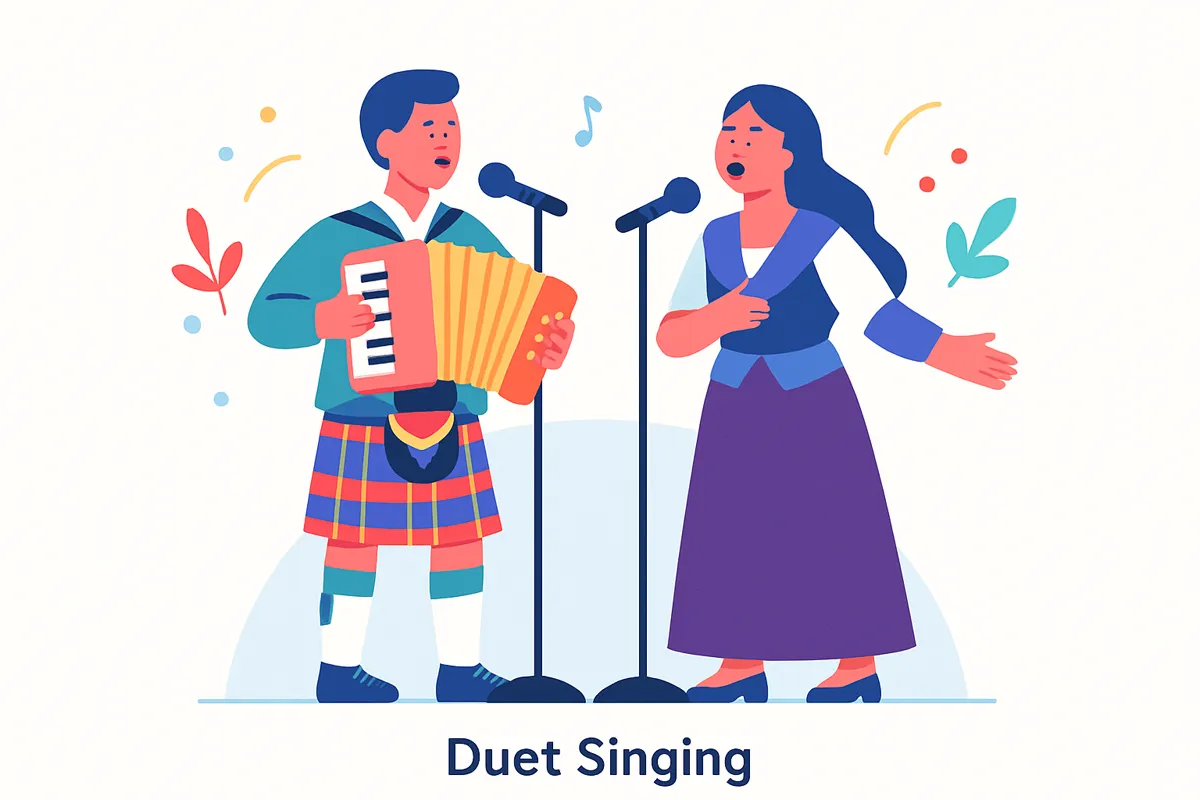
A vocal item in which two singers perform a prepared Gaelic song together as a pair, rated on how well their voices blend, balance and move as one.
A duet is a song sung by exactly two voices, and a duet competition asks a question that a solo round never does: can two singers sound like one performance? Each partner has to hold their own line, listen to the other, and still arrive together at every entry, breath and final note. The pair is judged as a unit, so a brilliant singer paired with an uncertain one loses marks that a solo entry would never lose.
On the eTalenter templates the title appears once, on the Scottish Gaelic festival template, where it is an On Stage item that runs across ten bands: P1-P3, P4-P5, P6-P7, 11-12 (Secondary), 13-15 Years, 16-18 Years, then Senior Ladies (female only), Senior Men (male only), Senior Mixed and Senior Open. Because two people take part in every entry, the template records the item as a Team entry rather than an Individual one, and every band is fixed to Scottish Gaelic. The ten-minute ceiling and the score out of 100, shown as a rating out of 10, are the app’s defaults, because the festival’s published rules print no numeric marking scheme for this item.
A round is brief and plain. The pair walk on, take their positions, and sing one prepared song in Gaelic, with the adjudicator listening for balance as much as for individual quality. Whether the two voices sing in unison, in harmony or answer each other is a choice made in the arrangement, and it shapes what the panel hears: unison exposes any difference in pitch, while harmony exposes any weakness in the supporting line.
Organisers keep duets in a programme because they give pupils a gentler step between solo singing and the choir. Two friends can share the nerves of the stage, yet each still has to carry real responsibility, and the senior divisions give adult pairs of every combination a class of their own.
Where Duet Singing is run
On the eTalenter templates Duet Singing is used only in the Scottish Gaelic festival template, a national Gaelic-language cultural festival in Scotland, where it is a paired item across the junior school bands and the four senior divisions. Duet classes of this kind are a familiar part of vocal competitions in many places; this page describes only the item as the template carries it.
- Scotland, United Kingdom
Key facts
- Two singers perform together, so the template records each entry as a Team
- Open to both genders in the junior bands and in Senior Mixed and Senior Open; Senior Ladies is female-only and Senior Men male-only
- Ten bands: P1-P3, P4-P5, P6-P7, 11-12 (Secondary), 13-15, 16-18, then the four senior divisions
- Language is fixed to Scottish Gaelic on every band
- Ten-minute ceiling and a /100 maximum are app defaults, since the published rules print no numeric scheme
- Adjudication sheets are issued to entrants and the adjudicator’s decision is final, as the festival rules state
On eTalenter, Duet Singing is filed under On Stage and typically scored with Rating out of 10. It appears in 1 ready-made event templates — each one can adjust its time limit, age-group assignment and scoring setup independently.
Across the templates that use it, Duet Singing is most often entered as an Team competition, typically scored out of 100, commonly time-limited to around 10 minutes where a limit is set.
What judges look at in Duet Singing
What a Duet Singing panel is actually weighing up, and where the marks are usually won or lost:
- Blend and balance: whether neither voice dominates and the two tones sit together as one sound
- Shared intonation: both singers landing on the same pitch at unison passages and holding true intervals in harmony
- Togetherness: matching entries, breaths, phrase endings and the final note without visible cues
- Gaelic diction: clear, correct and matched pronunciation, with vowels shaped alike by both partners
- Musical shape: agreed dynamics and phrasing that serve the song rather than two separate performances
- Stage presence: a composed, connected pair who look at ease singing beside each other
Treat these as the judging focus, not a fixed rubric: publish your own weighted criteria for Duet Singing under Scoring Setup, or start from the full singing competition judging criteria guide.
How to prepare for Duet Singing
How entrants and their teachers usually get Duet Singing right on the day:
- Choose a song that suits both voices, with a range neither partner has to strain for, and agree early whether to sing in unison, harmony or in turn
- Rehearse together from the start rather than learning separately and meeting late, so the breathing patterns grow together
- Record a rehearsal on a phone and listen for moments where one voice covers the other, then adjust volume until the balance is even
- Mark the breaths and phrase endings on a shared copy of the words so both singers release on the same beat
- Work through the Gaelic words slowly with a fluent speaker until both partners say each syllable alike
- Practise the walk-on, the starting note and the finish, because a shaky start or ragged ending costs a pair more than a single singer
- Check the festival notice for set songs, any rule on accompaniment and the entry details for the band before choosing
Ready-made event templates that include Duet Singing
Open any template to preview it in eTalenter and install it as a live, editable event.
| Template | Category | Score label | Competitions |
|---|---|---|---|
| Royal National Mod (Scotland) | On Stage | Rating out of 10 | 10 |
Frequently asked questions
Is Duet Singing judged individually or as a team?
Across eTalenter’s templates it’s most often run as an Team entry, though an organiser can set either participation type when assigning the item to an age group.
How many singers are in a duet?
Two. The pair performs one song together and is judged as a unit, which is why the template records each entry as a Team.
Is Duet Singing the same as Solo Singing?
No. Solo Singing is one performer carrying a song alone. A duet is judged on blend, balance and togetherness as well as on each voice.
Can the two singers be different ages or genders?
Within the junior bands both genders are open. In the senior divisions the template sets Ladies as female-only and Men as male-only, while Senior Mixed and Senior Open admit both. The age rules for a pair are in the festival notice, so check it before entering.
Can I use an instrument or a backing track?
The template does not say. Check the festival notice or ask the organiser before rehearsing with any accompaniment.
Want the full judging picture? Read the full singing competition judging criteria guide, or browse every on stage competition item.
Try Duet Singing in eTalenter
See every ready-made template that runs Duet Singing, and install one as a live event — age groups, rules and scoring included.


Leave a Reply
You must be logged in to post a comment.