
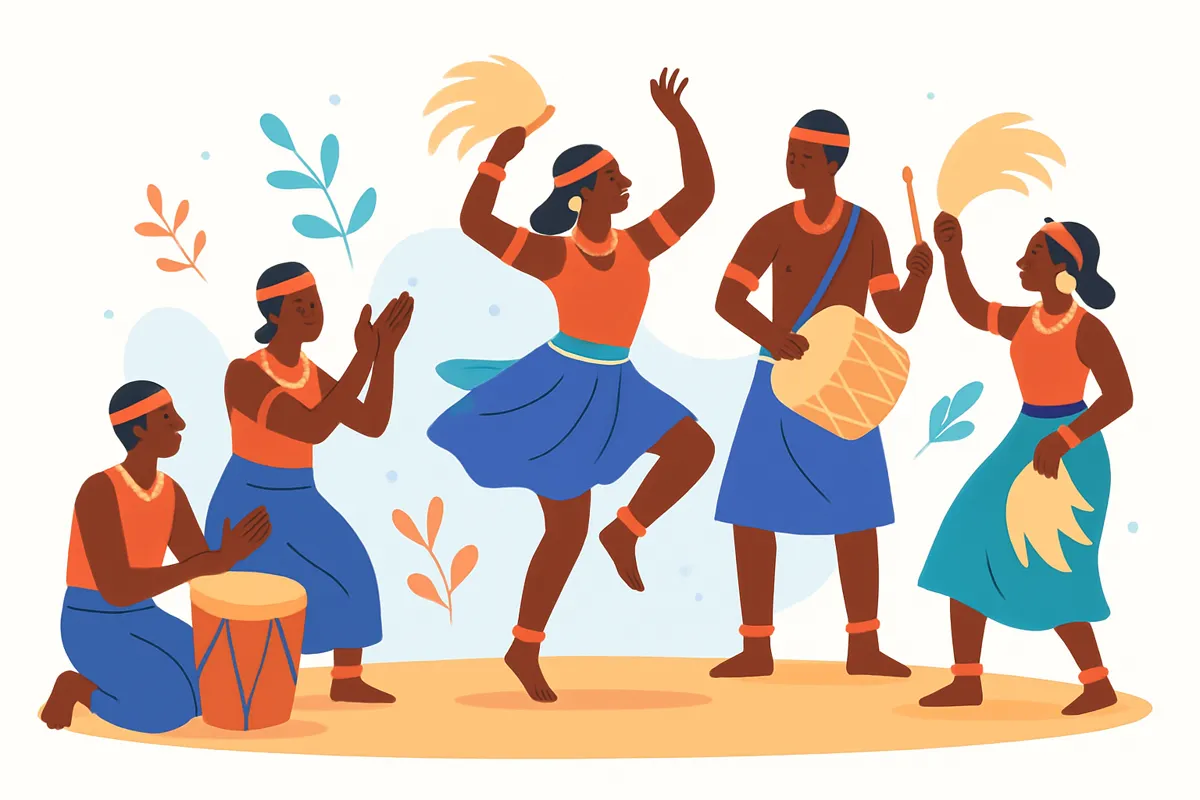
A team dance that draws on cultural traditions, music and costume and reshapes them into a staged, creative piece, entered as one team across five age groups.
Cultural Creative Dance is a staged group dance in which a team takes the dance, music, dress and storytelling of a cultural tradition and shapes them into an original, choreographed piece. The word creative matters: the panel is not looking for a copy of a village or ceremonial dance as it is usually done, but for a composition that is clearly rooted in a tradition and has been thoughtfully arranged for the stage.
On the eTalenter Kenya national drama and film festival template it sits on the On Stage programme, third in the order after the two Play items. It is a Team item open to boys and girls together, and the template offers it in five age groups: Pre-Primary (3 to 5), Primary (6 to 12), Junior School (13 to 15), Secondary (14 to 18, with overlap allowed) and Tertiary (19 and over). That gives five classes, each scored out of 100.
A round runs like any staged group piece. The team is called, sets up, performs its dance to live or recorded music, and clears the stage. An entry usually has a clear opening formation, a development through changing patterns and rhythms, and a defined ending, often with a short spoken or sung introduction that tells the audience which tradition is being shown and what the dance is about.
The template does not set a time limit and does not break the 100 marks into headings, because the source material for this strand does not publish a dance scheme the way it does for a Play. Organisers should enter the running time and the marking headings from their own notice, and tell teams in advance whether recorded music, live drummers or props are allowed.
Organisers run the class to keep traditional dance alive in schools and colleges while rewarding fresh choreography, and to give younger learners a performing item they can join without needing spoken lines.
Where Cultural Creative Dance is run
On the eTalenter templates this item appears on one: the Kenya national drama and film festival template, in its On Stage section. Cultural dance classes under a similar name run at many school and community festivals, but this page describes the item as that template sets it up, so entrants elsewhere should check their own notice for time limits, cast size, music rules and judging headings.
- Kenya
Key facts
- Team item: the whole group is judged together, boys and girls in the same entry
- Five age groups on the template, from Pre-Primary (3 to 5) up to Tertiary (19 and over)
- Five classes in all, one per age group, each with a maximum score of 100
- No time limit is set on the template, so the organiser enters their own running time
- The 100 marks are not split into headings on the template; the organiser sets the headings from their own notice
- Modern Creative Dance is a separate item on the same template, so the two should not be mixed up on entry forms
On eTalenter, Cultural Creative Dance is filed under On Stage and typically scored with Marks. It appears in 1 ready-made event templates — each one can adjust its time limit, age-group assignment and scoring setup independently.
Across the templates that use it, Cultural Creative Dance is most often entered as an Team competition, typically scored out of 100.
What judges look at in Cultural Creative Dance
What a Cultural Creative Dance panel is actually weighing up, and where the marks are usually won or lost:
- Rootedness in the tradition: movement, rhythm, music and dress that clearly come from the culture the team names, rather than a generic dance with a costume added
- Creativity of choreography: new formations, transitions and contrasts built from traditional steps, rather than a straight repeat of a well-known dance
- Synchrony and team control: dancers moving together where the piece calls for it, with spacing and formations that hold from start to finish
- Music and rhythm: dancers staying with the beat and the drummers or recording, and music that suits the dance and the age group
- Costume and presentation: dress, props and make-up that fit the tradition and the story, and a stage presence that holds the audience from the first step
- Age-appropriateness: steps and themes that suit the group, with Pre-Primary teams judged on joyful, clear movement rather than difficulty
Treat these as the judging focus, not a fixed rubric: publish your own weighted criteria for Cultural Creative Dance under Scoring Setup, or start from the full group dance judging criteria guide.
How to prepare for Cultural Creative Dance
How entrants and their teachers usually get Cultural Creative Dance right on the day:
- Choose one tradition and learn it properly before adapting it, ideally from an elder, a cultural officer or a local dance group, rather than from a video alone
- Write a short introduction for the audience that names the tradition and the story of the dance, and rehearse it as part of the piece
- Plan the stage as a picture: decide the opening formation, two or three changes of pattern and the closing pose, and mark them on the floor in rehearsal
- Rehearse with the real music or drummers from early on, so the team learns the cues instead of depending on a teacher counting aloud
- Keep the piece inside the time the organiser allows and practise the entry and exit, since slow set-up eats into a team’s time
- Make costumes safe and easy to move in, and test them in a full run so nothing falls off or restricts the dancers
- Ask someone outside the team to watch a full run and say which part they could not follow, then simplify that part
- Give younger groups fewer, cleaner moves done together rather than a long routine done raggedly
Ready-made event templates that include Cultural Creative Dance
Open any template to preview it in eTalenter and install it as a live, editable event.
| Template | Category | Score label | Competitions |
|---|---|---|---|
| Kenya National Drama and Film Festival | On Stage | Marks | 5 |
Frequently asked questions
Is Cultural Creative Dance judged individually or as a team?
Across eTalenter’s templates it’s most often run as an Team entry, though an organiser can set either participation type when assigning the item to an age group.
Is Cultural Creative Dance judged as a team or individually?
As a team. It is a Team item on the template, so the whole group receives one score.
How is it scored?
Out of 100 for each age-group class. The template does not split the marks into headings, so the organiser should publish the headings in their own notice.
Is there a time limit?
The template does not set one, so the organiser should enter a running time from their own notice.
Is it the same as Modern Creative Dance?
No. They are separate items on the same template. Cultural Creative Dance draws on a tradition, while Modern Creative Dance is its own class.
Can we use recorded music or props?
That is up to the organiser. The template does not fix it, so check the notice for your festival before you rehearse with them.
Want the full judging picture? Read the full group dance judging criteria guide, or browse every on stage competition item.
Try Cultural Creative Dance in eTalenter
See every ready-made template that runs Cultural Creative Dance, and install one as a live event — age groups, rules and scoring included.

Leave a Reply
You must be logged in to post a comment.