
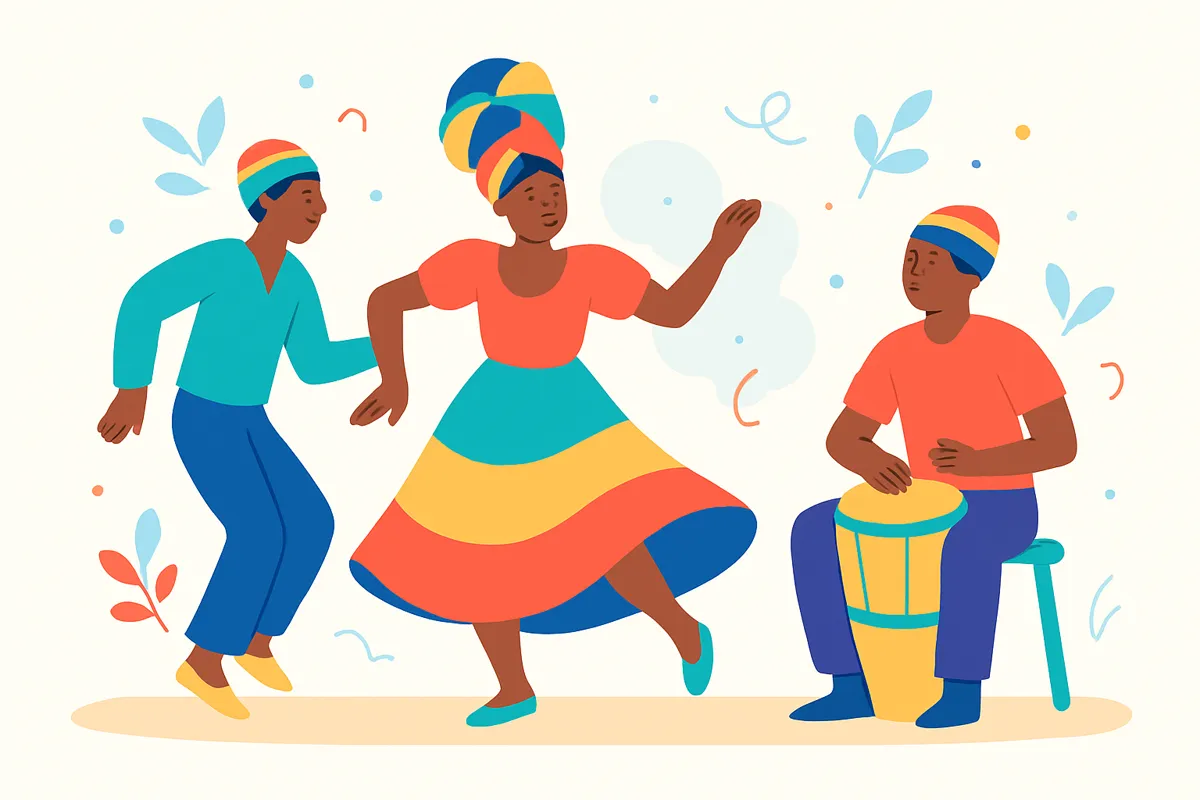
A team dance item in a national performing arts festival in Jamaica, where a group performs the popular social and street dance of the island, the steps and party energy that grew up around dancehall and reggae music.
Dance – Jamaican Popular Dance is a team category in the Dance discipline of the Jamaican national performing arts festival that this template is rebuilt from. “Popular” here is the opposite of “classical” or “folk”: it means the dances people actually do at parties, in yards, on street corners and in front of a sound system, the moves that spread by being copied. In the Jamaican setting that points to the social and street dance that grew up around dancehall and reggae music, and the festival gives it a stage of its own alongside the more formal styles.
The easiest way to place the category is to read the list around it. Dance – Jamaican Creative Folk Dance covers the island’s traditional folk forms. Dance – Other Popular Dance and Dance – Combined Popular Dance sit next to it on the same template as separate categories. The style categories (Ballet, Jazz, Modern / Contemporary Dance, Praise Dance) judge a trained technique, and the festival’s Music discipline has its own vocal item for Jamaican popular song. This item is the one for a group working in current Jamaican dance vocabulary.
The extract used to build the template lists the category and its limits but prints no definition and no marking table, so this page does not claim what the festival counts as a Jamaican popular dance. An organiser who runs the category should say in the entry notice which music is acceptable, whether lyrics must be suitable for a family audience, whether a mix of several tracks is allowed, and whether routines may be built from named, well-known steps or must be newly choreographed.
On the template the item is a Team entry in every one of the seven classes, from the youngest children (ages 3-6) through adults and the combined class. The limit is four minutes with a warning bell at three, the score is out of 100, both genders enter in one list and the language is English. Those are the facts the source supports, and a programme can be safely built around them.
A typical entry opens with a strong group formation or a signature move, moves through two or three recognisable sections with changes of formation and level, and finishes on a clean hit rather than a fade. Because the style depends on groove and attitude as much as on steps, a routine that is technically tidy but flat will lose to one that is slightly looser but clearly enjoying itself. Organisers like the category because it fills the hall, brings in younger entrants who would never enter a ballet class, and works well in a mixed-age showcase.
Where Dance – Jamaican Popular Dance comes from
The popular dance of Jamaica is closely tied to dancehall, the music and street culture that took shape in Kingston from the late 1970s and 1980s. In that world a new step often becomes popular because a song, a sound system or a well-known dancer launches it, and it is soon copied and renamed across the island. This is a well-documented general history; the festival template itself does not define the category.
Where Dance – Jamaican Popular Dance is run
On eTalenter this item is used in one template, the Jamaican national performing arts festival template, where it is assigned to all seven classes (six age bands from 3-6 up to adults aged 20 and over, plus a combined class) inside the Dance discipline. Group routines in the dancehall and reggae social-dance vocabulary also turn up in school concerts, youth competitions, carnival-season showcases and community talent shows in Jamaica and across the wider Caribbean diaspora, each with its own age bands, time limits and music rules, so read the notice of the event you are entering instead of assuming the limits here.
- Jamaica (the national performing arts festival the template is built from)
Key facts
- A Team item: one group performs one piece, entered as a team in every class
- Open to both genders in a single list, with the language set to English
- Offered in all seven classes, from Class 1 (ages 3-6) to Class 6 (adults, 20 and over) and the combined class
- Four-minute limit with the warning bell at three minutes
- Scored out of 100 on the template; the festival awards medals against published mark bands, not first, second and third
- Different from Dance – Jamaican Creative Folk Dance (traditional folk forms) and from the Other Popular Dance and Combined Popular Dance categories, all listed separately on the same template
- The extract used for the template prints no definition of the category and no per-criterion weights, so none are asserted here
On eTalenter, Dance – Jamaican Popular Dance is filed under On Stage and typically scored with Marks. It appears in 1 ready-made event templates — each one can adjust its time limit, age-group assignment and scoring setup independently.
Across the templates that use it, Dance – Jamaican Popular Dance is most often entered as an Team competition, typically scored out of 100, commonly time-limited to around 4 minutes where a limit is set.
What judges look at in Dance – Jamaican Popular Dance
What a Dance – Jamaican Popular Dance panel is actually weighing up, and where the marks are usually won or lost:
- The source does not print this category’s marking table, so what follows is organiser guidance for agreeing yardsticks with the panel, not rules from the source
- Authentic style: the movement is recognisably current Jamaican popular dance, performed with the bounce, weight and attitude that belong to it rather than as a stiff copy of steps
- Group unity: the team hits the same counts and shapes together, and the formations change cleanly without gaps, collisions or dancers hunting for their spot
- Choreographic range: more than one repeated move, with variety in tempo, levels and floor patterns, and a build towards a strong finish
- Energy and stage presence: faces, eye contact and commitment from every dancer, including the back row, so the performance fills the space
- Presentation and suitability: costume that suits the style and the age of the group, music cut cleanly to the piece, content appropriate for the class, and a finish inside the four-minute limit
Treat these as the judging focus, not a fixed rubric: publish your own weighted criteria for Dance – Jamaican Popular Dance under Scoring Setup, or start from the full group dance judging criteria guide.
How to prepare for Dance – Jamaican Popular Dance
How entrants and their teachers usually get Dance – Jamaican Popular Dance right on the day:
- Ask the organiser in writing which music is allowed and whether lyrics must be suitable for a family audience, and keep the reply, because it decides how the track is chosen and edited
- Choose a track with a clear beat and build the routine in counts of eight, so the whole team can find the groove again after a mistake
- Learn the base movement first, the bounce and weight shift, before teaching named steps, and drill it until the team moves from the same centre
- Plan three or four sections with different formations and levels, and place the strongest move in the last twenty seconds rather than the first
- Rehearse with the sound system volume you will have on the day and film from the front, since a loose, party-style piece can look messy to a panel unless the spacing is rehearsed
- Time the edit to the three-minute warning, with a definite last beat, so the end is a cue and not an accident
- Keep costume practical for fast movement and suitable for the age group, and test it through a full run so nothing slips or catches
- With younger classes, use short phrases the children can repeat accurately, give every child a visible moment, and keep the content and the music suitable for their age
Ready-made event templates that include Dance – Jamaican Popular Dance
Open any template to preview it in eTalenter and install it as a live, editable event.
| Template | Category | Score label | Competitions |
|---|---|---|---|
| JCDC National Performing Arts Festival (Jamaica) | On Stage | Marks | 7 |
Frequently asked questions
Is Dance – Jamaican Popular Dance judged individually or as a team?
Across eTalenter’s templates it’s most often run as an Team entry, though an organiser can set either participation type when assigning the item to an age group.
What counts as Jamaican popular dance?
In general terms it means the social and street dance of the island, in the dancehall and reggae tradition, as opposed to classical or traditional folk dance. The extract used for this template gives no formal definition, so check the organiser’s notice for what is allowed.
Is it the same as Jamaican creative folk dance?
No. The template lists them as separate categories. The folk category draws on traditional island dance forms, while popular dance is the current social and street style. Check the entry notice for where the organiser draws the line.
How is it different from Other Popular Dance and Combined Popular Dance?
They are three separate Team categories on the same template. This one is for Jamaican popular dance; the other two are listed under their own names, and the extract does not define them, so ask the organiser how a routine is assigned.
Is it judged individually or as a team?
As a team. It is a Team entry in every class on the template, so the group is entered and scored as one unit. Solos, duets, trios and quartets enter the festival’s separate dance items.
How long can the piece be?
The template sets four minutes with a warning bell at three.
How is it marked?
The template scores out of 100. The festival awards medals against mark bands, and the extract used for the template prints no per-criterion weights for this category, so an organiser using it should agree and publish their own.
Want the full judging picture? Read the full group dance judging criteria guide, or browse every on stage competition item.
Try Dance – Jamaican Popular Dance in eTalenter
See every ready-made template that runs Dance – Jamaican Popular Dance, and install one as a live event — age groups, rules and scoring included.

Leave a Reply
You must be logged in to post a comment.