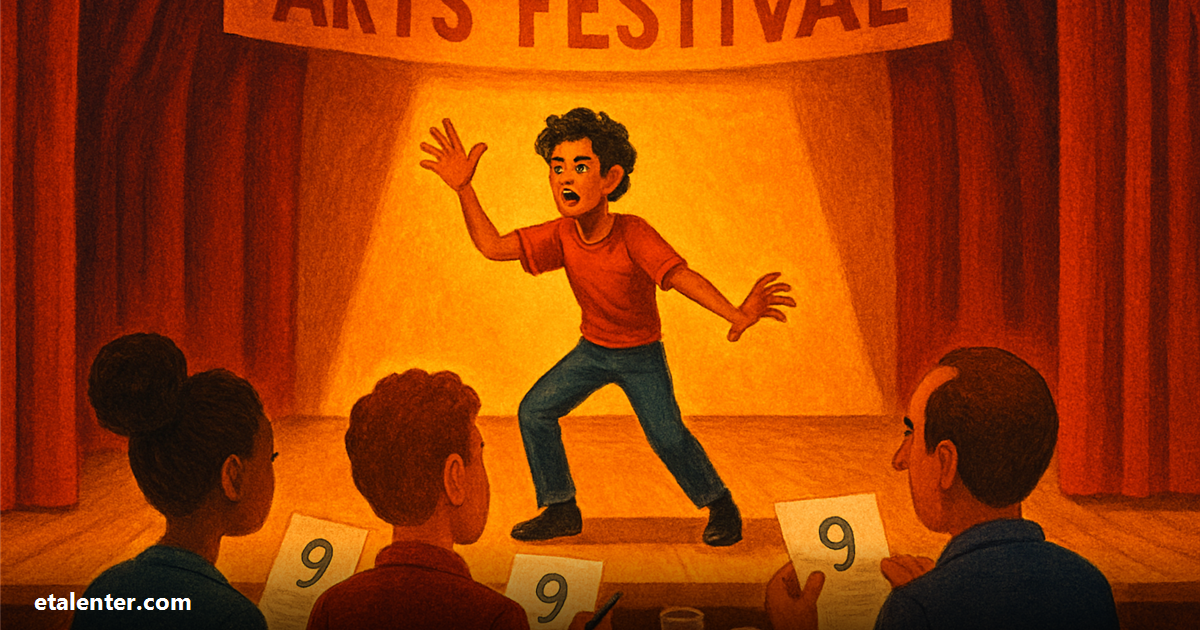
Mono act is the hardest item on the stage schedule to judge and the easiest to judge badly. One performer, five minutes, no co-actor to react to, no set, and often four or five characters to be built and dropped in front of a hall that is still settling down. Panels reach for the loudest performance because volume is easy to score. The criteria for judging a mono act competition exist to stop that: they reward the switch between characters, the honesty of the theme and the control of the stage, not the shouting. This guide gives a sample marking scheme with weightage, a printable mono act judgement sheet, a deduction table, what separates mono act from mimicry and mime, and how to judge the item when fifty entries are waiting backstage.
What mono act actually is — and what it is not
Half the arguments after a mono act result come from a panel and a participant using the word differently. Settle it in the rules, in these terms:
- Mono act — one performer enacting a story, alone, usually playing more than one character and switching between them with voice and body. Dialogue is central. It is a piece of theatre performed by one person.
- Mimicry — imitation of voices, film stars, birds, instruments. The skill is in the resemblance, not in a story. Score it as its own item with its own rubric; a mimicry act entered in mono act should lose theme and script marks, not win on impressions.
- Mime — silent, gesture only, no dialogue at all. A different item again, and worth its own criteria sheet.
- Monologue / soliloquy — one character speaking at length, no switching. Some organizers accept it inside mono act; if you do, say so, because a rubric that awards 25 marks for character transformation will otherwise punish it unfairly.
Write one sentence in your rules stating which of these you are running. It takes a minute and it removes an entire category of appeal.
Mono act judging criteria: a sample marking scheme (100 marks)
Publish the criteria, the weightage and the time limit with the competition rules, before entries close. Participants write and rehearse against the rubric — a script built for a panel that rewards theme and transformation looks nothing like one built for a panel that rewards volume.
| Criterion | Weightage | What the judge looks for | What pulls marks down |
|---|---|---|---|
| Characterisation & transformation | 25 | Each character is distinct in voice, posture and rhythm; the switch is instant and readable from the back row | Every character sounding the same; a switch the audience has to be told about |
| Expression & emotional range | 20 | Face and body carry the emotion; the performer can go quiet and still hold the hall | One pitch of grief or anger held for five minutes; expression that stops between lines |
| Script, theme & content | 20 | A story with a beginning, a turn and an end; a theme that earns its emotion honestly | Borrowed film dialogue; a plot that exists only to reach a crying scene |
| Dialogue delivery, diction & voice modulation | 15 | Audible, clean pronunciation; pace and volume varied deliberately, pauses used | Shouting throughout; swallowed line endings; speed that outruns the meaning |
| Stage use, movement & timing | 10 | The whole stage used with purpose; entry and exit composed; the act fits the time limit | Rooted to the mic; pacing without reason; an act that stops rather than ends |
| Overall impact & originality | 10 | The piece stays with the panel after the next chest number walks on | The same three well-known pieces the panel has already heard twice today |
| Total | 100 | ||
Why transformation carries the most marks
Mono act is the only item in the catalogue where a single body has to hold a conversation. If a mother, a son and a neighbour all sound like the same fourteen-year-old, the audience is following a recitation, not a scene. That is why characterisation and transformation deserve a quarter of the sheet: it is the skill the item exists to test, and it is the one thing a louder performance cannot fake.
It also fixes the item’s oldest problem. Mono act attracts scripts engineered to make a hall cry — a dying parent, an abandoned child, a soldier’s last letter — and panels reward the tears rather than the acting. Score theme honesty inside the script head: does the emotion arise from the story, or is the story a delivery mechanism for the emotion? Brief the judges in exactly those words, and tell participants in the rules that a manipulative script is not a scoring advantage.
Adjust the rubric by age group
Mono act usually runs from upper primary upwards, and the same six heads should stay in place across every age group so tabulation and house points remain comparable. Shift the weightage instead:
- UP (upper primary) — move 5 marks from script into expression, and expect two characters rather than five. At this age a clean, audible, felt performance of a simple story is the ceiling, and rewarding ambition over control produces shouting.
- HS (high school) — the standard 25/20/20/15/10/10 scheme works as printed. Three to four characters is the normal range, and transformation becomes genuinely visible.
- HSS and above / youth and open categories — raise script, theme and content to 25 and originality to 15, taking the marks from expression. At this level an adapted or self-written piece with a point of view should beat a well-performed standard, and a stronger interpretation head separates the top five.
- Junior, Intermediate, Senior groupings — church, club and association events that use named age bands rather than school classes can map onto the same three tiers above; what matters is that every participant in a band is scored on one identical sheet.
Sample themes and script guidance to publish with your rules
An open mono act item produces forty deathbed scenes. Announcing themes — one per age group, or a short list to choose from — spreads the entries, makes the panel’s job comparable and gives teachers something to prepare against. Themes organizers commonly use:
- Family and generations — a conversation across two or three ages, the natural home of the multi-character switch.
- School and childhood — the exam, the friend who left, the teacher. Age-appropriate for UP and HS and hard to overdo.
- Social message — road safety, addiction, the environment, kindness to elders. Popular in school and youth events; ask for a story, not a speech.
- Work and livelihood — the farmer, the fisherman, the migrant worker, the shopkeeper. Rich in dialect and posture, and rewards observation.
- Folk tales and literature — an adapted scene from a story or a play, which lifts the standard of the script across the whole entry list.
- Humour and satire — deliberately worth including so the day is not five hours of tragedy; judge it on the same six heads.
Alongside the theme, state the practical script rules: language or languages permitted, whether recorded background music or sound cues are allowed, whether props and costume changes are permitted (most mono act rules allow neither, or one simple prop), and whether the script must be original or may be adapted with acknowledgement. Ask for a copy of the script with the entry if you intend to check originality — deciding to check it after the result is announced is too late.
Printable mono act competition score sheet
Print one sheet per judge per participant, or one sheet per judge with a row per chest number. Fill in the item, age group and time limit before the session begins, and make sure all three judges hold the identical version — a panel scoring on two different sheets produces a total no tabulator can defend.
| Criterion | Max marks | Marks awarded | Judge’s remarks |
|---|---|---|---|
| Characterisation & transformation | 25 | ||
| Expression & emotional range | 20 | ||
| Script, theme & content | 20 | ||
| Dialogue delivery, diction & modulation | 15 | ||
| Stage use, movement & timing | 10 | ||
| Overall impact & originality | 10 | ||
| Less: time / rule deductions | – | ||
| Total | 100 |
Leave a footer line for Item · Age group · Language · Chest number · Time taken · Judge’s name · Signature · Date. Recording the time taken on the sheet itself is what makes a later overrun deduction verifiable instead of remembered.
Fix the time limit and deductions before the first chest number
Five minutes is the limit most school and youth events use for mono act, with a warning bell at four and a final bell at five; some open and youth categories allow seven. Whatever you choose, publish it, ring it audibly, and have the deduction applied by the timekeeper or item in-charge, not by the judges — otherwise three judges each dock the same overrun and the participant is penalised three times for one breach.
| Breach | Suggested deduction | Applied by |
|---|---|---|
| Over the time limit, up to 30 seconds | 2 marks | Stage timekeeper |
| Over the time limit, beyond 30 seconds | 5 marks | Stage timekeeper |
| Prompting or dialogue fed from off stage | 3 marks | Item in-charge |
| Props, costume change or assistance not permitted by the rules | 5 marks | Item in-charge |
| Obscenity, offensive gesture or personal targeting | Act stopped; entry disqualified | Item in-charge |
| Script proved to be copied where originality was required | As stated in the rules, up to disqualification | Organizing committee |
How to judge a mono act competition with many participants
Mono act is emotionally heavy to watch in bulk. Fifty entries at five minutes each is more than four hours of tragedy, and by the thirtieth act the panel is not scoring on the scale it used at the start. Chest number 3 and chest number 47 end up measured against different standards, and no one in the hall can see it happening.
Three habits carry most of the fairness. Brief the panel with a reference band before the session — what 20 out of 25 on transformation looks like next to 15 — so the opening entries and the closing ones share a scale. Schedule a short break every ten to twelve acts; in an item this draining, a rested panel is a fairness measure, not a courtesy. And give judges only the chest number from the draw, never the name, school, house or unit; in a small event the panel will recognise faces anyway, but the number on the sheet is the discipline that keeps the marks honest and the tabulation defensible.
Write the tie-break order into the rules too. For mono act the usual sequence is: higher marks on characterisation and transformation, then higher marks on script and theme, then the majority preference of the panel, then a shared rank with both participants placed equal. If the item feeds a higher level — a sub-district or district round — decide in advance how many qualifiers a shared rank promotes, before it happens on stage.
Setting mono act criteria up in eTalenter
On paper this is six criteria multiplied by every participant, every judge and every age group, plus a timekeeper’s deductions arriving separately, in an item where the entry list runs for hours. In eTalenter you set mono act up once as a judged Arts competition, enter these criteria with their weightage, and assign it to the age groups, languages and gender categories you actually run, with participation type set to Individual. Every participant carries a chest number from the draw; each judge scores the same rubric on their own device; the system totals, averages across the panel, applies your grades and points, rolls points up to houses, schools or units and flags ties for you to settle by your published rule. From there you review results, assign ranks and awards, publish online or to the podium display, and print certificates and trophy stickers from the same marks. Where the item runs at several levels, the winners promote upward and the results cascade to the next round instead of being retyped.
Read how the panel and tabulation work in our judge scoring and tabulation guide, take the ready tables from the judges’ score sheet template, and compare the rubric for the other spoken items in our elocution and speech competition judging criteria and recitation and poetry judging criteria.
Frequently asked questions
What are the judging criteria for a mono act competition?
A widely used set is characterisation and transformation, expression and emotional range, script and theme, dialogue delivery and modulation, stage use and timing, and overall impact and originality — commonly weighted 25/20/20/15/10/10 out of 100. Publish the criteria, the weightage and the time limit with the competition rules before entries close, so participants build their script against the same sheet the panel will use.
What is the time limit for mono act?
Five minutes is the most common limit in school and youth events, with a warning bell at four minutes; some open and youth categories allow up to seven. State the limit and the bell in the rules, record the time taken on each judgement sheet, and apply any overrun deduction once, through the timekeeper — not separately by each judge.
Is mono act the same as mimicry?
No. Mono act is a story enacted by one performer, usually playing several characters, with dialogue at its centre. Mimicry is imitation — of voices, film stars, birds or instruments — and does not require a plot. Run them as separate items with separate criteria; a mimicry piece entered in mono act will lose heavily on script and theme, and that is the rubric working correctly.
Use this rubric at your next fest
Copy the marking scheme and the score sheet above into your rules, or set them up once in eTalenter and let the panel score on their phones while totals, deductions, grades, ranks, house points and certificates come out at the other end. Explore eTalenter’s competition management software, message us on WhatsApp, or write to support@etalenter.com and we will configure the judging criteria for every item on your stage schedule.