
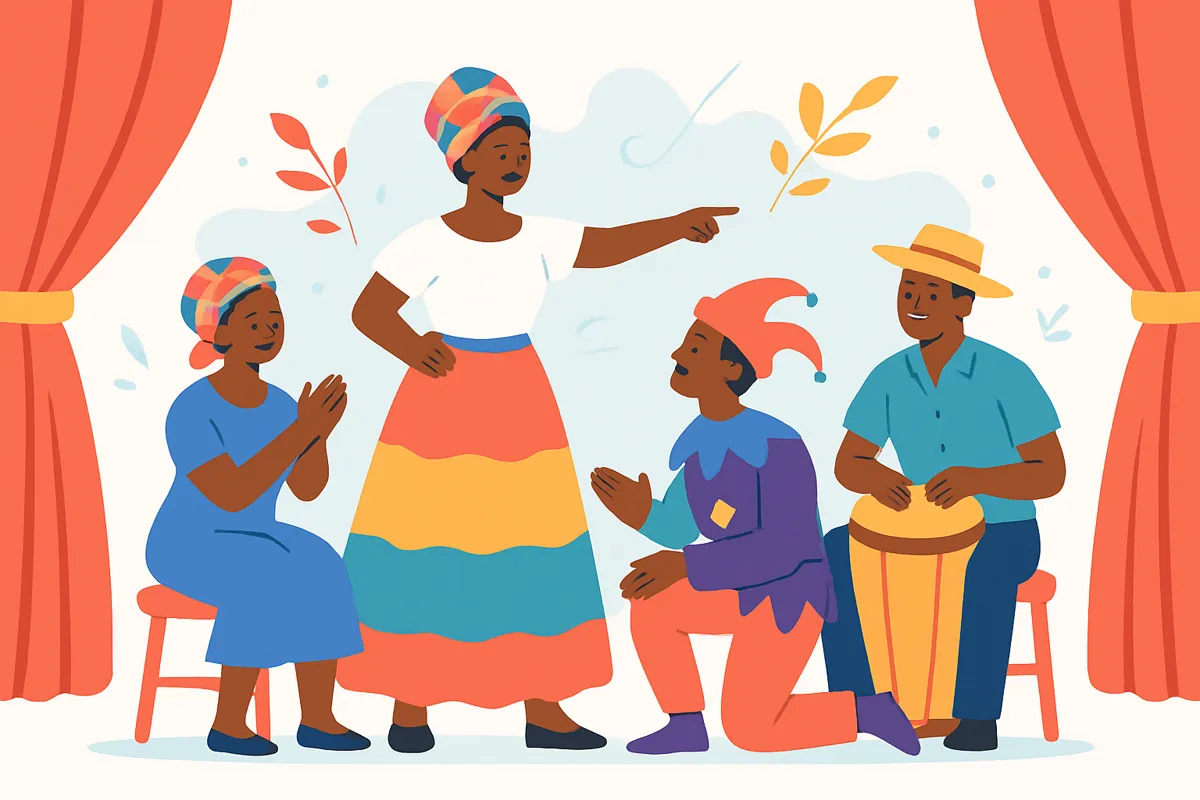
A drama category in a national performing arts festival in Jamaica where a group stages a short play drawn from the life, concerns and voices of a community, in four minutes and scored out of 100.
Drama – Community Drama / Popular Theatre is the thirtieth category on the Jamaican national performing arts festival list this template is rebuilt from, and it is the drama category that is defined by where a play comes from rather than by its genre or its size. Comedy, Tragedy, Farce and Musical describe how a play feels. Community drama, also called popular theatre, describes whose story it tells: a local issue, a shared memory or a common problem, performed by people who live with it, for an audience that recognises it.
The extract used to build the template names the category and its limits but prints no definition, no rule on script origin and no marking table, so this page describes what community drama and popular theatre normally mean in competitions and does not claim to know what this festival requires. In most programmes the term points to a short play created by a group out of its own surroundings: a neighbourhood meeting that goes wrong, a family argument over a land boundary, a school story about bullying, a market-day scene about rising prices, a health message told through characters instead of a lecture. The language is the language of the people on stage, the setting is a place the audience knows, and the point of the piece is usually a question the community is asking itself.
What separates a strong entry from a weak one is honesty and shape. A community play that only repeats a slogan feels like an announcement; one that lets characters want different things, argue and change feels like life. Popular theatre usually keeps its staging simple on purpose, with a few chairs, a cloth, a handful of props and a cast that doubles in several parts, so that the energy goes into the people and the story. In four minutes there is room for one situation, one turning point and one landing, which may be a resolution or an open question left for the audience to carry out of the room.
On the template the item is offered in all seven classes, from the youngest children (ages 3-6) through the age bands to adults (20 and over) and the combined class. Every class has the same limits: four minutes with a warning bell at three, a score out of 100, both genders in one list and English as the language. The category is recorded as a team entry in every class and the template fixes no number of actors, which suits community groups, schools, youth clubs, scout troops and neighbourhood drama circles that rarely have a fixed cast size.
Organisers keep a category like this because it connects the festival to the daily life of its area. It lets groups that are not trained theatre companies compete with material they know first-hand, it brings local issues on to a public stage in a form people enjoy watching, and it gives younger performers a way to treat serious subjects through character and story. For a festival that wants to reach beyond established drama clubs, it is often the category that draws the widest range of entries.
Where Drama – Community Drama / Popular Theatre comes from
Popular theatre and community theatre grew out of the twentieth-century movements that took drama out of formal playhouses and into villages, workplaces and neighbourhoods, using performance to start conversations about shared problems. Brazilian director Augusto Boal’s Theatre of the Oppressed, developed from the 1960s and influenced by educator Paulo Freire’s ideas on learning through dialogue, is among the best-known sources, and theatre-for-development practice spread across Africa, Asia, the Caribbean and Latin America in the decades that followed. Festival categories borrow the idea in a competition-sized form of a few minutes.
Where Drama – Community Drama / Popular Theatre is run
On eTalenter this item is used in one template, the Jamaican national performing arts festival template, where it is assigned to all seven classes (six age bands from 3-6 up to adults aged 20 and over, plus a combined class) inside the Drama discipline as a team entry. Community drama and popular theatre categories appear in school and youth drama festivals, community arts programmes, health and social-awareness campaigns, civic youth events and regional theatre competitions in the Caribbean, Africa, South Asia and Latin America, usually under names such as community play, social-issue drama, street theatre or theatre for development. Each event sets its own rules on length, script origin, topics and staging, so read the notice of the event you are entering instead of assuming the limits here.
- Jamaica (the national performing arts festival the template is built from)
- Community and popular theatre traditions are also found in the wider Caribbean, Africa, South Asia and Latin America
Key facts
- A short group play drawn from the life, concerns and voices of a community, recorded as a team entry in every class on the template
- Open to both genders in one list, with the language set to English
- Offered in all seven classes, from Class 1 (ages 3-6) to Class 6 (adults, 20 and over) and the combined class
- Four-minute limit with the warning bell at three minutes
- Scored out of 100 on the template; the festival awards medals against published mark bands rather than first, second and third
- Defined by its source and purpose, not its genre, so it sits beside genre categories such as Drama – Comedy and Drama – Tragedy, the shorter Drama – Skit and the spontaneous Drama – Improvisation
- The extract used for the template prints no definition, no topic, script-origin or cast-size rule and no per-criterion weights, so none are asserted here
- Ideas, not rules: a street meeting about a blocked drain, a family deciding whether to sell the land, a school corridor story about bullying, a market scene about prices, a clinic waiting room where a rumour spreads, a village response to a flood warning
On eTalenter, Drama – Community Drama / Popular Theatre is filed under On Stage and typically scored with Marks. It appears in 1 ready-made event templates — each one can adjust its time limit, age-group assignment and scoring setup independently.
Across the templates that use it, Drama – Community Drama / Popular Theatre is most often entered as an Team competition, typically scored out of 100, commonly time-limited to around 4 minutes where a limit is set.
What judges look at in Drama – Community Drama / Popular Theatre
What a Drama – Community Drama / Popular Theatre panel is actually weighing up, and where the marks are usually won or lost:
- The source does not print this category’s marking table, so what follows is organiser guidance for agreeing yardsticks with the panel, not rules from the source
- Rooted in a real community: the setting, language and problem feel specific and recognisable instead of generic, and the audience can tell whose story is being told within the first half minute
- A story, not a slogan: characters want different things and the issue comes out through what they do, so the message lands without anyone stopping to deliver a speech
- Shape inside four minutes: one situation, a clear turning point and a deliberate landing, whether that is a resolution or an open question for the audience
- Ensemble work: the whole cast is in the scene, entrances and exits are tidy, nobody is left standing idle and doubled roles are easy to tell apart
- Voice and clarity: every line is audible and understood in English at the back of the room, with natural speech rhythms and no shouting to cover for weak pacing
- Respect and balance: the piece treats the people and the problem seriously and avoids mocking a real group, so that a hard subject is handled with care
- Simple, purposeful staging: a few props and one or two costume signals do several jobs, and the piece finishes cleanly inside the limit
Treat these as the judging focus, not a fixed rubric: publish your own weighted criteria for Drama – Community Drama / Popular Theatre under Scoring Setup, or start from the full drama & skit judging criteria guide.
How to prepare for Drama – Community Drama / Popular Theatre
How entrants and their teachers usually get Drama – Community Drama / Popular Theatre right on the day:
- Ask the organiser in writing whether the script must be original, whether topics are restricted, whether live or recorded sound is allowed and what cast sizes are permitted, and keep the answer with your entry paperwork
- Start with a real question from your area, such as what people argue about at the standpipe, in the school yard or at the meeting hall, and choose the one that several cast members have lived themselves
- Build the piece in rehearsal by improvising it: let the cast play the situation, record what works, then write down only the lines that are worth keeping
- Give the issue two sides with real arguments, so the audience is thinking instead of being told what to think
- Write one sentence each for the opening, the turning point and the landing, and test every scene against those three sentences, cutting whatever does not serve them
- Time a complete run with a stopwatch and aim to finish around three minutes thirty, because a nervous cast usually runs slower on the day and a warning bell at three leaves little room
- Teach every actor a physical signature for each part they double, such as a hat, a stoop or a different walk, so the changes read instantly
- Rehearse in a space as big as the festival stage, with someone at the back checking they can hear every word, and fix the entrances and exits as a drill
- Practise the first ten seconds and the final image the most: how the cast takes its places, and how it holds still after the last line so the audience knows the piece is over
- If you lose at parish level, ask whether the panel could name the problem, whether the characters felt like real neighbours and whether the ending landed; those are the usual places to gain marks
Ready-made event templates that include Drama – Community Drama / Popular Theatre
Open any template to preview it in eTalenter and install it as a live, editable event.
| Template | Category | Score label | Competitions |
|---|---|---|---|
| JCDC National Performing Arts Festival (Jamaica) | On Stage | Marks | 7 |
Frequently asked questions
Is Drama – Community Drama / Popular Theatre judged individually or as a team?
Across eTalenter’s templates it’s most often run as an Team entry, though an organiser can set either participation type when assigning the item to an age group.
What is community drama or popular theatre in a competition?
A short play made by a group out of the life and concerns of its own community and performed for people who recognise them. The extract used for this template gives no further definition, so check the organiser’s notice for what the panel will accept.
Is it the same as a skit?
No. A skit is a very short sketch built on one situation and one payoff, and is judged as comic or dramatic craft. Community drama is defined by its source and purpose, a story drawn from a community, and it is expected to carry that story and its concern through the characters. On the template they are separate categories with the same four-minute limit.
Do we have to write our own script?
The template does not say whether the piece must be original or may be an existing text. Ask the organiser. Many community groups build their play in rehearsal from improvisation, but do not assume it is required or allowed.
Can the play be about a serious or sensitive topic?
The extract used for the template prints no topic rules, so ask the organiser first. Popular theatre often deals with health, safety, family or school issues, and panels generally reward care and balance, so avoid mocking real people or groups.
Is it entered as an individual or a team?
As a team. The template records it as a team entry in every class and sets no number of actors, so ask the organiser for the minimum and maximum cast.
How long can it be and how is it marked?
The template sets four minutes with a warning bell at three, and scores out of 100. The festival awards medals against mark bands, and the extract used for the template prints no per-criterion weights for this category, so an organiser using it should agree and publish their own.
Want the full judging picture? Read the full drama & skit judging criteria guide, or browse every on stage competition item.
Try Drama – Community Drama / Popular Theatre in eTalenter
See every ready-made template that runs Drama – Community Drama / Popular Theatre, and install one as a live event — age groups, rules and scoring included.



Leave a Reply
You must be logged in to post a comment.