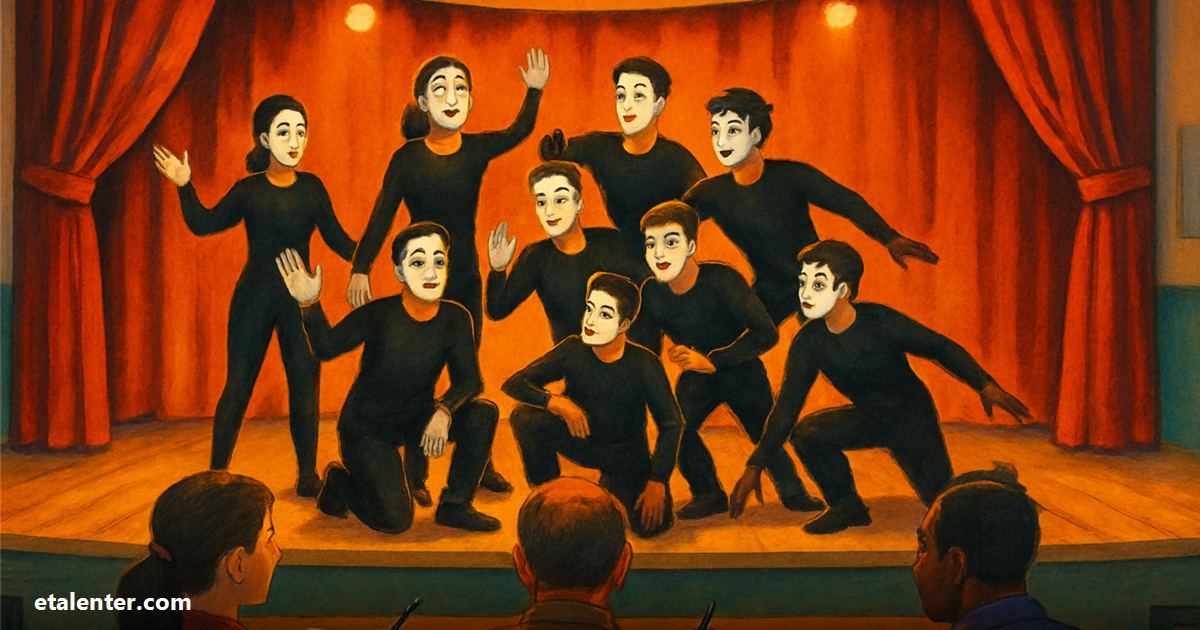
Mime and tableau are the two items on an arts fest schedule where nobody says a word — and where panels most often score the costume instead of the piece. A group of eight walks on in black, faces painted white, and for five minutes the whole story has to arrive through the body. A tableau team holds a frozen picture and the judge has thirty seconds to read a theme from it. The criteria for judging a mime and tableau competition exist to keep the marks on what the item is actually testing: whether the theme reaches the back row without dialogue, and whether the group moves as one. This guide gives sample marking schemes with weightage for both items, printable mime and tableau judgement sheets, a deduction table, sample themes, and how to run the items when a dozen teams are queued backstage.
Mime and tableau are two different items — score them separately
They get bracketed together because both are silent and both are usually group items, but they test opposite skills, and one rubric for both produces an unwinnable result. Write the difference into your rules:
- Mime — a story performed in movement and gesture, with no dialogue and no spoken sound from the performers. The group moves continuously through a narrative; recorded background music or percussion cues are usually permitted. The skill is making an audience follow a plot without a single word.
- Tableau — a living picture. The team arranges itself into a composed, frozen scene and holds it, sometimes moving through two or three successive freezes with a blackout or a narration line between them. The skill is composition: levels, grouping, sightlines and stillness.
- Mime with tableau moments — many school entries do both, freezing at the climax of a mime. That is fine, but decide which item they are entered in and score them on that item’s sheet only.
The practical test: if the piece stops moving and asks to be looked at, it is a tableau. If it keeps moving and asks to be followed, it is a mime. State which one you are running, and if you run both, run them as two competitions with two rubrics.
Mime competition judging criteria: a sample marking scheme (100 marks)
Publish the criteria, the weightage and the time limit with the competition rules before entries close. A group that knows theme clarity carries 25 marks builds a simpler, cleaner story; a group that does not will spend three weeks on face paint.
| Criterion | Weightage | What the judge looks for | What pulls marks down |
|---|---|---|---|
| Theme clarity & storytelling | 25 | The story is followable without dialogue, from the back of the hall, on one viewing | A theme only the team understands; a piece that needs the compere to explain it |
| Expression & body language | 25 | Face and body carry the emotion; gestures are precise and readable, not vague waving | Blank faces above busy hands; emotion switched on only when the performer is centre stage |
| Group coordination & synchronisation | 20 | The team moves as one unit; freezes land together; transitions are rehearsed | Two performers leading and six following a beat late; a ragged freeze |
| Stage use, composition & timing | 15 | Depth and width of the stage used; nobody masked behind another; the piece fits the time limit | Everyone in one line at the front; a strong idea that runs out of time before its ending |
| Make-up, costume & discipline | 10 | Uniform, appropriate, and serving the piece; clean entry and exit | Costume doing the work the acting should do; performers breaking character at the exit |
| Overall impact & originality | 5 | An idea the panel has not already seen twice that morning | The same three social-message pieces every school brings |
| Total | 100 | ||
Note what is deliberately small. Make-up and costume are capped at 10 because a mime competition judged on face paint stops being a mime competition — a well-resourced school buys that head, and an eight-child team from a smaller unit cannot. Keep the marks on the two things any team can rehearse for free: a clear story and a group that moves together.
Tableau competition judging criteria: a sample marking scheme (100 marks)
A tableau is judged as a picture, so the weightage moves to composition and stillness. Movement marks disappear; holding a pose without a wobble becomes a scoring skill in its own right.
| Criterion | Weightage | What the judge looks for | What pulls marks down |
|---|---|---|---|
| Theme clarity & message | 25 | The frozen picture communicates one idea immediately and without narration | A crowded scene with three competing ideas; a theme legible only from the programme note |
| Composition & grouping | 25 | Levels used — standing, seated, kneeling, lifted; a clear focal point; balanced sightlines | A flat row of performers at the same height; the main figure hidden behind the group |
| Stillness, control & expression | 20 | The freeze is genuinely still and held; faces stay in the scene throughout | Swaying, blinking out of character, smiling at a parent in the third row |
| Costume, make-up & props | 15 | Costume and props build the picture and are handled safely | Props that need a stagehand mid-freeze; unsafe lifts or stacking |
| Transitions & use of the stage | 10 | Entry, each change of freeze and exit are composed and rehearsed | Performers walking into position while the audience watches |
| Overall impact & originality | 5 | A picture that stays with the panel after the next team walks on | A well-known photograph reproduced with no interpretation |
| Total | 100 | ||
Printable mime and tableau judgement sheet
Print one sheet per judge per team. Fill in the item, age group, time limit and team name before the session begins, and make sure every judge on the panel holds the identical version — a panel scoring on two different sheets produces a total no tabulator can defend. The two columns of maximum marks let you use one printed sheet for both items; strike out the column you are not using at the top of the session.
| Criterion | Max (Mime) | Max (Tableau) | Marks awarded | Judge’s remarks |
|---|---|---|---|---|
| Theme clarity & message | 25 | 25 | ||
| Expression & body language (Mime) / Composition & grouping (Tableau) | 25 | 25 | ||
| Group coordination (Mime) / Stillness & control (Tableau) | 20 | 20 | ||
| Stage use & timing (Mime) / Costume, make-up & props (Tableau) | 15 | 15 | ||
| Make-up & costume (Mime) / Transitions & stage use (Tableau) | 10 | 10 | ||
| Overall impact & originality | 5 | 5 | ||
| Less: time / rule deductions | – | – | ||
| Total | 100 | 100 |
Leave a footer line for Item · Age group · Team name · Unit or house · Chest number · Number of performers · Time taken · Judge’s name · Signature · Date. Recording the number of performers matters in group items: a team that walks on with eleven when the rules cap it at ten is a deduction, and the sheet is where you prove it.
Set the time limit, team size and deductions before the first team
Five minutes is the limit most school and youth events use for mime, with a warning bell at four; tableau is usually shorter, often three to five minutes including the entry and the changes of freeze. Team size is commonly capped somewhere between six and twelve. Whatever you decide, publish it, ring the bell audibly, and have deductions applied by the timekeeper or item in-charge, not by the judges — otherwise three judges each dock the same overrun and the team is penalised three times for one breach.
| Breach | Suggested deduction | Applied by |
|---|---|---|
| Over the time limit, up to 30 seconds | 2 marks | Stage timekeeper |
| Over the time limit, beyond 30 seconds | 5 marks | Stage timekeeper |
| Any spoken word or vocal sound from a performer | 5 marks | Item in-charge |
| More performers on stage than the rules permit | 5 marks | Item in-charge |
| Props, set pieces or stage assistance not permitted by the rules | 5 marks | Item in-charge |
| Unsafe lift, stack or pyramid without permitted support | Act stopped; scored up to the point of stopping | Item in-charge |
| Obscenity, offensive gesture or targeting of a person or community | Entry disqualified | Organizing committee |
The spoken-sound deduction is the one to state most explicitly. In mime, a gasp, a laugh or a shouted count from the back of the group is the single most common breach, and a panel that has not been told the penalty will each invent one.
Adjust the rubric by age group
Mime and tableau usually run from upper primary upwards. Keep the same six heads across every age group so tabulation and house points stay comparable, and shift the weightage instead:
- UP (upper primary) — move 5 marks from originality into group coordination, and expect one simple idea rather than a three-part story. At this age a small team holding a single clear scene together is the ceiling.
- HS (high school) — the printed schemes work as they stand. Teams of eight to twelve, two or three scene changes, and genuine group synchronisation become visible.
- HSS and above / youth and open categories — raise theme and originality by 5 marks each, taking them from make-up and costume. At this level an interpretation with a point of view should beat a polished version of a familiar piece.
- Junior, Intermediate, Senior groupings — church, club and association events that use named age bands rather than school classes map onto the same three tiers. What matters is that every team inside a band is scored on one identical sheet.
Sample themes to publish with your rules
An open mime item produces nine anti-drug pieces in a row. Announcing a theme — one per age group, or a short list to choose from — spreads the entries, makes the panel’s job comparable, and gives teachers something to prepare against. Themes organizers commonly set:
- Environment and climate — water, waste, trees, the changing seasons. Visual, universally legible, and it suits both items.
- Everyday work and livelihood — the farmer, the fisherman, the construction worker, the market. Rich in posture and rhythm, and it rewards observation over theatrics.
- Kindness, family and community — caring for elders, helping a stranger, a family across three generations.
- Safety and civic sense — road safety, first aid, queueing, public property. A staple of school events; ask for a scene, not a poster.
- Historical or literary moments — strongest for tableau, where a single composed picture can carry a whole event.
- Humour and everyday absurdity — worth including deliberately so the session is not five hours of message pieces; judge it on the same heads.
Alongside the theme, state the practical rules: maximum and minimum team size, whether recorded background music is permitted and who operates it, whether props, set pieces or hand-held boards are allowed, whether a narrator or a single announced title is permitted for tableau, and the make-up expectations. Say it once in the rules and you will not be arguing it at the wings.
Running a group item with many teams
Group items are the slowest part of any arts fest schedule. Every team needs the stage cleared, props placed, music cued and eight or twelve performers assembled, and a dozen entries can eat a whole session. Two decisions save the day. Fix a changeover time — two minutes between teams, counted — and hold to it. And take the draw seriously: teams should perform in drawn chest-number order, with the order published, so no one believes the schedule was arranged around a favourite.
Brief the panel with a reference band before the session — what 20 out of 25 on theme clarity looks like next to 15 — so the first team and the last are measured on the same scale. Give judges only the team name and chest number, never the school, house or unit. Note that in group items a single unit or house often enters more than one team, each with its own name, so the sheet must identify the team, not just the unit it came from.
Write the tie-break order into the rules before you need it. For mime the usual sequence is: higher marks on theme clarity, then on group coordination, then the majority preference of the panel, then a shared rank. For tableau, put composition second instead of coordination. If the item feeds a higher level — a sub-district, district or zonal round — decide in advance how many qualifiers a shared rank promotes.
Setting mime and tableau up in eTalenter
On paper this is six criteria multiplied by every team, every judge and every age group, plus a timekeeper’s deductions arriving separately, in items where each entry is a roster of ten children rather than one name. In eTalenter you set mime and tableau up as judged Arts competitions, enter these criteria with their weightage, and assign each to the age groups and gender categories you actually run, with participation type set to Team and a cap on members. Teams are built during registration — a coordinator can create them through bulk participant management, or a guardian can create a team and assign members through the public registration form — so a house or unit can enter several differently named teams in the same item, each as its own entry with its own chest number from the draw.
From there each judge scores the same rubric on their own device; the system totals, averages across the panel, applies your grades and points, rolls points up to houses, schools or units, and flags ties for you to settle by your published rule. You review results, assign ranks and awards, publish online or to the podium display, and print certificates and trophy stickers from the same marks. Where the item runs at several levels, winning teams promote upward and results cascade to the next round instead of being retyped.
Read how the panel and tabulation work in our judge scoring and tabulation guide, take the ready tables from the judges’ score sheet template, and compare the rubrics for the other stage items in our mono act judging criteria and group dance competition judging criteria.
Frequently asked questions
What are the judging criteria for a mime competition?
A widely used set is theme clarity and storytelling, expression and body language, group coordination and synchronisation, stage use and timing, make-up and costume, and overall impact and originality — commonly weighted 25/25/20/15/10/5 out of 100. Keep costume and make-up capped so that a well-resourced team cannot buy marks, and publish the criteria with the rules before entries close.
What is the difference between mime and tableau?
Mime is a silent story told through continuous movement and gesture. Tableau is a frozen living picture that the team composes and holds, sometimes moving through two or three successive freezes. Mime is judged mainly on storytelling and group movement; tableau on composition, stillness and the clarity of a single image. Run them as separate items with separate score sheets.
Is background music or narration allowed in a mime competition?
That is the organizer’s decision, and it must be stated in the rules. Most events permit recorded instrumental music or percussion cues but prohibit any spoken word or vocal sound from the performers, with a deduction for a breach. For tableau, some events allow a single announced title or a short narration line between freezes. Decide it before entries open, not at the wings on the day.
Use these rubrics at your next fest
Copy the marking schemes and the judgement sheet above into your rules, or set them up once in eTalenter and let the panel score on their phones while totals, deductions, grades, ranks, house points and certificates come out at the other end. Explore eTalenter’s competition management software, message us on WhatsApp, or write to support@etalenter.com and we will configure the judging criteria for every item on your stage schedule.