
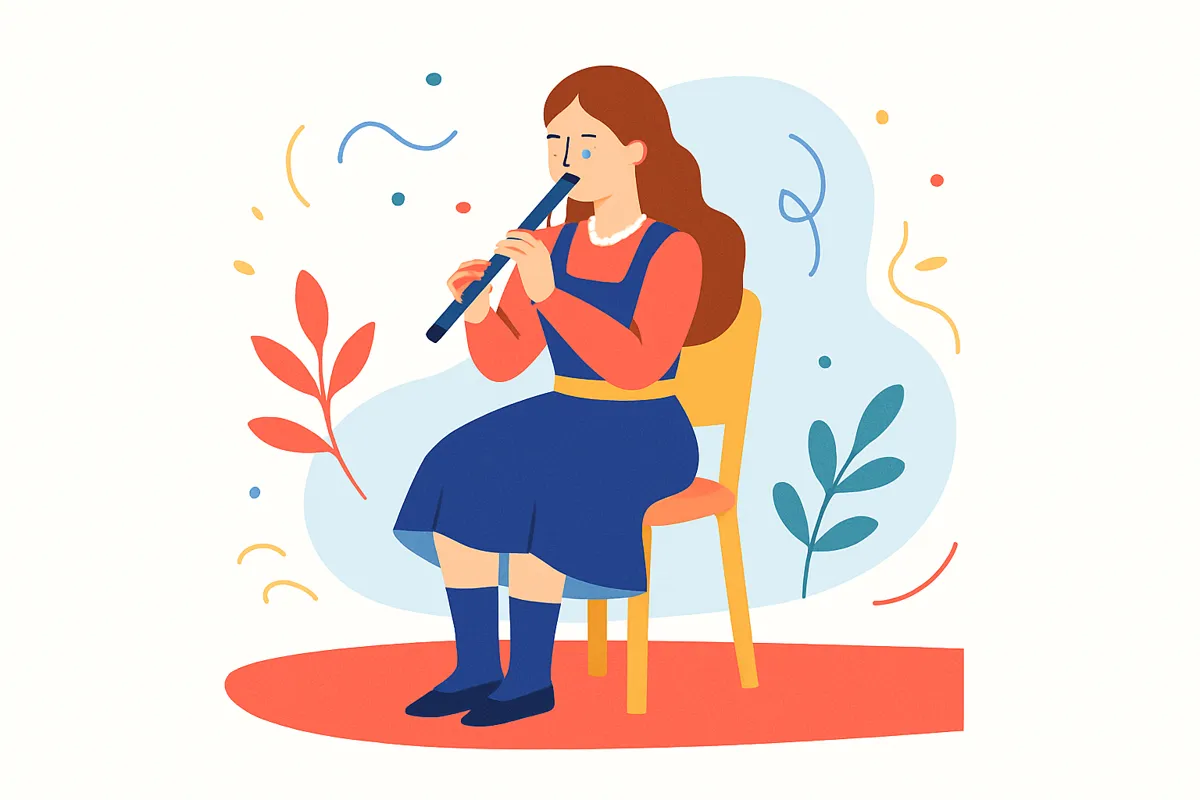
A solo whistle item in which one player performs traditional Irish dance tunes on a simple six-hole whistle, entered individually in one of four age bands and judged on breath control, fingering, ornamentation, rhythm and the lift of the tune.
Whistle is the solo class for the whistle as it is played in Irish traditional music: a simple six-hole pipe, usually of metal or plastic, blown through a fixed mouthpiece with no reed to adjust. There are no keys and no valves, so everything the listener hears comes from breath and fingers alone. The player covers and lifts the six holes to make the notes, and decorates the tune with the short cuts, taps and rolls that give Irish dance music its character. Because the instrument is so plain, nothing hides a wobbly breath or a late finger, which is why the class rewards clean, unfussy playing.
On the eTalenter templates the item is part of the Irish traditional music festival template, where it is the fourth class in the programme, after the fiddle, button accordion and flute. The festival rules give the item the name Whistle, not Tin Whistle, and the template follows that wording. It runs in four age bands, A Under 12, B 12 to 15, C 15 to 18 and D Over 18, and the programme lists it once in each band’s block. Every entry is Individual and open to both genders, no spoken language is attached because the class is played, and the scoring label is a rating out of 10 with a maximum of 100. The ten-minute ceiling is an app default; the source rules do not print a time limit or a marking scheme for the item.
A round is short and exposed. The entrant is called, settles at the front, and plays the tune or tunes they have prepared, usually dance tunes such as a reel, jig, hornpipe or polka, with no accompaniment shown in the template. The adjudicators listen for a steady, sweet tone with no squeaking on the high notes, ornaments that are small and exactly placed, and a pulse that stays lively from the first bar to the last. The template’s Evidence records that adjudicators sit apart and mark separately, and that results are compiled on a points system of 11, 7, 5, 4, 3, 2 and 1 for the top places, so a placing is built from several independent opinions rather than one.
Organisers run a whistle class because the instrument is cheap, easy to carry and often the first one a young player learns, so it brings the widest range of newcomers into a traditional music programme. A beginner can enter Under 12 with a couple of well-learned tunes, while an older player uses the Over 18 band to show command of style and ornament, and the same item lets a festival follow a learner from first tune to confident performer.
Where Whistle comes from
Simple fipple whistles of this kind have been made in many forms for centuries, and the mass-produced six-hole metal whistle became widely available in the nineteenth century, when it was sold cheaply as the penny whistle. It was taken up in Irish traditional music as a melody instrument that sits alongside the flute and pipes.
Where Whistle is run
On the eTalenter templates Whistle is used in a single template, the Irish traditional music festival template in the Cultural and Folk Festival category, where it sits among the solo instrumental classes beside Fiddle, Button Accordion, Flute, Piano Accordion, Concertina, Uilleann Pipes, Harp and Banjo. Whistle playing is also a familiar class at traditional music events elsewhere in the British Isles and in communities around the world where Irish music has spread; this page describes only the item as the template carries it.
- Ireland
Key facts
- A solo item, so the template records every entry as Individual
- Four age bands: A Under 12, B 12 to 15, C 15 to 18 and D Over 18, all open to both genders
- Part of the Irish traditional music festival template only; the programme repeats the item in each age band’s block
- The rules name the class Whistle, not Tin Whistle; no spoken language is set because the class is instrumental
- Rating out of 10 with a /100 maximum and a ten-minute ceiling; these are app defaults, as the source rules print neither a time limit nor a per-criterion marking scheme
- Adjudicators mark separately and places are compiled on a points system of 11, 7, 5, 4, 3, 2 and 1; first prize may be withheld and first and second places qualify to the next level
On eTalenter, Whistle is filed under On Stage and typically scored with Rating out of 10. It appears in 1 ready-made event templates — each one can adjust its time limit, age-group assignment and scoring setup independently.
Across the templates that use it, Whistle is most often entered as an Individual competition, typically scored out of 100, commonly time-limited to around 10 minutes where a limit is set.
What judges look at in Whistle
What a Whistle panel is actually weighing up, and where the marks are usually won or lost:
- Breath control: an even, steady stream of air that keeps the pitch true, with no shrill overblowing on the top notes and no weak, breathy notes at the bottom
- Ornamentation: cuts, taps and rolls that are small, crisp and placed exactly where the tune calls for them, not sprinkled on every note to cover uncertain fingering
- Fingering accuracy: holes covered fully and lifted cleanly, since a half-covered hole or a late finger is heard at once on an instrument with nothing to mask it
- Timing and lift: a steady pulse that makes the tune feel danceable, with no rushing through the easy bars or dragging through the hard ones
- Tone: a clear, sweet sound held consistently across the range, with breaths taken at natural phrase ends rather than in the middle of a line
- Style and tune choice: playing that fits the dance type chosen, with phrasing and variation that make the tune sound lived-in rather than merely correct
Treat these as the judging focus, not a fixed rubric: publish your own weighted criteria for Whistle under Scoring Setup, or start from the full instrumental music judging criteria guide.
How to prepare for Whistle
How entrants and their teachers usually get Whistle right on the day:
- Choose tunes you can play cleanly at pace from memory; a simple jig played with lift and tidy ornaments beats a showy reel that falls apart in the second part
- Learn each tune by ear as well as from the page, listening to good whistle players until you can hear where the cuts and rolls fall and where the phrases breathe
- Practise slowly with a metronome and raise the speed only when the ornaments are still clean; fast, blurred playing is the quickest way to lose marks
- Work on breath away from the tunes: long steady notes, then slow scales, listening for the top notes going sharp when the air pushes too hard
- Practise the ornaments on their own, one at a time, until they are small and automatic, then place them into the tune a few at a time
- Record a full run and listen back for uneven rhythm, squeaks and ornaments that smudge, then choose three weak spots to fix that week
- Check that your whistle is in tune and in good order before the day, and rehearse the whole performance from walking up to finishing; read any adjudication feedback afterwards to set one target for the next event
Ready-made event templates that include Whistle
Open any template to preview it in eTalenter and install it as a live, editable event.
| Template | Category | Score label | Competitions |
|---|---|---|---|
| Fleadh Cheoil (Comhaltas Ceoltoiri Eireann) | On Stage | Rating out of 10 | 4 |
Frequently asked questions
Is Whistle judged individually or as a team?
Across eTalenter’s templates it’s most often run as an Individual entry, though an organiser can set either participation type when assigning the item to an age group.
Is Whistle the same as Tin Whistle?
It is the same instrument. The festival rules the template follows name the class Whistle rather than Tin Whistle, and the template uses that name. You may also hear it called a penny whistle.
Is Whistle the same as Flute?
No. Both are played in Irish traditional music, but the flute is a larger, deeper-toned instrument played across the lips, while the whistle is a simple pipe blown through a fixed mouthpiece. The template carries Flute as its own separate item, so choose the class that matches your instrument.
Is Whistle a team event?
No. The template records every entry as Individual. Duets, trios and bands are separate items in the same programme and are not covered by this page.
Which age band do I enter?
The template has four bands: A Under 12, B 12 to 15, C 15 to 18 and D Over 18. The source rules define them as age-group codes, and the date on which your age is counted is set by the festival, so check the notice before you enter.
Can I play with a backing track or an accompanist?
The template does not show any accompaniment, and the item is a solo class. Check the festival notice if you plan to use anything beyond your own playing.
How is the winner decided?
The template’s Evidence records that adjudicators sit apart and mark separately, and that placings are compiled on points of 11, 7, 5, 4, 3, 2 and 1. First prize may be withheld, and first and second places qualify to the next level.
Want the full judging picture? Read the full instrumental music judging criteria guide, or browse every on stage competition item.
Try Whistle in eTalenter
See every ready-made template that runs Whistle, and install one as a live event — age groups, rules and scoring included.

Leave a Reply
You must be logged in to post a comment.