

A three-player instrumental item in which a trio of musicians all play the melody of traditional Irish dance tunes together, entered in one of four age bands and judged on unison, tuning, rhythm and how the three fit as one sound.
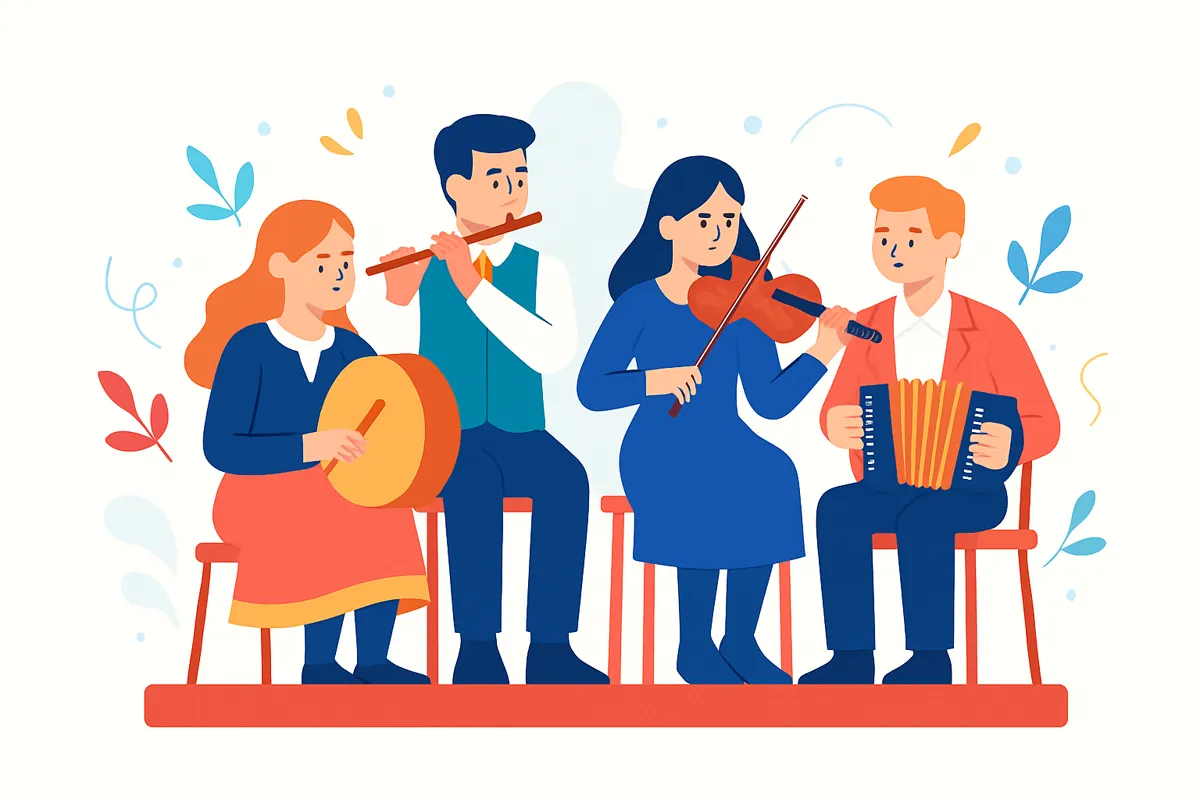
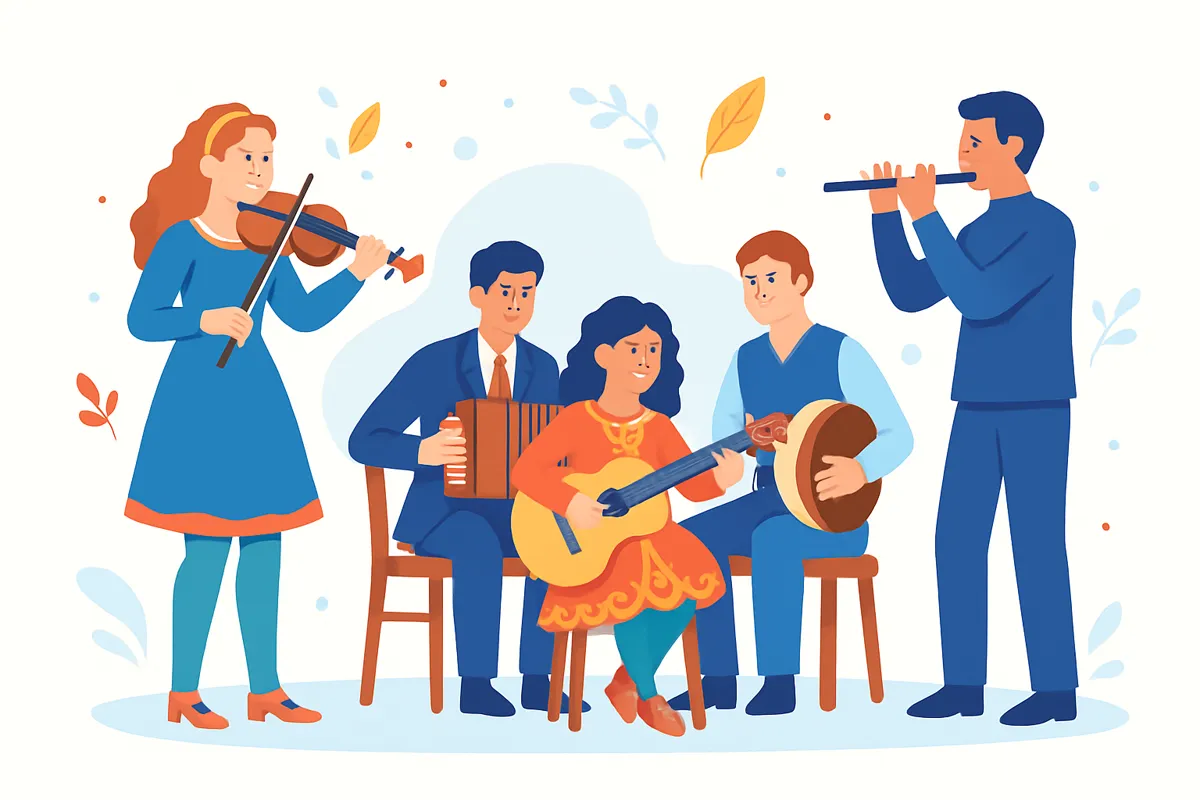
A trio in Irish traditional music is three musicians playing the same tune at the same time, not a lead player with two accompanists. The rules behind this template are explicit: a trio is made up of three melody instruments, and every member must play the melody at all times. That makes the item a test of agreement across three people. All three have to share one version of each tune, the same ornaments in the same places, the same breathing points and the same pulse, so that a listener hears one thick, rich instrument rather than three players working in parallel.
On the eTalenter templates the item belongs to the Irish traditional music festival template, where it is the eleventh class in the programme, straight after Duets. It runs in four age bands, A Under 12, B 12 to 15, C 15 to 18 and D Over 18, each open to both genders with no spoken language attached. Three players take part in each entry, so the template records the item as a Team entry, like the duet before it and unlike the solo classes at the start of the programme. The score is held as a rating out of 10 with a 100 maximum and a ten-minute ceiling; these are app defaults, because the source rules print no marking scheme and no time limit for the class.
What a trio plays depends on the age band. In the two younger bands the rules ask for one tune from each of two tune categories, in Band C one from each of three, and in the senior band one from each of four. The categories include reels, jigs of several kinds, hornpipes, polkas, marches, slides, set dances, mazurkas and airs, and each tune is played twice. Selections, where several tunes are run together, are not allowed. Electronic and amplified instruments are not accepted, and a player may not change instrument or re-tune during the performance. A senior trio needs at least two different melody instruments, so three fiddles may enter the younger bands but not Band D.
The entry rules matter as much as the music. All three players are named on the entry form with the instrument each one plays, and once a trio has qualified that combination of people and instruments must be kept through every later round in the same year, with no substitution of person or instrument. A competitor may enter the trio class only once in any age band, and may also play in a higher band if he or she changes instrument, provided at least one member of the trio belongs to that higher band. Two adjudicators normally listen to a trio, a solo having one, an individual mark is given for each tune, and a trio can be recalled to play one further piece of its own choice. Organisers keep trios as a class of their own because it is the step between the pair and the larger group and ceili band classes, and it rewards the skill of fitting in with two other players.
Where Trios is run
On the eTalenter templates Trios is used in a single template, the Irish traditional music festival template in the Cultural and Folk Festival category, where it comes after Duets and before Ceili Bands, Grupai Ceoil and the two sean-nos singing classes. The festival it follows is a national traditional music competition in Ireland, with qualifying rounds at county and regional level and first and second places going forward to the next round. Playing tunes in threes is common in sessions and music schools in many countries; this page describes only the item as the template carries it.
- Ireland
Key facts
- Three players perform together, so the template records every entry as a Team
- Four age bands: A Under 12, B 12 to 15, C 15 to 18 and D Over 18, all open to both genders, with no spoken language attached
- All three players must play the melody throughout; a senior trio (Band D) needs at least two different melody instruments
- Tunes required: one from each of two categories in Bands A and B, three in Band C and four in Band D, each tune played twice, with no selections
- No electronic or amplified instruments, no change of instrument or tuning mid-performance, and no substitution of person or instrument after qualifying
- Rating out of 10 with a /100 maximum and a ten-minute ceiling are app defaults, as the source rules print neither a time limit nor a per-criterion marking scheme
On eTalenter, Trios is filed under On Stage and typically scored with Rating out of 10. It appears in 1 ready-made event templates — each one can adjust its time limit, age-group assignment and scoring setup independently.
Across the templates that use it, Trios is most often entered as an Team competition, typically scored out of 100, commonly time-limited to around 10 minutes where a limit is set.
What judges look at in Trios
What a Trios panel is actually weighing up, and where the marks are usually won or lost:
- Three-way unison: all players using the same version of each tune, with notes, ornaments and phrase endings landing together, and no player a fraction ahead or behind
- Tuning across three instruments: how well the trio match pitch when the instruments differ, for example a fiddle, a flute and a concertina, and whether they hold it through a long tune
- One shared pulse: a single tempo and a single set of accents for each tune type, with a clean start and a clean finish that nobody has to signal obviously
- Balance and blend: no instrument covering the others, so a quieter whistle or harp is still heard beside a louder box or pipes and the three tones join into one sound
- Tune choice across categories: tunes of different types selected to meet the age band and played accurately by all three, not a showy tune that only one member can carry
- Style and ornament: traditional decoration used in matching places by all three, with a lively, danceable rhythm rather than a stiff or over-ornamented performance
Treat these as the judging focus, not a fixed rubric: publish your own weighted criteria for Trios under Scoring Setup, or start from the full instrumental music judging criteria guide.
How to prepare for Trios
How entrants and their teachers usually get Trios right on the day:
- Fix one version of each tune early. With three people the chance of drift is higher than in a duet, so agree notes, ornaments, repeats and part changes together and write them down
- Practise slowly before fast and use a metronome until all three can start and stop together without a count-in the audience can see
- Pick tunes that all three instruments can play cleanly. A tune that sits well on a fiddle may be awkward on a flute or harp, so choose keys and tunes the weakest instrument can finish
- Tune the three instruments against each other, not just to a tuner, in the room where you will play, and check again after warming up
- Sit or stand so that all three players can hear each other, and rehearse in that arrangement, because the hardest part of a trio is hearing the player on the far side
- Plan the entrance and exit: who gives the lead-in, how the first note is counted, and how the three finish together on the last note
- Check that the entry names all three players with the correct instrument for each, and remember that after qualifying you cannot swap a player or an instrument for a later round
- Record a run-through and listen for the bars where one player rushes or an instrument is covered, then rework those few bars rather than replaying the whole set
Ready-made event templates that include Trios
Open any template to preview it in eTalenter and install it as a live, editable event.
| Template | Category | Score label | Competitions |
|---|---|---|---|
| Fleadh Cheoil (Comhaltas Ceoltoiri Eireann) | On Stage | Rating out of 10 | 4 |
Frequently asked questions
Is Trios judged individually or as a team?
Across eTalenter’s templates it’s most often run as an Team entry, though an organiser can set either participation type when assigning the item to an age group.
What is the difference between a trio and a duet in this festival?
The only difference in the music is the number of melody instruments: two for a duet and three for a trio. In both, every player must play the melody at all times. The rules treat them as neighbouring classes with the same tune requirements for each age band.
Can three of the same instrument enter a trio?
In the younger bands the rules allow it, since they only ask for three melody instruments. In the senior band, Band D, the trio must have at least two different melody instruments, so three fiddles could not enter that band.
Is a trio judged as a group or as three soloists?
As a group. The template records the item as a Team entry, and the marks reward how well the three players fit together as well as how well each plays. Two adjudicators normally hear a trio and a mark is given for each tune played.
Can we play our tunes as a set?
No. The rules do not allow selections in a trio. You play the required tunes from the stated categories, and each one is played twice.
Can we replace a member after we have qualified?
No. The names and instruments listed on the entry have to be kept through every later round of the same year; once a trio has qualified, no substitution of person or instrument is allowed.
Can a trio be asked to play again?
Yes. An adjudicator may recall a competitor, and in the case of a trio one new piece of the players own choice must then be performed.
Want the full judging picture? Read the full instrumental music judging criteria guide, or browse every on stage competition item.
Try Trios in eTalenter
See every ready-made template that runs Trios, and install one as a live event — age groups, rules and scoring included.

Leave a Reply
You must be logged in to post a comment.