
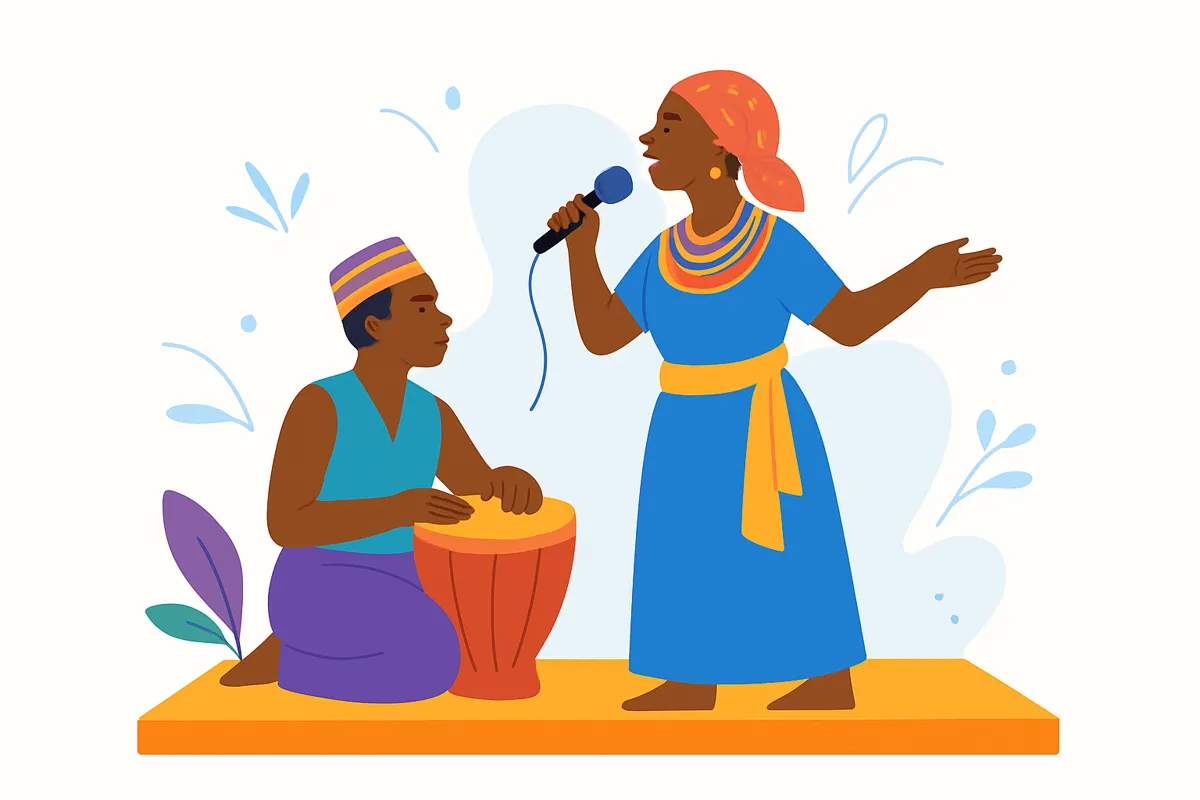
A solo performance of verse, in which one speaker presents a poem or a piece of poetic text by voice, face and gesture, entered individually across five age groups.
Solo Verse is a one-person verse-speaking item. A single performer takes a poem, or a piece of poetic text, and brings it to life for an audience and a panel, using voice, pace, face and a measured amount of movement. Unlike a plain recitation, the word performance matters: the panel is watching a speaker who understands the piece and wants the listeners to understand it too, not a learner reading words off a memory.
On the eTalenter Kenya national drama and film festival template, Solo Verse sits in the On Stage programme, straight after Modern Creative Dance. It is an Individual item open to boys and girls together, offered in five age groups: Pre-Primary (3 to 5), Primary (6 to 12), Junior School (13 to 15), Secondary (14 to 18, with overlap allowed) and Tertiary (19 and over). Each class is scored out of 100, and the template lists the language as English.
A round is short and simple to run. The speaker is called, steps to a marked spot, pauses, delivers the piece from memory, and leaves. A strong entry opens with a settled pause, shapes the poem through changes of pace and volume, uses the face and hands to underline the meaning instead of acting out every line, and ends on a clear final beat, so the audience knows the poem has finished.
The template sets no time limit and does not divide the 100 marks into headings, because the source material for this strand publishes no verse scheme comparable to the one for a Play. Organisers should therefore publish the running time, whether the poem is set or chosen, whether it may be original, and the judging headings in their own notice before entries open.
Organisers run the class because verse is the cheapest performing item to stage: it needs no set, no team and no equipment, so it opens the stage to learners who might never join a play or a dance, and it builds memory, diction and confidence along the way.
Where Solo Verse is run
On the eTalenter templates this item appears on one: the Kenya national drama and film festival template, in its On Stage section. Verse speaking runs at school, college and community festivals in many countries under names such as recitation, poetry speaking or spoken verse, but this page describes the item as that template sets it up, so entrants elsewhere should check their own notice for time limits, choice of piece and judging headings.
- Kenya
Key facts
- Individual item: one speaker is judged alone, boys and girls in the same entry pool
- Five age groups on the template, from Pre-Primary (3 to 5) to Tertiary (19 and over)
- Each of the five classes has a maximum score of 100, with no time limit or heading split set on the template
- The template lists the language as English; organisers running other languages should say so in their notice
- Listed fifth on the On Stage programme, after Modern Creative Dance; Choral Verse, the group version, is a separate item
- Delivered from memory, with voice leading and gesture in support
On eTalenter, Solo Verse is filed under On Stage and typically scored with Marks. It appears in 1 ready-made event templates — each one can adjust its time limit, age-group assignment and scoring setup independently.
Across the templates that use it, Solo Verse is most often entered as an Individual competition, typically scored out of 100.
What judges look at in Solo Verse
What a Solo Verse panel is actually weighing up, and where the marks are usually won or lost:
- Understanding of the text: delivery that shows the speaker knows what each line means, so emphasis falls on the right words
- Voice and diction: clear, audible speech with correct pronunciation, and volume that carries to the back of the hall without shouting
- Pace, pause and rhythm: changes of speed and well-placed silences that follow the poem’s shape instead of a single hurried or sing-song pattern
- Memory and fluency: a secure delivery with no prompting, no stumbles and no restarts
- Expression and gesture: face, eyes and hands that support the meaning without turning the poem into a mime
- Choice and fit: a piece suited to the speaker’s age and voice, delivered with a confident entrance, stance and finish
Treat these as the judging focus, not a fixed rubric: publish your own weighted criteria for Solo Verse under Scoring Setup, or start from the full recitation and poetry judging criteria guide.
How to prepare for Solo Verse
How entrants and their teachers usually get Solo Verse right on the day:
- Choose a poem you can explain in one sentence; if you cannot say what it is about, the panel will not hear it either
- Mark the text: underline the words to stress, put a slash at each breath and a double slash at each long pause, then speak from the marked copy
- Learn the poem in short sections, then run it from the first line every day so the joins between sections become secure
- Record yourself on a phone and listen for rushing, flat endings and swallowed words, then fix one thing at a time
- Practise in the largest room you can find, speaking to the far wall, so volume and clarity feel natural on the day
- Keep gestures few and deliberate: one clear hand or head movement at a key line is worth more than constant movement
- Rehearse the entrance and exit as well: walk on, pause, begin, finish, hold the last beat, and leave, since a hesitant start or an early walk-off costs marks
- For younger speakers, pick a shorter, rhythmic piece and perform it with energy; for older speakers, a piece with a shift of mood gives more to show
Ready-made event templates that include Solo Verse
Open any template to preview it in eTalenter and install it as a live, editable event.
| Template | Category | Score label | Competitions |
|---|---|---|---|
| Kenya National Drama and Film Festival | On Stage | Marks | 5 |
Frequently asked questions
Is Solo Verse judged individually or as a team?
Across eTalenter’s templates it’s most often run as an Individual entry, though an organiser can set either participation type when assigning the item to an age group.
Is Solo Verse the same as Choral Verse?
No. They are separate items on the same template. Solo Verse is one speaker, judged individually; Choral Verse is a group speaking together.
Can I read from a script or use notes?
The template does not say, so check your festival’s notice. Verse speaking is normally delivered from memory.
How long can the piece be?
The template sets no time limit, so the organiser should publish a running time in their own notice.
How are the marks split?
Each age-group class is out of 100. The template does not divide the marks into headings, so the organiser should list the headings in their notice.
Can I perform a poem I wrote myself?
That is for the organiser to decide; the template does not fix it. Ask before you rehearse an original piece.
Want the full judging picture? Read the full recitation and poetry judging criteria guide, or browse every on stage competition item.
Try Solo Verse in eTalenter
See every ready-made template that runs Solo Verse, and install one as a live event — age groups, rules and scoring included.


Leave a Reply
You must be logged in to post a comment.