
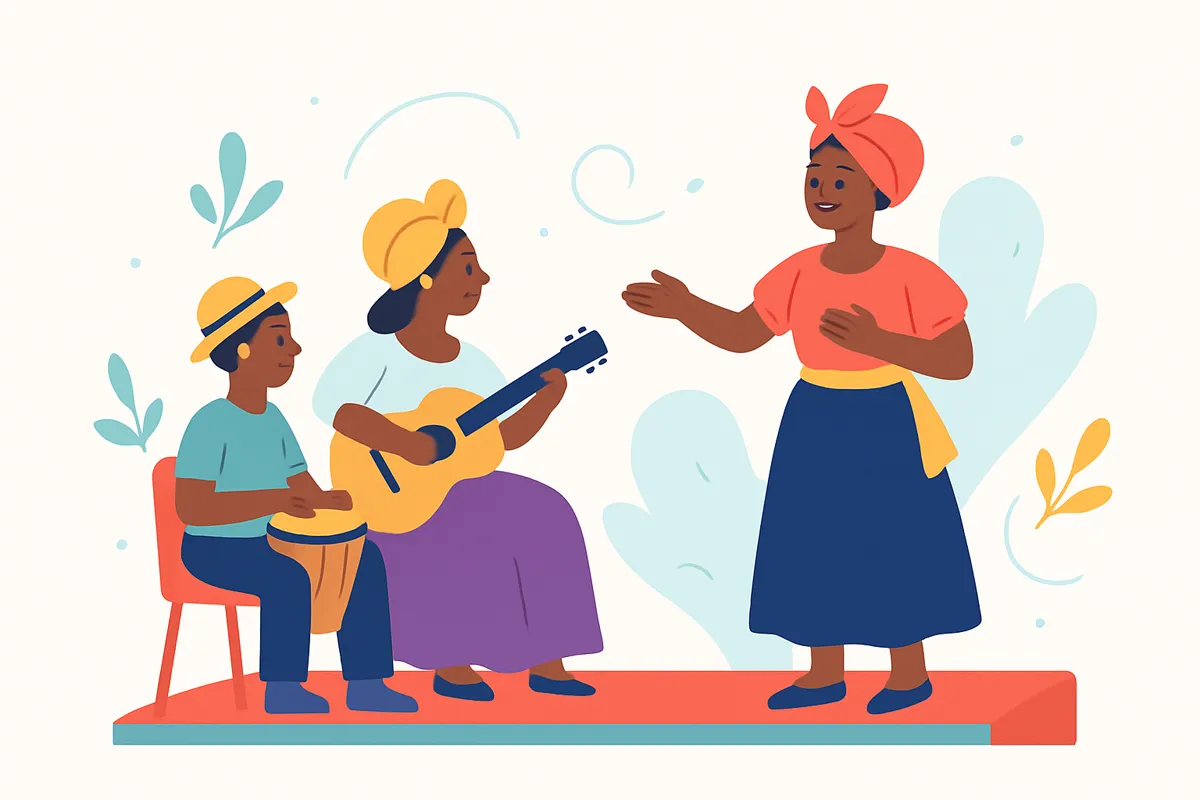
A spoken category in which each entrant performs one story from the oral tradition, in Jamaican, Standard English or another language, recorded on the template as a four-minute entry scored out of 100 and offered in all seven classes.
Speech – Story Telling is the sixty-fourth entry on the Jamaican national performing arts festival template and the ninth category of its Speech discipline. It follows public speaking and leads into the sonnets, psalms and Shakespeare class. The festival handbook files it as category 11 of the speech syllabus, with the abbreviation ST on entry forms. It is the longest solo class in the discipline: where the poem and prose classes are capped at three minutes, a story is given between five and seven minutes.
The handbook defines story telling as the oral art in the performance of legends, tales, myth, fairy tale, tradition and parable, and says it is ideally folk tales such as the Anancy stories. The requirement for each class from 1 to 6 is to present one selection from the wide range of oral traditions, whether in Jamaican, Standard English or otherwise, and the content may be foreign or local. So the choice of story and language is the entrant’s, and the class asks for telling rather than reading a text aloud.
On the day the round is simple. The entrant walks on, tells one story from beginning to end and leaves; there is no set text and no preparation period, unlike public speaking. The panel marks voice, speech, presentation and interpretation on the four-part table shared by the whole Speech discipline. Because the story is told rather than recited, the presentation heading carries real weight: stage presence, performance energy and visual impact are part of the mark, and the handbook’s costume rule applies, which asks for clothing suited to the character, bright and bold colours, and no school uniform or plain black, white or grey unless the story calls for it.
The same general rules as the other speech classes apply: the right author or source of the story must be acknowledged, and a copy of the selection goes in with the entry form. The handbook does not say whether the story must be learned by heart, whether props or audience participation are allowed, or how a story handed down by word of mouth should be credited on the form. Those are points to confirm with the organiser before entering.
The template records the item as a team entry, both genders together, with English as the language, a four-minute window with the warning bell at three minutes and a score out of 100, in all seven classes. The handbook describes the category as a solo class for Classes 1 to 6 with a story of five to seven minutes, so a four-minute window would cut off every story that meets the handbook’s minimum. An organiser who wants to follow the handbook should set the entry type to individual and the time limit to seven minutes. Organisers run a story telling class because it gives entrants a place to be judged on voice, timing and characterisation in a form that is older than the printed page.
Where Speech – Story Telling comes from
Anancy stories are widely recognised as Jamaican folk tales about a spider who is also a trickster, carried to the Caribbean by people from West Africa and retold ever since by parents, teachers and community storytellers. The handbook names them as the ideal subject for the class. Nothing in the source for this template says when the class joined the festival or how it has developed, so no festival history is claimed here.
Where Speech – Story Telling is run
On eTalenter this item is used in one template, the Jamaican national performing arts festival template, where it is assigned to all seven classes (six age bands from the youngest children to adults aged 20 and over, plus a combined class) in the Speech discipline, after public speaking and ahead of the sonnets, psalms and Shakespeare class. Story telling competitions of one kind or another are common in school, library and community festivals around the world, and a general Story Telling item with its own page also appears on other templates; this page covers the version defined by the Jamaican festival handbook, and each event sets its own time limits, age bands and rules.
- Jamaica (the national performing arts festival the template is built from)
Key facts
- Abbreviation ST on entry forms; the handbook lists it as category 11 of the speech syllabus, for Classes 1 to 6, and its awards scheme names it Best Story Telling (Classes 1-6)
- One selection from the oral traditions, in Jamaican, Standard English or another language; the content may be local or foreign, and the handbook names legends, tales, myths, fairy tales, traditions and parables, ideally folk tales such as Anancy stories
- Time: five to seven minutes, with seven minutes as the maximum
- The template gives a team entry, both genders together, English as the language, a four-minute limit with the warning bell at three minutes and a score out of 100, in all seven classes; the handbook describes an individual class for Classes 1 to 6
- Marked on the shared four-part speech table: voice production, speech, presentation and interpretation, weighted 20, 30, 20 and 30 at auditions, 10, 35, 15 and 40 at parish level and 4, 20, 4 and 22 (out of 50) at the national finals
- Ideas, not rules, for choosing a story: a trickster tale where the clever character is outwitted at the end; a legend about how a hill, a river or a place got its name; a family story told in the voice of the person who lived it; a fable with a clear lesson that suits the age of the listeners. Always check the source and suitability with the organiser
On eTalenter, Speech – Story Telling is filed under On Stage and typically scored with Marks. It appears in 1 ready-made event templates — each one can adjust its time limit, age-group assignment and scoring setup independently.
Across the templates that use it, Speech – Story Telling is most often entered as an Team competition, typically scored out of 100, commonly time-limited to around 4 minutes where a limit is set.
What judges look at in Speech – Story Telling
What a Speech – Story Telling panel is actually weighing up, and where the marks are usually won or lost:
- The handbook prints one marking table for the whole Speech discipline, so a story is scored on the same four headings as every other speech class; the points below follow that table and are a summary, not a quotation of the rule
- Voice production: audibility, projection, tone, resonance, colouring, texture and pace, worth 20 at auditions, 10 at parish level and 4 of 50 at the national finals. Over five to seven minutes a single voice becomes tiring, so marks go to the teller who gives each character a different pitch and pace, slows for suspense and lifts for comedy, and are lost to one who keeps one tone from the first line to the last
- Speech: articulation, enunciation and pronunciation, worth 30, 35 and 20 of 50. Dialogue in Jamaican, Standard English or another language must be clear to the listener. The handbook names Oxford English as its pronunciation reference for Standard English speaking and says nothing about how that applies to a story told in Jamaican or in another language, so ask the organiser how the panel reads it
- Presentation: costume, stage presence, performance energy, style and visual impact, worth 20, 15 and 4 of 50. A story is a performance, so gesture, facial expression and the use of the stage count. Movement that shows the spider climbing or the giant approaching earns marks; constant pacing that has no connection to the tale loses them
- Interpretation: comprehension, expression, mood and feeling and believability, worth 30, 40 and 22 of 50. This is where most stories are won. The panel rewards a teller who understands why the story matters, builds to the turning point, lets the ending land and sounds as if the characters are real; it marks down one who rushes through the plot as a list of events
- Time and choice of story: the story should fill the five to seven minutes without being cut off at seven. A tale that is too thin runs short, and one that is too long forces the teller to hurry the ending, which is the weakest place to lose marks
Treat these as the judging focus, not a fixed rubric: publish your own weighted criteria for Speech – Story Telling under Scoring Setup, or start from the full speech competition judging criteria guide.
How to prepare for Speech – Story Telling
How entrants and their teachers usually get Speech – Story Telling right on the day:
- Check the rules first: one story, between five and seven minutes, from the oral traditions, with the source acknowledged and a copy of the text ready for the entry form. Ask the organiser whether the story may be told from memory only, whether props are allowed and how a traditional story should be credited
- Choose a story you enjoy hearing yourself. If the tale is folk material, find two or three versions, learn the shape they share and then decide which details to keep so the version you tell is yours
- Break the story into scenes, no more than six or seven, and write one line for each. Learn the scenes and the turning points first, and the exact words second; a teller who knows the route can recover from a slip, and one who has only memorised the words cannot
- Give every character a voice and a way of moving, and keep them consistent. Practise switching between the narrator and the characters quickly so the audience always knows who is speaking
- Time it with a stopwatch at performing speed. Aim for about six minutes so there is room for pauses and nerves, and know which scene you would shorten if you were running long, because the seven-minute limit is a maximum
- Practise the ending separately and often. A story can be told well and still lose its audience if the last lines are rushed; hold the pause before the final line and then let it land
- Rehearse in the costume you will wear and on a space of similar size, and ask a listener who does not know the story to tell it back to you afterwards. If they cannot, the plot, the voices or the pace are not yet clear
- After a result, ask for the adjudicator’s comments and note which of the four headings lost marks. Interpretation and voice are usually the quickest to improve: choose a story with more contrast, add a stronger low point before the turning point and keep the pace varied
Ready-made event templates that include Speech – Story Telling
Open any template to preview it in eTalenter and install it as a live, editable event.
| Template | Category | Score label | Competitions |
|---|---|---|---|
| JCDC National Performing Arts Festival (Jamaica) | On Stage | Marks | 7 |
Frequently asked questions
Is Speech – Story Telling judged individually or as a team?
Across eTalenter’s templates it’s most often run as an Team entry, though an organiser can set either participation type when assigning the item to an age group.
What counts as story telling in this category?
The handbook defines it as the oral art in the performance of legends, tales, myth, fairy tale, tradition and parable, ideally folk tales such as Anancy stories. The story is told aloud to the audience, in Jamaican, Standard English or another language, and the content may be local or foreign.
How long should the story be?
The handbook sets five to seven minutes, with seven minutes as the maximum. The template gives a four-minute window with the warning bell at three minutes, which is shorter than the handbook’s minimum, so an organiser following the handbook should change the limit to seven minutes.
Do I have to learn the story by heart?
The handbook does not say so for this class. It does say that public speaking entrants must speak directly to the audience and only glance at cue cards, but that rule is written for public speaking. Ask the organiser whether notes or a book are allowed before you rely on either.
Can I tell a story in Jamaican or another language?
Yes. The handbook says performers may present from the wide range of oral traditions whether in Jamaican, Standard English or otherwise. The template records English as the language, so an organiser who wants other languages should check the entry settings.
Is this judged individually or as a team?
The handbook describes it as a solo class for Classes 1 to 6. The template records it as a team entry, so an organiser who wants the handbook’s version should set the entry type to individual.
How is story telling different from public speaking or reading a prose piece?
Public speaking gives a topic and thirty minutes to prepare a short speech, and the prose classes ask for a published prose selection. Story telling is a tale from the oral tradition, performed at greater length, so characterisation, pace and suspense matter more than argument or a close reading of an author’s words.
Want the full judging picture? Read the full speech competition judging criteria guide, or browse every on stage competition item.
Try Speech – Story Telling in eTalenter
See every ready-made template that runs Speech – Story Telling, and install one as a live event — age groups, rules and scoring included.

Leave a Reply
You must be logged in to post a comment.