
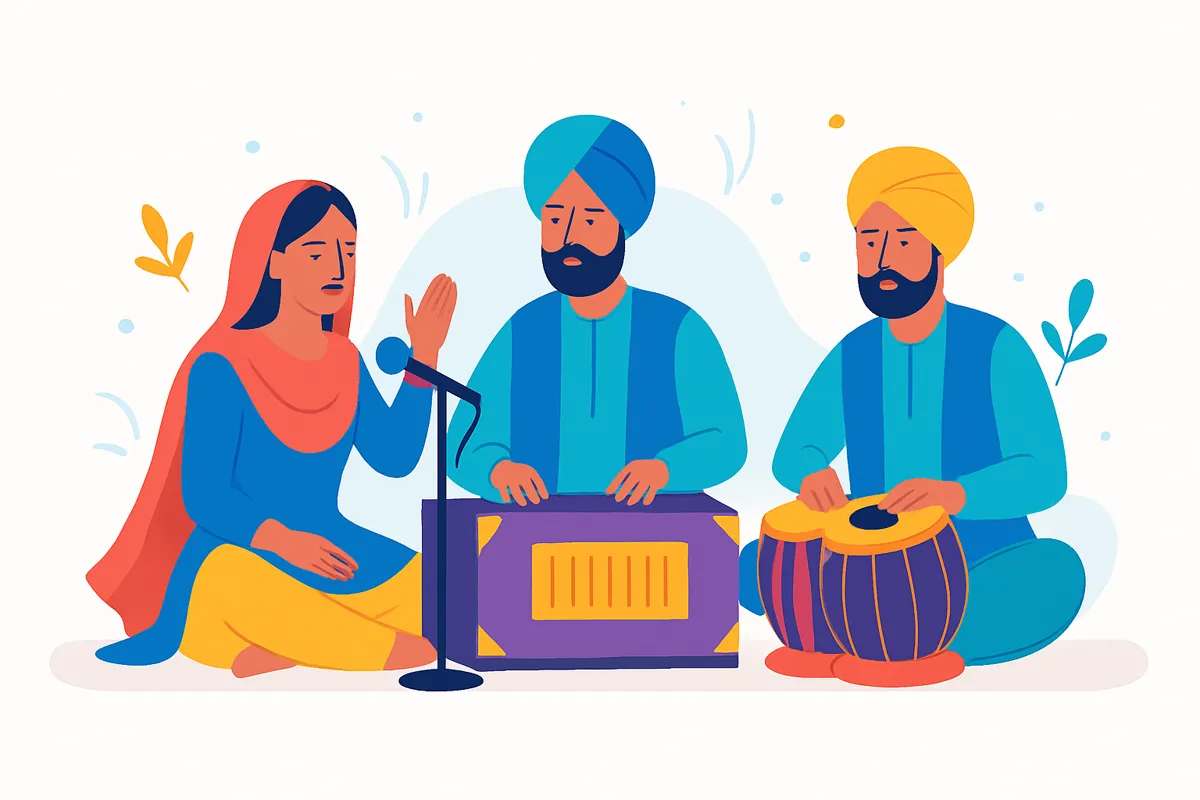
A solo devotional singing item in which the entrant sings a shabad (a hymn from the Sikh tradition) or a bhajan (a Hindu devotional song) and is judged on tune, diction and sincerity of feeling.
Shabad/Bhajan is a solo devotional singing item. A shabad is a hymn drawn from the Sikh tradition of sung scripture, usually set to a simple, steady melody, while a bhajan is a devotional song from the wider Hindu tradition, often in Hindi, Braj or a regional language. The title lists both because campus festivals in north India draw singers from both traditions, and the entrant chooses whichever suits their voice and background.
On the north Indian university zonal youth festival template that carries it, the item is listed under On Stage as an Individual competition for the Open (College) band, with male and female entrants rated together. Language is left open, so a singer may perform in Punjabi, Hindi or another language, and each performance has a time allowance of up to ten minutes.
A round is straightforward. Each singer performs a single hymn or devotional song, usually with a harmonium and tabla, or a small accompaniment if the organiser allows, and the panel rates it on the spot. The strongest entries are calm and unhurried: the words are clear, the pitch holds against the drone, and the mood stays reverent from the first line to the last rather than being performed for effect.
Organisers keep this slot because devotional singing is a shared cultural strand on many campuses, and it gives students who do not sing film or classical music a place in the programme while keeping the festival’s music section varied.
Where Shabad/Bhajan comes from
Sung devotional poetry is long established in both traditions: shabad kirtan in the Sikh tradition and bhajan singing in the Bhakti tradition of devotional music across India.
Where Shabad/Bhajan is run
On the eTalenter templates this exact title appears once, on a north Indian university zonal youth festival template, as a college-level On Stage music item. It is a campus festival item rather than a school one, and it sits beside the light vocal, classical vocal and group singing slots rather than replacing them. The template records it as a rating-style item, so check the festival’s own notice for how scores are shown on the day.
- Punjab, India
- Chandigarh, India
Key facts
- Individual solo item, male and female entrants rated together
- Songs are a shabad (Sikh hymn) or a bhajan (Hindu devotional song); light film or classical raga items belong to other slots
- Open (College) band, with ages running up to the mid-twenties on this template
- Up to 10 minutes per performer on the template
- Language is open (Any/NA), so the singer may choose Punjabi, Hindi or another language
- Judged by a panel on the spot, with accompaniment arrangements set by the organiser
On eTalenter, Shabad/Bhajan is filed under On Stage and typically scored with Rating out of 10. It appears in 1 ready-made event templates — each one can adjust its time limit, age-group assignment and scoring setup independently.
Across the templates that use it, Shabad/Bhajan is most often entered as an Individual competition, typically scored out of 100, commonly time-limited to around 10 minutes where a limit is set.
What judges look at in Shabad/Bhajan
What a Shabad/Bhajan panel is actually weighing up, and where the marks are usually won or lost:
- Sruti and pitch: staying steady against the drone or harmonium, especially on long held notes at the end of a line
- Diction and pronunciation: devotional verses must be sung clearly and correctly, with no swallowed syllables in Punjabi, Hindi or Braj words
- Bhava or sincerity: a calm, reverent delivery earns more than showy ornamentation
- Rhythm and tempo: an even pulse with the tabla or clap pattern, and no rushing near the close
- Choice of piece: a recognised shabad or bhajan sung faithfully, rather than a film song dressed as devotion
- Time discipline: a complete piece, shaped to finish inside the ten-minute allowance
Treat these as the judging focus, not a fixed rubric: publish your own weighted criteria for Shabad/Bhajan under Scoring Setup, or start from the full light music judging criteria guide.
How to prepare for Shabad/Bhajan
How entrants and their teachers usually get Shabad/Bhajan right on the day:
- Choose one piece in a comfortable range; a simple hymn sung steadily beats a hard one sung shakily
- Learn the meaning of every verse so your expression follows the words, particularly for older Punjabi or Braj text
- Rehearse with the actual accompaniment, or a drone and tabla in the same key and tempo, several times before the day
- Ask the organiser early whether live instruments, a recorded track or unaccompanied singing is allowed
- Time a full run-through and shape the piece to the limit instead of cutting it off mid-verse
- Keep the opening plain and the ending settled; devotional singing rewards restraint
- Record yourself once and listen for drifting pitch on long notes, which is the commonest fault
Ready-made event templates that include Shabad/Bhajan
Open any template to preview it in eTalenter and install it as a live, editable event.
| Template | Category | Score label | Competitions |
|---|---|---|---|
| Panjab University Zonal Youth Festival (Punjab, India) | On Stage | Rating out of 10 | 1 |
Frequently asked questions
Is Shabad/Bhajan judged individually or as a team?
Across eTalenter’s templates it’s most often run as an Individual entry, though an organiser can set either participation type when assigning the item to an age group.
What is the difference between a shabad and a bhajan?
A shabad is a hymn from the Sikh tradition of sung scripture, while a bhajan is a devotional song from the wider Hindu tradition. Either is acceptable in this item.
Can I sing in Punjabi or Hindi?
Yes. The template sets the language to Any/NA, so the entrant picks the language of the piece.
Is Shabad/Bhajan the same as Light Vocal?
No. Light vocal covers geet, ghazal and folk songs, while this item is limited to devotional hymns and songs. They are separate slots on the same kind of festival.
How long can I sing?
The template allows up to ten minutes per performer. Check the festival’s own notice for any shorter limit on the day.
Want the full judging picture? Read the full light music judging criteria guide, or browse every on stage competition item.
Try Shabad/Bhajan in eTalenter
See every ready-made template that runs Shabad/Bhajan, and install one as a live event — age groups, rules and scoring included.


Leave a Reply
You must be logged in to post a comment.