
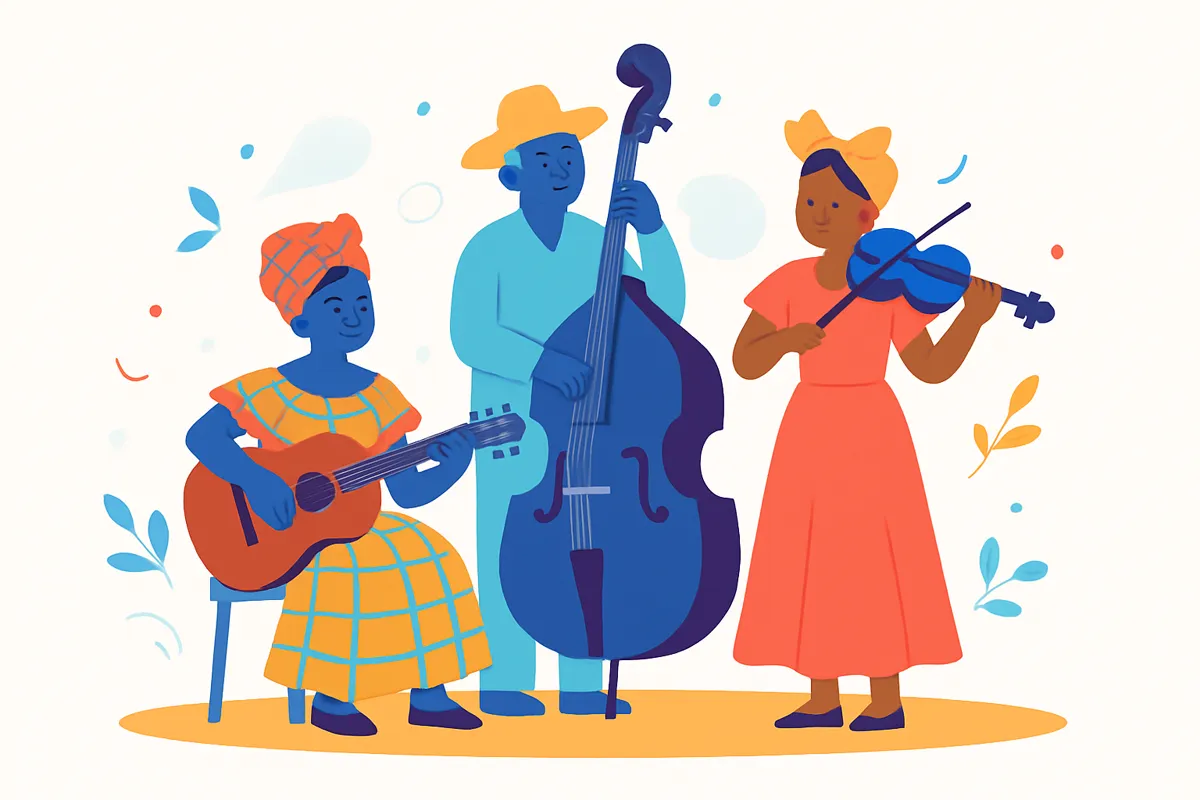
A music category in a national performing arts festival in Jamaica where entrants play a string instrument such as the violin, cello or guitar before a panel, in four minutes, scored out of 100 and open to all seven classes from age 3 to adult.
Music – String Instruments is the third entry in the Music discipline of the Jamaican national performing arts festival list this template is rebuilt from. It follows the piano class and the wind class and, like the wind class, names a family rather than one instrument. In ordinary festival usage the family covers the bowed strings (violin, viola, cello, double bass) and the plucked strings (guitar, harp, and in a Caribbean setting often the bass guitar, ukulele or mandolin), but the extract used to build the template does not print a list, so the organiser decides what is admitted.
That extract gives the category, the classes and the limits only. It prints no set-piece list, no rule on whether a pianist or a backing track may accompany, no statement on playing from the score, and no per-criterion marking table, so this page describes how string classes are commonly run and does not claim to know the festival’s requirements. A sensible organiser publishes a short notice before entries open that names the instruments allowed, says whether amplified instruments such as an electric guitar are welcome, says whether the entrant brings an accompanist, and says who provides a chair, a music stand and a power socket if one is needed.
A typical string round runs like this. The entrant walks on with the instrument already tuned or tunes quietly against a reference note, settles the chair and stand, and plays one piece for the panel. Strings are unforgiving in a way that other families are not: nothing on a violin, cello or fretless instrument marks the correct pitch for the player, so the panel hears every bit of finger placement, and the bow arm shows in the evenness of the tone, the crossing from one string to another and the clean start and end of each note. For plucked instruments the same attention goes to the right hand: the evenness of the picking or strumming, the control of the thumb, and the damping of strings that should not ring on.
On the template the item is offered in all seven classes, from Class 1 (ages 3-6) through the age bands up to adults aged 20 and over, with a combined class for any mix of ages. Every class has the same limits: four minutes with a warning bell at three, a score out of 100, both genders in one list and English as the language. The template records the entry as a team entry in every class, which is the setting it applies across the whole festival; a string entrant is usually a soloist, and an organiser who also wants duets, trios or a small string ensemble should say so in the notice. Small hands mean very young entrants often play a fractional-size violin, a ukulele or a classical guitar, so it helps to print the instrument beside each name on the programme.
Organisers keep a string category because it connects the festival to the private teachers and school orchestras that develop string players over years, and it lets guitar and ukulele players, who rarely have a stage in a school band, compete alongside the orchestral instruments. Audiences enjoy it for the change of mood after the breath-driven wind class: quieter, closer playing in which every flaw and every moment of real feeling carries to the back of the hall.
Where Music – String Instruments comes from
Stringed instruments are among the oldest in the world: a stretched string over a resonating body appears in archaeological finds and early art from many civilisations. The violin family took its present form in northern Italy in the sixteenth century, and the makers of that period set a standard for the instrument that players still follow. The guitar descends from several earlier plucked instruments of Spain and the Mediterranean and settled into its modern six-string shape in the nineteenth century. Solo string classes grew with the spread of competitive music festivals and school orchestras in Britain, its former colonies and North America during the nineteenth and twentieth centuries.
Where Music – String Instruments is run
On eTalenter this item is used in one template, the Jamaican national performing arts festival template, where it is assigned to all seven classes (six age bands from 3-6 up to adults aged 20 and over, plus a combined class) inside the Music discipline, between the wind instruments and the concert band. String solo classes are a standard part of competitive music festivals in Britain and Ireland, of Commonwealth festivals in the Caribbean, Africa, Australia and New Zealand, of state and provincial school music contests in North America, and of conservatoire and youth-orchestra programmes elsewhere. Many of those events split bowed strings from guitar or harp and enter by grade rather than by age; this template keeps all strings in one list divided by age class, so an organiser with a large entry may choose to split the list.
- Jamaica (the national performing arts festival the template is built from)
Key facts
- A solo or small-group performance on a string instrument in front of a panel, recorded as a team entry on the template, with both genders in one list and the language set to English
- The family covers bowed strings (violin, viola, cello, double bass) and plucked strings (guitar, harp and similar); the template does not list individual instruments, so the organiser sets what is allowed
- Offered in all seven classes, from Class 1 (ages 3-6) to Class 6 (adults, 20 and over) and the combined class
- Four-minute limit with the warning bell at three minutes, enough for one movement, one song or a trimmed piece
- Scored out of 100 on the template; the festival awards medals against published mark bands rather than first, second and third
- Third in the Music discipline, after Pianoforte and Wind Instruments and ahead of Concert Band, Stage Band, Steel Pan Music and Recorder
- The extract used for the template prints no repertoire list, accompaniment rule or per-criterion weights, so none are asserted here
- Ideas, not rules, for how an organiser might handle a big entry: separate bowed and plucked lists, a rule that electric instruments bring their own lead and amplifier, and a printed instrument name beside every entrant so the panel is ready for what is coming
On eTalenter, Music – String Instruments is filed under On Stage and typically scored with Marks. It appears in 1 ready-made event templates — each one can adjust its time limit, age-group assignment and scoring setup independently.
Across the templates that use it, Music – String Instruments is most often entered as an Team competition, typically scored out of 100, commonly time-limited to around 4 minutes where a limit is set.
What judges look at in Music – String Instruments
What a Music – String Instruments panel is actually weighing up, and where the marks are usually won or lost:
- The source does not print this category’s marking table, so what follows is organiser guidance for agreeing yardsticks with the panel, not rules from the source
- Intonation: notes in tune with themselves and with any accompanist; on a violin, viola or cello a finger a hair off the pitch is heard at once, and on a fretted instrument the tuning of the open strings before the first note is part of the performance
- Tone: a clear, even sound with no scratching, buzzing or fret rattle, and a bow or picking hand that produces the same quality on every string
- Bow or plucking technique: smooth bow changes, controlled string crossings and a steady bow speed for bowed instruments; even picking, clean chord changes and damped open strings for guitars and harps
- Rhythm and pulse: a steady beat held through difficult passages, with rests given their full length, and tempo chosen for what the player can control
- Accuracy and recovery: correct notes and positions, and a slip handled by carrying on in time rather than stopping and restarting
- Musical expression and presentation: dynamics and phrasing that follow the music, a relaxed posture and instrument hold, a quiet and prepared start, and the piece finished inside four minutes
- Fit for the class: the youngest classes are judged on steadiness, a pleasant tone and confidence, older classes and adults on tuning, bowing or picking control and the difficulty of what they chose
Treat these as the judging focus, not a fixed rubric: publish your own weighted criteria for Music – String Instruments under Scoring Setup, or start from the full instrumental music judging criteria guide.
How to prepare for Music – String Instruments
How entrants and their teachers usually get Music – String Instruments right on the day:
- Ask the organiser in writing which instruments are allowed, whether amplified instruments are welcome, whether an accompanist or backing track is permitted and whether the score may be used, and keep the reply with your entry paperwork
- Choose a piece that sits comfortably in the hand; a piece just inside the player’s range played cleanly scores better than a showy one that needs constant corrections
- Time the piece with the repeats the organiser allows and check it finishes under four minutes, remembering the warning bell at three
- Tune at home and again in the waiting area with a tuner, then check the open strings once on stage; on a cold or humid day strings drift, and a retune before the first note costs seconds, not marks
- Practise slowly with a metronome for the hard bars and then at full tempo with the accompanist; rhythm slips are the most common way strong players lose marks
- Rehearse the whole performance from the walk-on to the bow, including sitting down, adjusting the stand and finding the first note, because the stage routine is part of the first impression
- Pack a kit: a spare set of strings or a spare string for the instrument, rosin and a cloth for bowed instruments, a spare plectrum or capo for plucked ones, a clip for the music and a tuner that clips on
- Play for someone before the day, ideally in a room with a different sound, so the first time the piece is heard in public is not the festival itself
- If the result is below what you hoped, ask for the adjudicator’s comments and look first at tuning, bow or picking evenness and the ending; most gains come from cleaner, steadier playing rather than a harder piece
Ready-made event templates that include Music – String Instruments
Open any template to preview it in eTalenter and install it as a live, editable event.
| Template | Category | Score label | Competitions |
|---|---|---|---|
| JCDC National Performing Arts Festival (Jamaica) | On Stage | Marks | 7 |
Frequently asked questions
Is Music – String Instruments judged individually or as a team?
Across eTalenter’s templates it’s most often run as an Team entry, though an organiser can set either participation type when assigning the item to an age group.
Which instruments count as string instruments?
In ordinary festival usage, the bowed strings (violin, viola, cello, double bass) and the plucked strings (guitar, harp, and often ukulele or mandolin). The extract used for this template does not list instruments, so check the organiser’s notice, in particular for electric guitar and bass guitar.
How long can the piece be?
The template sets four minutes with a warning bell at three minutes. Choose a piece, with repeats as the organiser allows, that finishes comfortably inside that time.
Can I use a piano accompanist or a backing track?
The extract used for the template does not say, so ask the organiser. Many string classes expect a piano accompanist for violin and cello pieces, while solo guitar is usually unaccompanied; do not assume, and confirm who supplies any accompanist before the day.
Is it a solo or a team entry?
The template records every item in this festival as a team entry, and a string player is normally a soloist. It does not fix a number of performers, so ask the organiser whether duets or small string groups are allowed.
Can I play from the music, or must it be memorised?
The extract used for the template does not say. Ask the organiser. If the score is allowed, bring a clean copy and a clip for the stand; if memory is expected, rehearse the piece without the page for several weeks.
How is it marked?
The template scores out of 100, and the festival awards medals against mark bands rather than first, second and third. The extract used for the template prints no per-criterion weights for this category, so an organiser using it should agree and publish their own.
Want the full judging picture? Read the full instrumental music judging criteria guide, or browse every on stage competition item.
Try Music – String Instruments in eTalenter
See every ready-made template that runs Music – String Instruments, and install one as a live event — age groups, rules and scoring included.

Leave a Reply
You must be logged in to post a comment.