
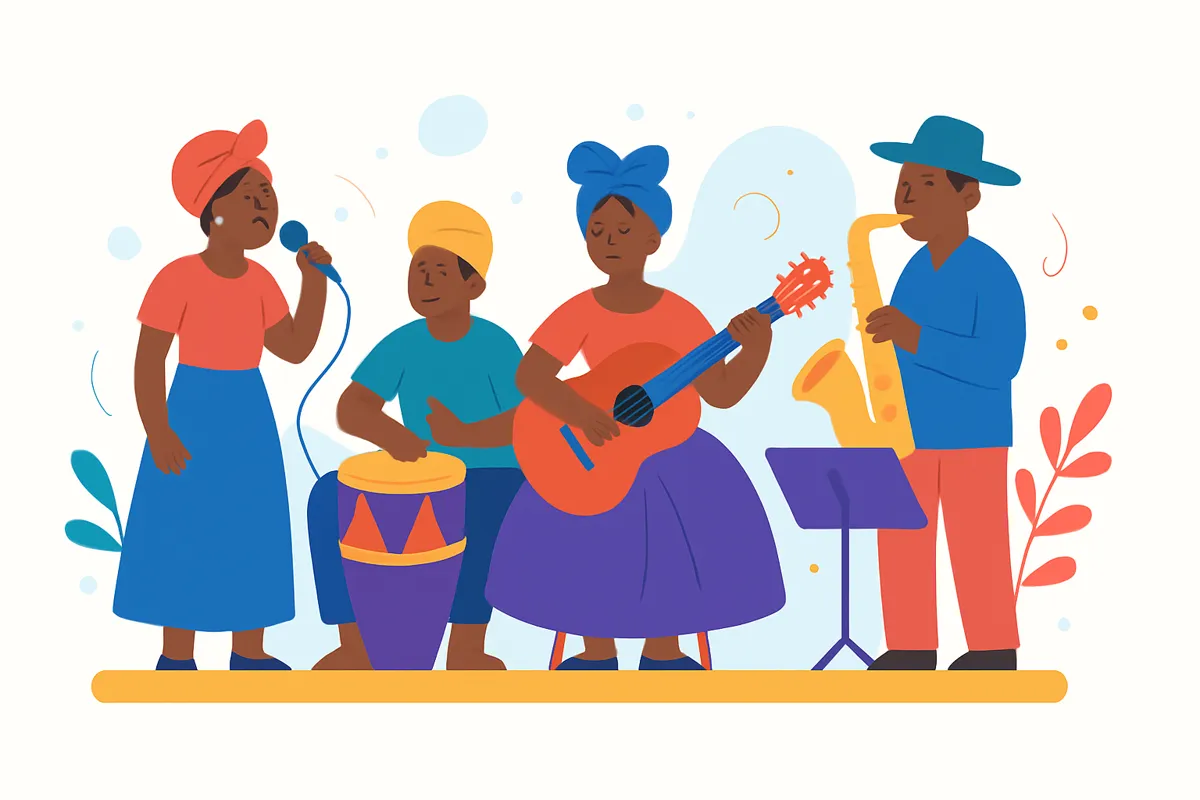
A music category in a national performing arts festival in Jamaica where a stage band, a group of saxophones, trumpets and trombones backed by a rhythm section, performs before a panel in four minutes, scored out of 100 and open to all seven classes from age 3 to adult.
Music – Stage Band is the fifth entry in the Music discipline of the Jamaican national performing arts festival list this template is rebuilt from, and the second ensemble class in a row after Concert Band. In ordinary usage a stage band, also called a jazz band or a big band, is a group built from three families of players: a saxophone section, a brass section of trumpets and trombones, and a rhythm section of drums, bass, piano and often guitar. It plays swing, blues, funk, Latin and popular arrangements, usually from written parts with room for short improvised solos, and it is the place a festival can show the music side of a school or community programme that is not marching or concert wind music.
The extract used to build the template gives the category, the classes and the limits only. It prints no minimum or maximum band size, no instrumentation list, no rule on arrangements or own-choice pieces, no statement on whether a conductor or a sound system is allowed, and no per-criterion marking table, so this page describes how stage band classes are commonly run and does not claim to know the festival requirements. An organiser using this template is wise to publish a short notice before entries open that sets the smallest and largest band, says whether amplification is supplied or banned, says whether the entry is a single arrangement or a short programme, and names who supplies a drum kit, amplifiers, a piano or keyboard, chairs and stands.
A round usually runs like this. The rhythm section sets up first, because a drum kit and an amplifier take longer to place than a row of chairs. The horns then take their seats, the band checks its pitch against one reference note, and the leader counts in. The panel listens for the groove before anything else: whether the drummer, bassist and pianist lock to the same pulse, and whether the horn section lands its short, accented notes together on the beat. After the groove it listens for balance between the horns and the rhythm section, for the shape of any solo, and for how cleanly the band stops. Four minutes is short for a big-band arrangement with solos, so the choice of piece and the cuts decide whether the band finishes in time.
On the template the item is offered in all seven classes, from Class 1 (ages 3-6) through the age bands up to adults aged 20 and over, with a combined class for any mix of ages. Every class has the same limits: four minutes with a warning bell at three, a score out of 100, both genders in one list and English as the language. The template records the entry as a team entry. The younger classes are unlikely to field a full saxophone-trumpet-trombone section, and it is reasonable for an organiser to say in the notice that a small group with a simple rhythm section, a lead melody and a couple of horns is welcome, and that the senior and combined classes are where a full-sized band is expected.
Organisers keep a stage band category because it is the festival slot for popular and jazz-style ensemble playing, which a concert band class and a wind instruments class do not cover, and because it asks for a skill soloists do not practise: playing a written part in time with others while a rhythm section drives underneath. Schools run stage bands to bring stronger players together, and a festival slot gives the group a deadline, an audience and a written comment from a panel that has heard other bands in the same afternoon.
Where Music – Stage Band comes from
The big band and its smaller cousins grew in the United States in the 1920s and 1930s, when dance bands organised players into saxophone, trumpet, trombone and rhythm sections that played written arrangements with space for improvised solos, and swing became the popular dance music of the late 1930s and 1940s. After the Second World War, high schools and colleges in North America adopted the same line-up for school jazz bands, which are often called stage bands because they play from a stage rather than marching on a field. The format spread through school and community music in the Caribbean, Britain and other countries that share the same band traditions.
Where Music – Stage Band is run
On eTalenter this item is used in one template, the Jamaican national performing arts festival template, where it is assigned to all seven classes (six age bands from 3-6 up to adults aged 20 and over, plus a combined class) inside the Music discipline, between the concert band class and the steel pan class. Stage band, jazz band and big band classes are a regular part of school and community music festivals in North America, Britain and Ireland, Australia and New Zealand, and the Caribbean, where they are usually entered by school year or ability grade rather than by age. This template keeps one list divided by age class, so an organiser with bands of very different sizes may choose to split the list by size or by amplified and acoustic lines as well.
- Jamaica (the national performing arts festival the template is built from)
Key facts
- A group performance by a stage band, normally saxophones, trumpets and trombones with a rhythm section, in front of a panel, recorded as a team entry on the template, with both genders in one list and the language set to English
- The template does not give band size, instrumentation, arrangement rules or amplification rules, so the organiser sets the smallest and largest band, the instruments allowed and what equipment is supplied
- Offered in all seven classes, from Class 1 (ages 3-6) to Class 6 (adults, 20 and over) and the combined class
- Four-minute limit with the warning bell at three minutes, enough for one tightly cut arrangement with a short solo or a medley of two short pieces
- Scored out of 100 on the template; the festival awards medals against published mark bands rather than first, second and third
- Fifth in the Music discipline, after Pianoforte, Wind Instruments, String Instruments and Concert Band and ahead of Steel Pan Music and Recorder
- The extract used for the template prints no per-criterion weights, so none are asserted here; a separate Music – Jazz category exists elsewhere in the same list and is not the same class
- Ideas, not rules, for an organiser: a minimum of six players with at least a drummer and one chordal player, a stage plan sent in advance showing where the kit and amplifiers will sit, a rule on whether the leader may also play, and a note on whether solos are expected or optional
On eTalenter, Music – Stage Band is filed under On Stage and typically scored with Marks. It appears in 1 ready-made event templates — each one can adjust its time limit, age-group assignment and scoring setup independently.
Across the templates that use it, Music – Stage Band is most often entered as an Team competition, typically scored out of 100, commonly time-limited to around 4 minutes where a limit is set.
What judges look at in Music – Stage Band
What a Music – Stage Band panel is actually weighing up, and where the marks are usually won or lost:
- The source does not print this category marking table, so what follows is organiser guidance for agreeing yardsticks with the panel, not rules from the source
- Groove and time feel: the drums, bass and piano or guitar lock to one steady pulse, the swing or straight feel matches the style of the arrangement, and the tempo does not rush through the louder passages
- Section playing: saxophones, trumpets and trombones play short notes, accents and endings together, with matching articulation, so the horns sound like one voice rather than a row of individuals
- Balance between horns and rhythm section: the melody can be heard over the kit, the bass is audible without booming, and a solo player can be heard at the front of the group
- Intonation and tone: sections tuned to a common reference before the first note and kept in tune after loud passages, with a clean sound from each instrument
- Improvisation and solos where the arrangement has them: a short, clear idea that fits the chords and the style, kept inside the time rather than a long solo that crowds out the rest of the piece
- Style and musicianship: dynamics, phrasing and ending that suit the piece, so a ballad is allowed to breathe and an up-tempo number has energy without losing control
- Presentation: quick and quiet set-up of the rhythm section, a clean count-in, a clean stop, and a finish inside four minutes; younger classes are judged on steadiness and togetherness more than on the difficulty of the piece
Treat these as the judging focus, not a fixed rubric: publish your own weighted criteria for Music – Stage Band under Scoring Setup, or start from the full instrumental music judging criteria guide.
How to prepare for Music – Stage Band
How entrants and their teachers usually get Music – Stage Band right on the day:
- Ask the organiser in writing for the minimum and maximum band size, the instruments allowed, whether amplification is permitted, and what drum kit, amplifiers, keyboard, chairs and stands are supplied, and keep the reply with your entry paperwork
- Choose an arrangement that the weakest section can play cleanly; a simple chart played together and in time beats an ambitious one where the parts fall apart, and for the youngest classes a two-chord groove with a clear melody is enough
- Time the piece with its repeats and solos against the four-minute limit and cut a chorus or a repeat in rehearsal rather than risk running past the warning bell
- Rehearse the rhythm section alone first, with a metronome or a click track, until the drums, bass and piano feel the same pulse, then add the horns by section and then full band
- Spend a whole rehearsal on the count-in and the ending only; the panel hears those two moments hardest and a ragged start or an unplanned ending cost marks even in a well-played piece
- Plan the stage change with a stopwatch: where the kit goes, who plugs in which amplifier, where the stands stand, and who carries what, so set-up and exit stay as short as possible
- Record a run-through on a phone at the back of the room and listen for balance; players inside a stage band cannot hear what the panel hears, and the recording usually shows that the drums or one section is too loud
- Pack a kit: spare reeds, valve oil and slide grease, spare sticks, spare leads and a power strip, a tuner, a stand light if the hall is dim, and a clip for each part
- If the result is below what you hoped, ask for the adjudicator comments and look first at groove, balance and the ending; most gains come from locking the rhythm section and tightening the horns, not from a harder arrangement
Ready-made event templates that include Music – Stage Band
Open any template to preview it in eTalenter and install it as a live, editable event.
| Template | Category | Score label | Competitions |
|---|---|---|---|
| JCDC National Performing Arts Festival (Jamaica) | On Stage | Marks | 7 |
Frequently asked questions
Is Music – Stage Band judged individually or as a team?
Across eTalenter’s templates it’s most often run as an Team entry, though an organiser can set either participation type when assigning the item to an age group.
What is a stage band?
In ordinary usage it is a school or community jazz band: saxophones, trumpets and trombones with a rhythm section of drums, bass, piano and often guitar, playing swing, blues, funk and popular arrangements. The extract used for this template does not give a definition, so check the organiser notice for the instruments allowed.
Is a stage band the same as a big band or a jazz band?
In school and festival usage the three names usually describe the same kind of ensemble. A big band is the full-sized professional line-up; stage band is the school and community name, and a jazz band is the general name. The template uses the name Stage Band, so follow the organiser notice on size.
How many players do I need?
The template sets no minimum or maximum band size. Ask the organiser. A stage band normally needs at least a rhythm section and a few horns to sound like one, and the largest size is limited by the stage and the number of chairs and amplifiers supplied.
How long can the performance be?
The template sets four minutes with a warning bell at three minutes, and whether set-up and the count-in are inside the slot is not stated, so ask. Choose an arrangement, with its repeats and solos, that finishes comfortably inside the limit.
Is Stage Band the same as the Concert Band class?
No. Concert Band is for a band of woodwind, brass and percussion playing under a conductor, usually concert and march music. Stage Band is built around a rhythm section and a jazz-style horn line, and the groove matters as much as the notes.
How is it marked?
The template scores out of 100, and the festival awards medals against mark bands rather than first, second and third. The extract used for the template prints no per-criterion weights for this category, so an organiser using it should agree and publish their own.
Want the full judging picture? Read the full instrumental music judging criteria guide, or browse every on stage competition item.
Try Music – Stage Band in eTalenter
See every ready-made template that runs Music – Stage Band, and install one as a live event — age groups, rules and scoring included.



Leave a Reply
You must be logged in to post a comment.