
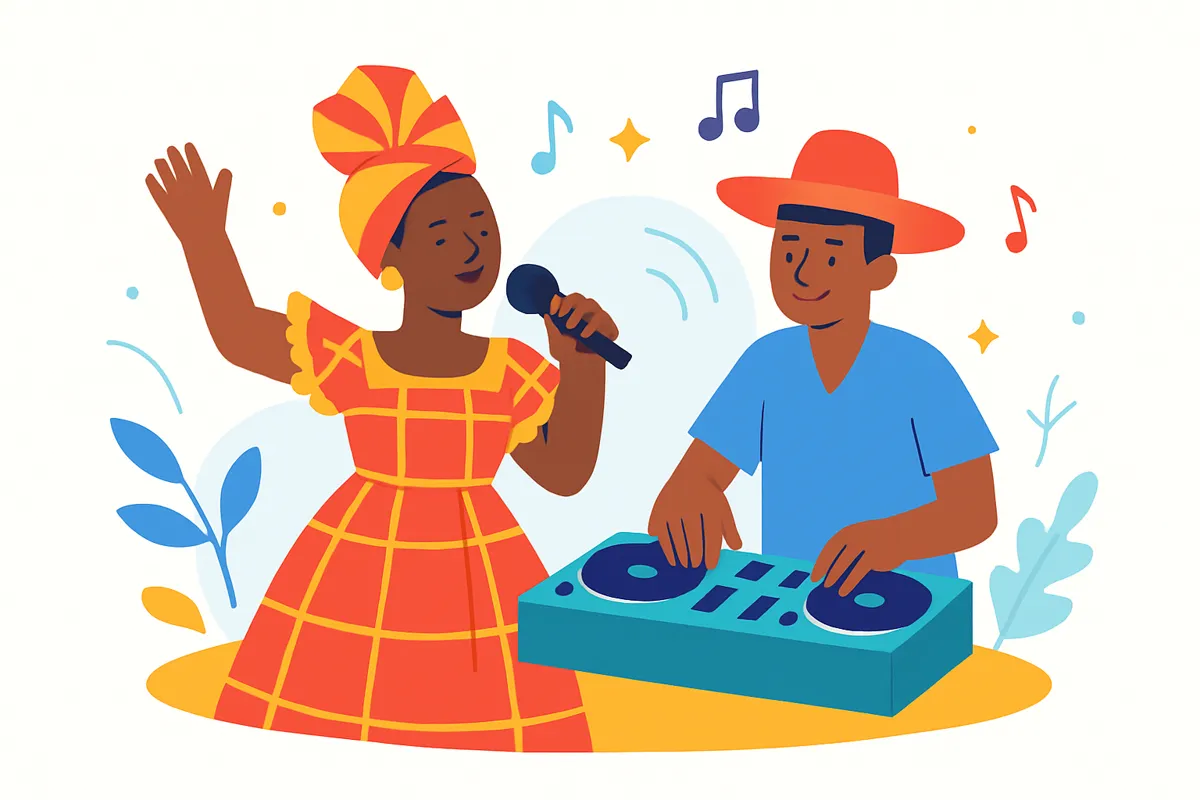
A team category in a national performing arts festival in Jamaica where a group performs a deejay (chanted, rhythmic) or sing-jay (sung and chanted) piece over a beat in four minutes, scored out of 100 and open to all seven classes from age 3 to adult.
Music – Dee-J / Sing-J is the fifteenth entry in the Music discipline of the Jamaican national performing arts festival list this template is rebuilt from. It follows the Vocal Jamaican Popular class and is the one class on the list named after a style of delivery instead of a kind of song. In Jamaican music a deejay is the vocalist who chants or talks rhythmically over a beat, and a sing-jay is a performer who moves between singing and that chanted style. Here the two are put into one class, so the entry is a rhythmic vocal piece first and a sung melody second.
The extract used to build the template gives the category, the classes and the limits only. It prints no definition of either term, no rule on whether the words must be original, no rule on backing tracks or live musicians, no content or language rule beyond English, no team size and no per-criterion marking table. This page therefore describes how a deejay or sing-jay class is commonly run and does not claim to know the festival requirements. An organiser using the template should publish a short notice before entries open saying what the class accepts, how large a team may be and what the panel will do about unsuitable lyrics.
The item is recorded as a team entry, which is a little unusual because deejaying is often a solo craft. In practice that can mean a lead voice supported by a small group answering lines, a pair trading verses, or several voices delivering one piece in turns. A typical round: the team is called, takes its places, the beat starts, and the lead delivers verses of up to four minutes in total, with any others coming in on the hook or the answer lines. The panel listens for how closely the words sit on the rhythm, how clear they are, how well the group stays together and whether the sung parts, if any, are in tune.
On the template the item is offered in all seven classes, from Class 1 (ages 3-6) through the age bands up to adults aged 20 and over, plus a combined class that the festival defines as any combination of the six age classes. Every class carries the same limits: four minutes with a warning bell at three, a score out of 100, both genders in one list and English as the language. For the youngest classes, organisers will usually want a clear note that the material must suit the age band.
Organisers like a class of this kind because it gives young people a legitimate stage for a style they already listen to every day, it rewards writing and breath control as much as volume, and it fills the gap between a straight song class and a speech class. The most useful planning step is a one-page notice fixing what counts as a deejay or sing-jay piece, the team size, the accompaniment rule and the content rule, so every entrant arrives with something the panel can judge on the same footing.
Where Music – Dee-J / Sing-J comes from
The deejay style grew out of Jamaican sound-system culture from the late 1950s and 1960s, where a performer talked and chanted over the instrumental side of a record to move a dance crowd; the sing-jay is a later blend of that chanted delivery with melodic singing. The style is widely credited as one root of rap in the Caribbean and North America. Nothing in the source for this template says how the class came to be part of the festival or what the organisers count as a deejay or sing-jay piece, so no festival history is claimed here.
Where Music – Dee-J / Sing-J is run
On eTalenter this item is used in one template, the Jamaican national performing arts festival template, where it is assigned to all seven classes (six age bands from 3-6 up to adults aged 20 and over, plus a combined class) inside the Music discipline, between the Vocal Jamaican Popular class and the Music – Jazz class. It sits apart from the festival’s speech classes, which have their own items such as Speech – Dub Poetry, and from its popular song class, which is judged as singing. Rhythmic spoken-word and rap-style classes appear in youth and school festivals in many countries, but those are separate items with their own rules and time limits.
- Jamaica (the national performing arts festival the template is built from)
Key facts
- A rhythmic vocal piece, chanted (deejay) or part sung and part chanted (sing-jay), delivered over a beat before a panel, recorded as a team entry with both genders in one list and the language set to English
- The template does not define either term, give a team size or state an accompaniment or content rule, so the organiser sets those
- Offered in all seven classes, from Class 1 (ages 3-6) to Class 6 (adults, 20 and over) and the combined class, which the festival defines as any combination of the six age classes
- Four-minute limit with the warning bell at three minutes, enough for two or three verses and a repeated hook
- Scored out of 100 on the template; the festival awards medals against published mark bands rather than first, second and third
- Fifteenth in the Music discipline, after Vocal Jamaican Popular and ahead of Music – Jazz; the speech item Speech – Dub Poetry is a separate item judged as spoken word
- Ideas, not rules, for an organiser: a notice defining both terms with a plain example of each, a team size range, a clear statement on backing tracks, a family-friendly content rule applied to every class and a request that the lyrics are written out on the entry form
On eTalenter, Music – Dee-J / Sing-J is filed under On Stage and typically scored with Marks. It appears in 1 ready-made event templates — each one can adjust its time limit, age-group assignment and scoring setup independently.
Across the templates that use it, Music – Dee-J / Sing-J is most often entered as an Team competition, typically scored out of 100, commonly time-limited to around 4 minutes where a limit is set.
What judges look at in Music – Dee-J / Sing-J
What a Music – Dee-J / Sing-J panel is actually weighing up, and where the marks are usually won or lost:
- The source does not print this category marking table, so what follows is organiser guidance for agreeing yardsticks with the panel, not rules from the source
- Rhythm and flow: words that land on the beat, a steady pulse from the first bar to the last and a delivery that rides the music instead of racing or dragging behind it
- Diction and clarity: every line understood by a listener who has never heard the piece, even at speed, with the hook easy to catch and consonants crisp
- Content and writing: lyrics with a clear idea, imagery and a shape of verse, hook and close, written for the class age and free of anything unsuitable for the audience
- Voice and control: breath that lasts a full verse, energy kept up to the last line and, for a sing-jay, sung phrases that stay in tune when the delivery switches back to chanting
- Teamwork: lead and supporting voices that know their cues, with answers and ad-libs landing together and no one talking over another
- Presence and stage discipline: a confident walk-on, eye contact, movement that fits the piece and a finish held together to the end of the beat
- Timing: a complete piece inside four minutes that does not need to be cut off at the bell
Treat these as the judging focus, not a fixed rubric: publish your own weighted criteria for Music – Dee-J / Sing-J under Scoring Setup, or start from the full singing competition judging criteria guide.
How to prepare for Music – Dee-J / Sing-J
How entrants and their teachers usually get Music – Dee-J / Sing-J right on the day:
- Ask the organiser in writing what counts as a deejay or sing-jay piece in this class, the allowed team size, whether a backing track or live musicians are allowed and what the content rule is; keep the reply with your entry paperwork
- Write the piece before choosing the beat: a clear idea, two or three verses and a short hook that the whole team can say together, then fit it to a beat that suits the pace of your delivery
- Give every team member a job: a lead for the verses, voices for the hook and short answer lines, and one person to count the team in; write the cues on the lyric sheet
- Practise the words slowly with the beat first, speed them up only when every syllable is still clear, then run the whole piece without the lyric sheet
- Record a rehearsal on a phone and listen for lines that rush, words that blur and voices that cover each other; fix those before adding any movement
- Train breath on purpose: say each verse in one breath group where you can and mark the places to breathe, so the end of the verse is as strong as the start
- If a sing-jay piece is planned, practise the switch between the sung line and the chanted line until it is smooth, and check the sung notes against a keyboard or tuner
- Keep movement small and shared: a step on the beat, a hand gesture on the hook, a clean freeze for the finish; busy movement that hides the words costs marks
- If a backing track is allowed, bring it on the device the organiser asks for, test the volume in the room and have a plan if it will not start
- Time the piece with its intro and agree where to cut if the warning bell sounds at three minutes
- After a lower result than hoped, ask for the adjudicator comments; work on clarity and teamwork first, since they usually move a score more than a longer set of lyrics does
Ready-made event templates that include Music – Dee-J / Sing-J
Open any template to preview it in eTalenter and install it as a live, editable event.
| Template | Category | Score label | Competitions |
|---|---|---|---|
| JCDC National Performing Arts Festival (Jamaica) | On Stage | Marks | 7 |
Frequently asked questions
Is Music – Dee-J / Sing-J judged individually or as a team?
Across eTalenter’s templates it’s most often run as an Team entry, though an organiser can set either participation type when assigning the item to an age group.
What is the difference between a deejay and a sing-jay?
In Jamaican music a deejay chants or talks rhythmically over a beat, and a sing-jay switches between singing and that chanted style. The extract used for this template does not define either term, so ask the organiser how the class treats a piece that is mostly sung or mostly chanted.
Is Music – Dee-J / Sing-J a solo or a team item?
On the template it is a team entry, so the whole group gets one score out of 100. The extract does not give a team size, so ask the organiser what range is allowed and whether a single performer may enter.
Can we use a backing track or live musicians?
The extract prints no accompaniment rule. Some organisers allow a recorded beat, some allow a small band or a single musician and some ask for unaccompanied voices, so ask before you plan and get the answer in writing.
Do the words have to be original?
The extract prints no rule. Many organisers prefer original lyrics for a class of this kind because writing is part of the skill, but some accept known pieces. Ask the organiser and ask what is expected for the youngest classes.
Is this the same as Speech – Dub Poetry?
No. Dub Poetry is a separate item in the Speech discipline, judged as spoken word with its own score. This item sits in the Music discipline and is judged on rhythmic or sung delivery over a beat, so a piece should be entered where its main skill belongs.
How long can the piece be?
Four minutes on the template, with the warning bell at three minutes. That is enough for two or three verses and a repeated hook, so a longer piece needs a cut agreed in advance.
Want the full judging picture? Read the full singing competition judging criteria guide, or browse every on stage competition item.
Try Music – Dee-J / Sing-J in eTalenter
See every ready-made template that runs Music – Dee-J / Sing-J, and install one as a live event — age groups, rules and scoring included.

Leave a Reply
You must be logged in to post a comment.