
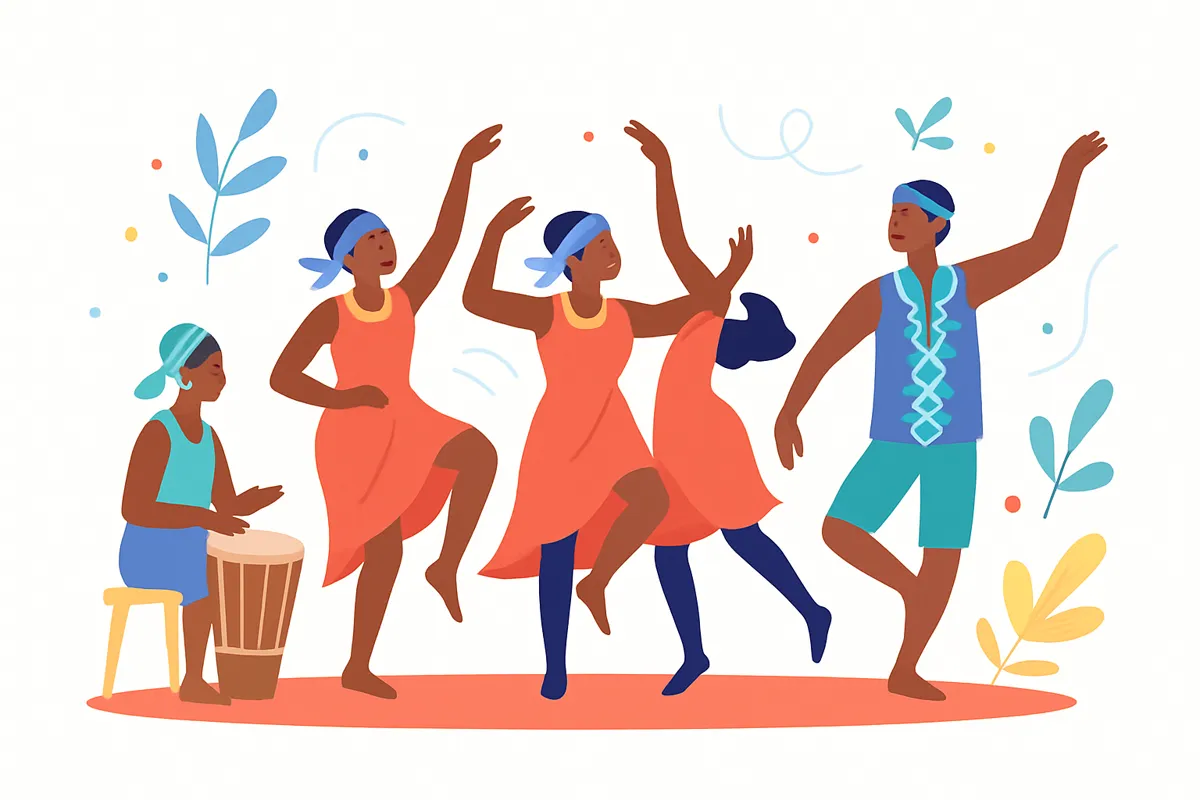
A staged team dance in contemporary, urban or fusion styles, composed by the group around an idea or message, and entered as one team across five age groups.
Modern Creative Dance is a staged group dance in a present-day style. Where a traditional class asks a team to work from a heritage dance, this one lets the group choose its own movement language, whether contemporary, hip-hop, jazz, street, or a blend, and shape it into an original piece. The word creative is the key: the panel expects choreography the team has composed, built around an idea, a story or a message, not a copy of a routine from a video.
On the eTalenter Kenya national drama and film festival template the item sits on the On Stage programme, fourth in the order, straight after Cultural Creative Dance. It is a Team item open to boys and girls together, offered in five age groups: Pre-Primary (3 to 5), Primary (6 to 12), Junior School (13 to 15), Secondary (14 to 18, with overlap allowed) and Tertiary (19 and over). Each of the five classes is scored out of 100.
A round follows the usual staged-item pattern. The team is called, takes its opening position, performs to recorded or live music, and leaves the stage. Strong entries open with a clear image, develop the idea through changes of tempo, level and formation, and finish on a defined moment, so the audience can tell what the piece was about without being told.
The template sets no time limit and does not divide the 100 marks into headings, because the source material for this strand publishes no dance scheme comparable to the one for a Play. Organisers should therefore enter the running time and the judging headings from their own notice, and say in advance what is allowed for music, props and lighting.
Organisers run the class to give young people a contemporary outlet beside the traditional one, to reward original choreography and teamwork, and to give learners a performing item that needs no spoken lines.
Where Modern Creative Dance is run
On the eTalenter templates this item appears on one: the Kenya national drama and film festival template, in its On Stage section. Contemporary group dance classes run at many school, college and community festivals under various names, but this page describes the item as that template sets it up, so entrants elsewhere should check their own notice for time limits, team size, music rules and judging headings.
- Kenya
Key facts
- Team item: the whole group is judged together, boys and girls in the same entry
- Open to present-day styles such as contemporary, hip-hop, jazz or a fusion of them, chosen by the team
- Five age groups on the template, from Pre-Primary (3 to 5) to Tertiary (19 and over)
- Each of the five classes has a maximum score of 100, with no time limit or heading split set on the template
- Listed fourth on the On Stage programme, after Cultural Creative Dance, which is a separate item
- Choreography is expected to be the team’s own work built around an idea, not a copied routine
On eTalenter, Modern Creative Dance is filed under On Stage and typically scored with Marks. It appears in 1 ready-made event templates — each one can adjust its time limit, age-group assignment and scoring setup independently.
Across the templates that use it, Modern Creative Dance is most often entered as an Team competition, typically scored out of 100.
What judges look at in Modern Creative Dance
What a Modern Creative Dance panel is actually weighing up, and where the marks are usually won or lost:
- Originality of choreography: movement, patterns and transitions the team has composed, rather than a routine lifted from a video or another group
- Concept and clarity: a visible idea or message that runs through the piece, with an opening, a development and a clear ending
- Technique and control: clean execution of the chosen style, with steps, balance and body control that suit the age group
- Unison and spacing: dancers who stay together where the piece needs it, and formations and levels that hold shape and use the whole stage
- Music and timing: movement that follows the beat and phrasing, and a music choice that fits the idea and is suitable for the age group
- Presentation and energy: costume, expression and stage presence that carry the piece from the first count to the last, without distracting from the dance
Treat these as the judging focus, not a fixed rubric: publish your own weighted criteria for Modern Creative Dance under Scoring Setup, or start from the full group dance judging criteria guide.
How to prepare for Modern Creative Dance
How entrants and their teachers usually get Modern Creative Dance right on the day:
- Start with the idea, not the steps: agree in one sentence what the piece is about, then choose movement that says it
- Pick one main style and one contrasting section rather than mixing many, so the piece feels designed instead of crowded
- Cut the music to the time the organiser allows before choreographing, so the dance is built to fit and never has to be rushed at the end
- Let team members contribute short phrases of movement, then the teacher or lead dancer joins them, which builds ownership and keeps the work original
- Draw the stage formations on paper and mark them on the floor, and rehearse the transitions between them as much as the dances themselves
- Rehearse the entrance, the opening pose and the exit, since a slow set-up costs time and a ragged ending loses the piece’s impact
- Choose costume and any prop that can be moved in freely, and test them in a full run so nothing slips or gets in the way
- For younger groups, use fewer, cleaner moves done in unison; for older groups, add levels, counterpoint and changes of pace
Ready-made event templates that include Modern Creative Dance
Open any template to preview it in eTalenter and install it as a live, editable event.
| Template | Category | Score label | Competitions |
|---|---|---|---|
| Kenya National Drama and Film Festival | On Stage | Marks | 5 |
Frequently asked questions
Is Modern Creative Dance judged individually or as a team?
Across eTalenter’s templates it’s most often run as an Team entry, though an organiser can set either participation type when assigning the item to an age group.
Is Modern Creative Dance judged as a team or individually?
As a team. It is a Team item on the template, so the whole group receives one score.
Is it the same as Cultural Creative Dance?
No. They are separate items on the same template. Cultural Creative Dance draws on a tradition, while Modern Creative Dance lets the team choose a present-day style and compose its own piece.
How long can the dance be?
The template sets no time limit, so the organiser should publish a running time in their own notice.
How are the marks split?
Each age-group class is out of 100. The template does not divide the marks into headings, so the organiser should list the headings in their notice.
Can we use a recorded track or props?
That is for the organiser to decide. The template does not fix it, so check your festival’s notice before you rehearse with a track or props.
Want the full judging picture? Read the full group dance judging criteria guide, or browse every on stage competition item.
Try Modern Creative Dance in eTalenter
See every ready-made template that runs Modern Creative Dance, and install one as a live event — age groups, rules and scoring included.

Leave a Reply
You must be logged in to post a comment.