
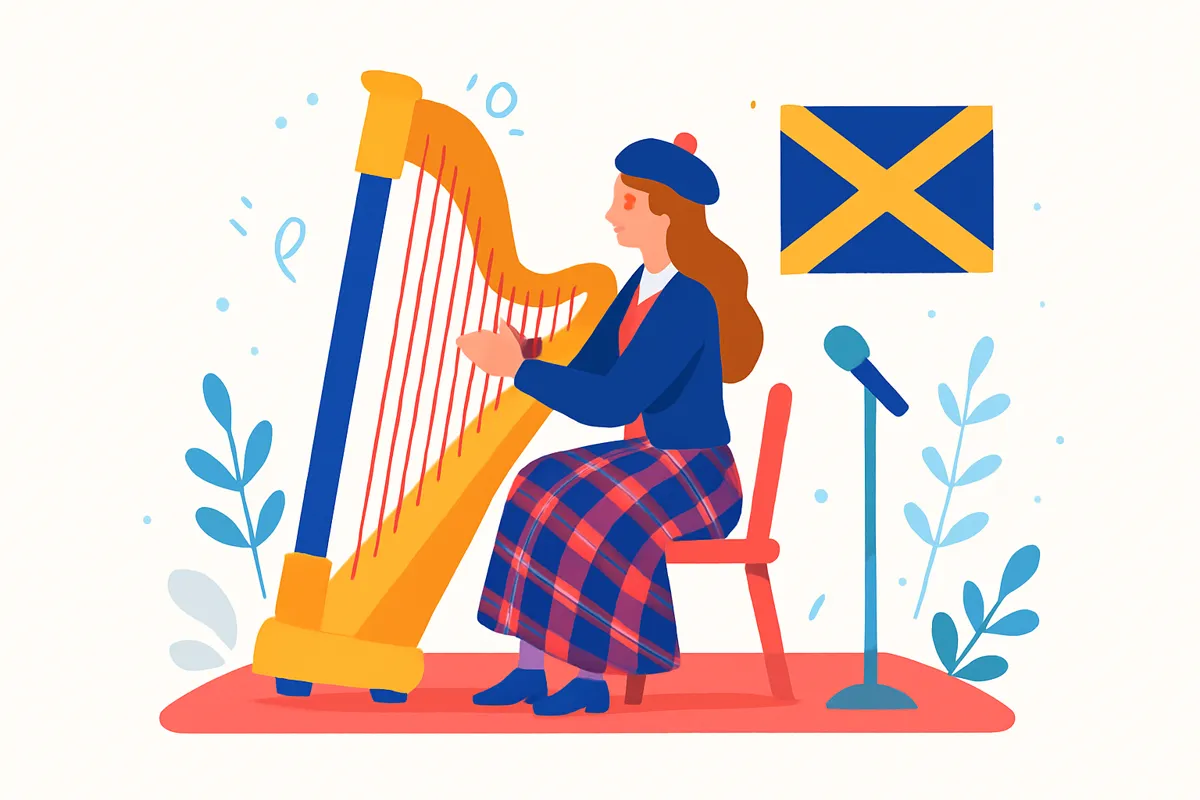
A solo item for the clarsach, the Scottish Gaelic harp, entered individually and judged on tone, finger technique, rhythm, tuning and the musical shaping of the tune.
The clarsach is the traditional harp of Scotland and the Gaelic-speaking world. It is a small-to-medium harp with a triangular frame and a row of strings, plucked with the fingertips of both hands. The right hand usually carries the tune in the upper strings while the left supplies bass notes and broken chords below, so a single player produces melody and accompaniment together. The sound is soft, ringing and long-lasting, which means every note is heard in full and a rushed or uneven passage has nowhere to hide.
In the Scottish Gaelic festival template Clarsach is the eighteenth item of the On Stage programme and the last of the instrumental run, after Piping, Bagpipes, Chanter, Fiddle, Accordion and Melodeon. It is offered across ten bands: P1-P3, P4-P5 and P6-P7 for primary classes, 11-12 (Secondary), 13-15 Years and 16-18 Years, then Senior Ladies, Senior Men, Senior Mixed and Senior Open. Senior Ladies is a female class and Senior Men a male class; every other band admits both. Each entry is Individual, no spoken language applies because the class is played, and the template records a rating out of 10 with a 100-mark maximum and a ten-minute ceiling.
A round is quiet and unhurried. The player is called, sits at the harp, checks the position of the instrument against the shoulder and settles before the first note. The adjudicator then listens for an even, ringing tone from each finger, clean changes between hands, accurate tuning and a pulse that stays steady through the slow passages as well as the lively ones. Because the harp sustains, damping a string at the right moment is as much a part of the performance as plucking it. The template’s Evidence records that no marking scheme is published for the programme, so the 100-mark maximum is the app default and not a printed split by criterion.
Organisers keep a clarsach class because it preserves an instrument that is central to Gaelic music yet far less common in entry lists than the fiddle or accordion. A young player can enter the lowest band with a single simple air, while advanced players use the senior bands to show command of tone, phrasing and arrangement. Running it as its own item also keeps harp players together, so they are compared with each other and not with louder instruments.
Where Clarsach comes from
The clarsach is one of the oldest instruments of Scotland and Ireland, and harps of this type were played in Gaelic households and courts for many centuries before the pipes became the national instrument. Its use declined and then revived in the twentieth century, and it is now taught widely in schools and music classes.
Where Clarsach is run
On the eTalenter templates Clarsach appears in one template only, the Scottish Gaelic festival template, where it is one of the instrumental classes beside Piping, Bagpipes, Chanter, Fiddle, Accordion and Melodeon. The Irish traditional music template carries a separate item called Harp, and a Western Australian music template carries Harp Solo; those are distinct catalogue items with their own entries and are not covered here. Harp classes are a regular part of traditional music festivals in Scotland, Ireland and Wales; this page describes only the item as the Scottish Gaelic template carries it.
- Scotland, United Kingdom
Key facts
- A solo item, so every entry is recorded as Individual
- Ten bands: P1-P3, P4-P5, P6-P7, 11-12 (Secondary), 13-15 Years and 16-18 Years, then Senior Ladies (female), Senior Men (male), Senior Mixed and Senior Open
- The junior bands and the Senior Mixed and Senior Open bands admit both genders
- No spoken language is set, because the class is instrumental
- Rating out of 10 with a 100-mark maximum and a ten-minute ceiling; these are app defaults, as the source publishes no marking scheme and the template ships no Grade bands
- Listed as its own item, separate from the Harp item in the Irish template, in the same On Stage programme as the other Gaelic instruments
On eTalenter, Clarsach is filed under On Stage and typically scored with Rating out of 10. It appears in 1 ready-made event templates — each one can adjust its time limit, age-group assignment and scoring setup independently.
Across the templates that use it, Clarsach is most often entered as an Individual competition, typically scored out of 100, commonly time-limited to around 10 minutes where a limit is set.
What judges look at in Clarsach
What a Clarsach panel is actually weighing up, and where the marks are usually won or lost:
- Tone: a full, even, ringing sound from every finger, plucked from the pad of the finger with no buzzing or dull, muffled notes
- Hand coordination: a clear tune in the upper hand with a bass part that supports it, and clean hand changes without gaps or bumps
- Tuning and string care: strings in tune at the start and fingers placed squarely, since an out-of-tune harp cannot be corrected mid-tune
- Rhythm and pulse: a steady beat with slower airs allowed to breathe and lively tunes kept crisp, without rushing the easy bars
- Damping and phrasing: strings stopped at the right moment so chords do not blur, and the tune shaped in phrases that follow the melody
- Presentation: a settled seat and posture, a calm start, a clean finish inside the time and a tune choice that suits the player’s age band
Treat these as the judging focus, not a fixed rubric: publish your own weighted criteria for Clarsach under Scoring Setup, or start from the full instrumental music judging criteria guide.
How to prepare for Clarsach
How entrants and their teachers usually get Clarsach right on the day:
- Choose a tune you can play securely from memory at the proper speed; a well-shaped simple air scores better than a showpiece that falters in the second part
- Practise hands separately first, then together very slowly, raising the speed only when the slow version is clean and even
- Work on short daily finger exercises and simple scales, because even tone comes from steady finger placement built over weeks, not from the last rehearsal
- Learn to damp strings cleanly by touching them at the end of each phrase, and listen to a recording to check that chords do not smear into one another
- Tune the harp before every practice and again just before the round, and bring a spare tuning key and strings in case of a snapped string
- Rehearse the whole entrance, seating, first note and exit, so the start feels calm and your hands do not shake from nerves
- After each event read the adjudication sheet, choose one target such as steadier timing or fuller tone, and work on only that before the next one
Ready-made event templates that include Clarsach
Open any template to preview it in eTalenter and install it as a live, editable event.
| Template | Category | Score label | Competitions |
|---|---|---|---|
| Royal National Mod (Scotland) | On Stage | Rating out of 10 | 10 |
Frequently asked questions
Is Clarsach judged individually or as a team?
Across eTalenter’s templates it’s most often run as an Individual entry, though an organiser can set either participation type when assigning the item to an age group.
Is a clarsach the same as a harp?
The clarsach is the Scottish Gaelic harp, so the two are closely related. On eTalenter the Scottish Gaelic template lists Clarsach as its own item, while the Irish traditional music template lists a separate Harp item with its own entries. Check the festival notice for which instrument and tune style it expects.
Is Clarsach a team event?
No. The template records every entry as Individual. Duets and harp groups are separate items and are not covered by this page.
Are boys and girls judged together?
In the junior bands, yes. At senior level there are four classes: Senior Ladies, a female class, Senior Men, a male class, and the Senior Mixed and Senior Open bands, which admit both genders.
Can I use a lever harp or does it have to be a traditional clarsach?
The template does not set an instrument specification, so the festival notice decides. Check it before you enter, and ask the organiser if it is silent on the type of harp allowed.
How long can I play for?
The template carries a ten-minute ceiling for the item. The festival notice may set shorter limits for individual bands, so check it before you choose how many tunes to prepare.
Want the full judging picture? Read the full instrumental music judging criteria guide, or browse every on stage competition item.
Try Clarsach in eTalenter
See every ready-made template that runs Clarsach, and install one as a live event — age groups, rules and scoring included.

Leave a Reply
You must be logged in to post a comment.