
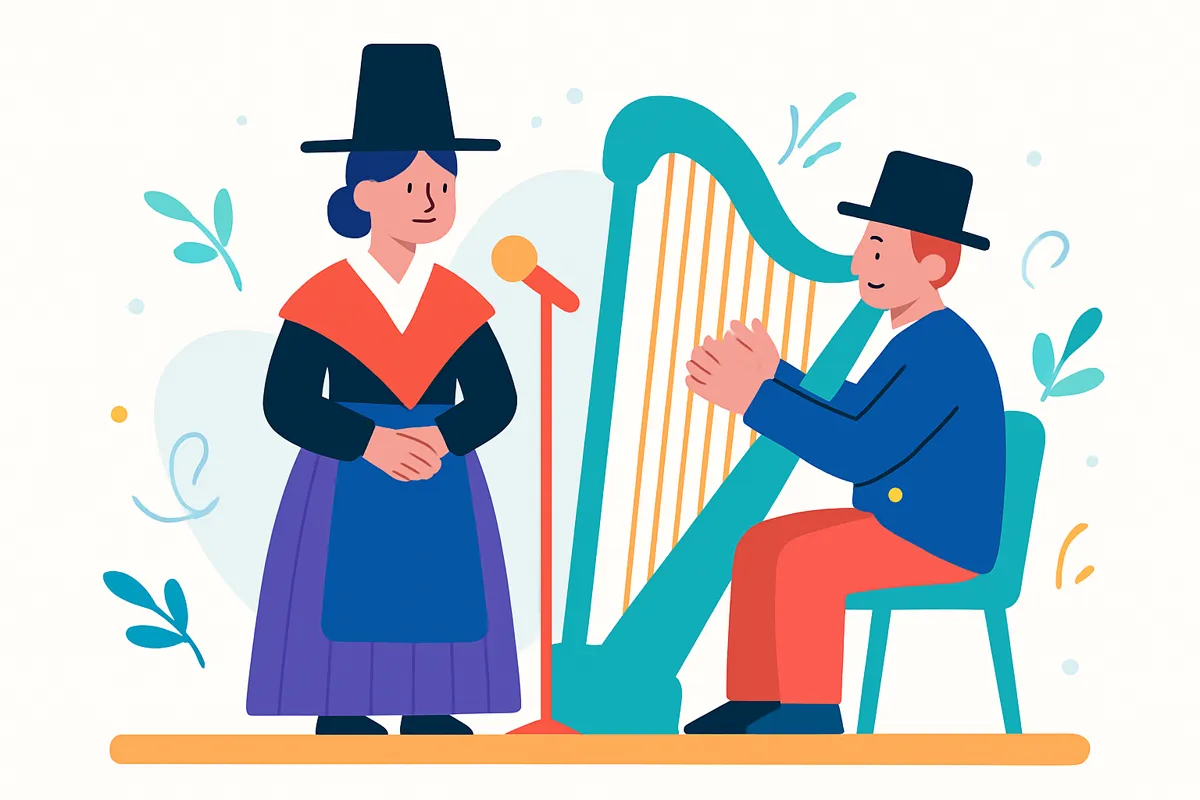
A solo Welsh-language item in which a singer delivers a poem to a harp, singing a melody of their own that runs against the tune the harpist plays.
Cerdd Dant, literally ‘string music’, is the Welsh art of singing a poem to a harp accompaniment. What makes it unusual is that the singer does not follow the harp. The harpist plays a traditional melody, and the singer performs a different melody of their own, fitted to the words of the poem, so the two lines move against each other and meet at set points. For a listener it sounds closer to a duet between voice and harp than to a song with backing.
On the eTalenter Welsh festival template it is an Individual item for both genders, offered in all seven school-year bands: Year 2 and under, Years 3-4, 5-6, 7-9, 10-11, 12-13 and a 14-25 band. Competitors are grouped by school year, not by an age range, and the language is fixed to Welsh because the item is built on Welsh verse. It is listed on the On Stage side of the festival, beside solo singing and recitation, and it is a separate item from both: it needs a poem, a singer, and a harpist who is part of the performance.
A round runs like any solo stage item. Each competitor is called in turn, takes a place beside the harpist and performs the set piece within the time allowed. The panel marks as the performance happens. The festival’s published rules print no numeric scheme for this item, so the template’s 10-minute field and /100 maximum are the app’s defaults; an organiser should replace them with whatever their own notice states. Prizes in the source are first, second and third in each competition.
Organisers keep the item because it carries a tradition that few other competitions do. It asks a young singer to understand a poem line by line, to keep a steady independent line against an instrument, and to work closely with an accompanist, which are skills that spill over into every other singing and speaking item on the programme.
Where Cerdd Dant is run
On the eTalenter templates Cerdd Dant appears on one template, a Welsh-language youth arts festival in Wales, where it sits in the On Stage section with the other solo stage items. The item belongs to Welsh culture and is found in Welsh-language festivals and eisteddfodau; it is not a general singing category, so entrants and organisers outside that tradition should look at the general Solo Singing page instead.
- Wales
Key facts
- Individual item: one singer performs with a harpist, boys and girls together
- Offered in all seven bands: Year 2 and under, Years 3-4, 5-6, 7-9, 10-11, 12-13 and 14-25
- Language fixed to Welsh on the template
- The singer’s melody differs from the tune the harp plays, so independence of line is the central skill
- The 10-minute time field and /100 maximum are the app’s defaults, because the published rules print no numeric scheme for this item
- The template scores it as a Rating out of 10; the source names first, second and third prizes and publishes no grade bands
On eTalenter, Cerdd Dant is filed under On Stage and typically scored with Rating out of 10. It appears in 1 ready-made event templates — each one can adjust its time limit, age-group assignment and scoring setup independently.
Across the templates that use it, Cerdd Dant is most often entered as an Individual competition, typically scored out of 100, commonly time-limited to around 10 minutes where a limit is set.
What judges look at in Cerdd Dant
What a Cerdd Dant panel is actually weighing up, and where the marks are usually won or lost:
- Independence: holding your own melody steadily while the harp plays a different one, and landing together at the points where the two lines meet
- Words and meaning: clear Welsh diction and phrasing that follows the poem’s sense, so the verse is understood and not lost in the tune
- Tuning and tone: secure pitch against the harp, with a steady, supported voice from first note to last
- Rhythm and accuracy of the setting: entering at the right moment, keeping the metre of the verse and not rushing or dragging when the harp moves on
- Partnership: eye contact, shared breathing and a clear start and finish with the harpist, so singer and instrument sound like one performance
- Presentation and time: a calm entrance, a steady stance and keeping within the time allowed
Treat these as the judging focus, not a fixed rubric: publish your own weighted criteria for Cerdd Dant under Scoring Setup, or start from the full singing competition judging criteria guide.
How to prepare for Cerdd Dant
How entrants and their teachers usually get Cerdd Dant right on the day:
- Learn the poem first, as speech: know what every line means and where its natural stresses fall before any melody is added
- Practise your own line without the harp until it is secure, then add the accompaniment slowly and only speed up when the line holds
- Record a rehearsal with the harpist and listen back for the places where the two lines drift apart or you follow the harp by mistake
- Agree the count-in, the tempo and the ending with your accompanist in advance, and rehearse together more than once, not only on the day
- Mark your breaths in the words so phrases end where the sense allows, and check they do not fall where the harp changes bar
- Sing it standing and in a larger room before the festival, so the volume and posture you use on the day are ones you have tried
- Time the whole piece against the limit and leave a little spare for nerves, then practise the entrance and the held final note
Ready-made event templates that include Cerdd Dant
Open any template to preview it in eTalenter and install it as a live, editable event.
| Template | Category | Score label | Competitions |
|---|---|---|---|
| Urdd Eisteddfod (Wales) | On Stage | Rating out of 10 | 7 |
Frequently asked questions
Is Cerdd Dant judged individually or as a team?
Across eTalenter’s templates it’s most often run as an Individual entry, though an organiser can set either participation type when assigning the item to an age group.
What does Cerdd Dant mean?
It is Welsh for ‘string music’, and it names the tradition of singing a poem to a harp, with the singer’s melody running against the tune the harpist plays.
Is Cerdd Dant the same as solo singing with a harp?
No. In ordinary accompanied singing the instrument supports the singer’s tune. In Cerdd Dant the harp plays one melody and the singer performs a different one, so the singer has to keep an independent line.
What age groups can enter?
The template has seven bands grouped by school year: Year 2 and under, Years 3-4, 5-6, 7-9, 10-11, 12-13, and a 14-25 band. The band follows the competitor’s school year on the festival’s cut-off date.
Do I need my own harpist?
Check your festival notice. The item needs a harp accompanist, and who supplies one is a matter for the organiser’s rules, which are not printed on the template.
How long can the performance be?
The template carries a 10-minute field, but that is the app’s default because the published rules print no figure for this item. Follow the time in your own festival notice.
Want the full judging picture? Read the full singing competition judging criteria guide, or browse every on stage competition item.
Try Cerdd Dant in eTalenter
See every ready-made template that runs Cerdd Dant, and install one as a live event — age groups, rules and scoring included.


Leave a Reply
You must be logged in to post a comment.