
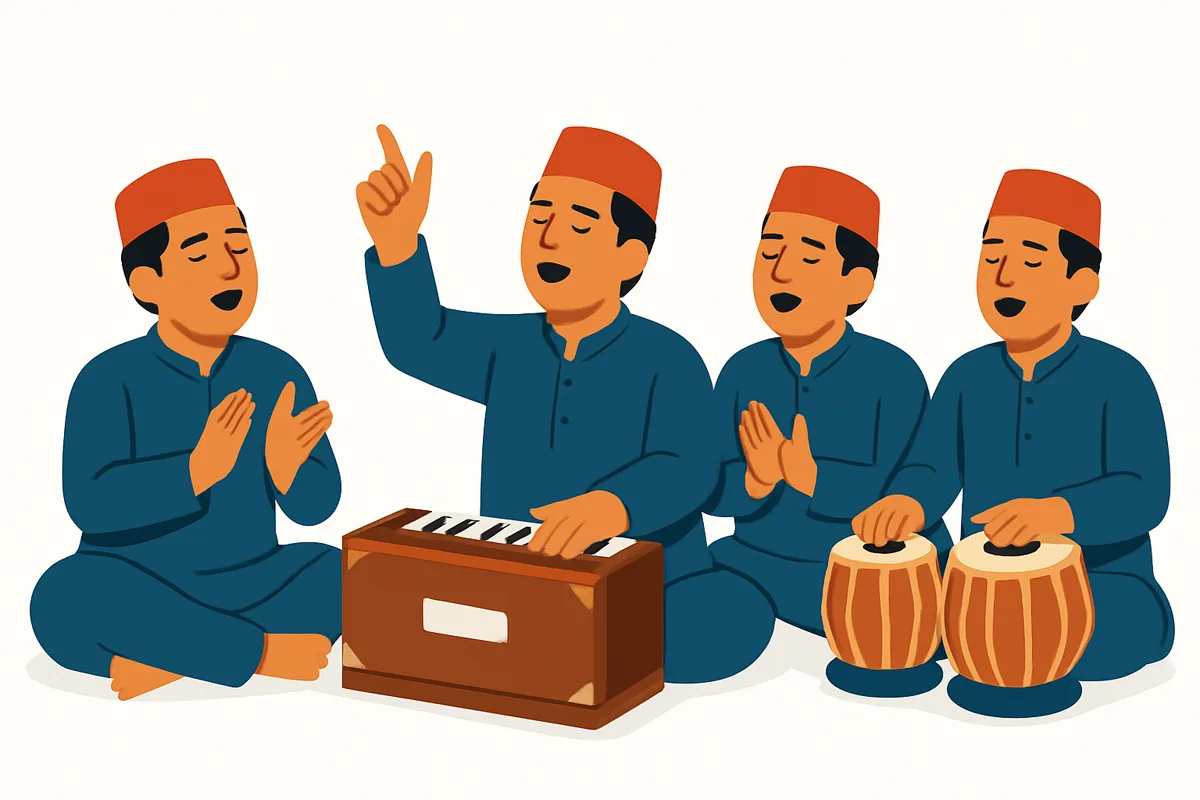
A team singing item built on the call-and-response devotional style of qawwali, with a lead voice, a chorus that answers and claps in time, and a harmonium and percussion beneath, scored out of 100 as Marks.
Qawwali is a group singing form in which a lead singer carries the verse while a chorus repeats the refrain, answers each line and keeps the rhythm with hand-claps. A harmonium and a dholak or tabla sit underneath. The form is built to build gradually: a slow opening, a steady rise in tempo and a climax the whole party sings together.
On the university youth festival template that carries it, Qawwali sits in the Music category as a Team competition. It is open to male and female students together in a single 17-25 Students age band, language is left open, and each team is given fifteen minutes. That is a longer limit than most other music items on the same template, which reflects how a qawwali needs time to build.
A round runs like this: the party takes the stage, tunes in, and performs one qawwali, often an opening verse in a slow introductory passage followed by the main composition. The panel marks the team as a whole. A strong entry has a lead voice that holds the audience, a chorus that is tight on the refrain, claps that stay together as the tempo rises, and a finish that lands inside the time limit.
Organisers keep Qawwali as its own item because it rewards something different from a plain group song: stage energy, interplay between lead and chorus, and a performance that grows. Keeping it separate from the Indian group song item also stops a devotional-style party being marked against an arranged choral piece.
Where Qawwali comes from
Qawwali is a long-established devotional music tradition of South Asia, sung in Urdu, Hindi, Punjabi and Persian, performed by a party that includes a lead singer, a chorus and accompanying instruments.
Where Qawwali is run
On eTalenter’s current templates this exact title appears once, on an inter-collegiate university youth festival template built from the published rules of one Mumbai university festival, where it is a Music item beside classical, light vocal, folk orchestra and western items. Qawwali also appears as a competition item at other South Asian campus and community cultural festivals, though time limits and scoring differ. Within eTalenter it is a separate catalogue entry from the Indian group song item, and the two should not be mixed up when you set an event up.
- Maharashtra, India
- Mumbai, India
Key facts
- Team item: one entry is one party, not one singer.
- Open to male and female students together, one 17-25 Students age band.
- Fifteen-minute limit per team; no separate warning bell is set.
- Scored out of 100 as Marks.
- Lead voice, answering chorus, hand-claps, harmonium and percussion are the usual ingredients.
- Language is left open on the template.
On eTalenter, Qawwali is filed under Music and typically scored with Marks. It appears in 1 ready-made event templates — each one can adjust its time limit, age-group assignment and scoring setup independently.
Across the templates that use it, Qawwali is most often entered as an Team competition, typically scored out of 100, commonly time-limited to around 15 minutes where a limit is set.
What judges look at in Qawwali
What a Qawwali panel is actually weighing up, and where the marks are usually won or lost:
- Lead voice: strength, tuning and the ability to hold the room through a long composition.
- Chorus response: refrains and answers that are clean, together and in tune with the lead.
- Rhythm and clapping: claps and percussion that stay in step as the tempo rises, with no drifting.
- Build and energy: a performance that grows from a slow opening to a climax rather than staying flat.
- Diction and feeling: words that can be understood and a devotional or emotional mood that is believable.
- Stagecraft and time: how the party sits, signals and finishes within fifteen minutes.
Treat these as the judging focus, not a fixed rubric: publish your own weighted criteria for Qawwali under Scoring Setup, or start from the full song judging criteria guide.
How to prepare for Qawwali
How entrants and their teachers usually get Qawwali right on the day:
- Choose a composition with a clear refrain the whole party can sing confidently; a strong, simple chorus beats a complicated one that drifts.
- Decide who is lead voice and who answers, and rehearse the hand-offs until the answers come in on time.
- Practise the tempo rise slowly; teams that speed up too fast lose their clapping first.
- Rehearse the clapping on its own, in unison, before adding the singing.
- Time a full run against fifteen minutes and agree where the introduction can be shortened if needed.
- Ask the organiser early whether your own harmonium and percussion players are allowed.
Ready-made event templates that include Qawwali
Open any template to preview it in eTalenter and install it as a live, editable event.
| Template | Category | Score label | Competitions |
|---|---|---|---|
| University of Mumbai Youth Festival | Music | Marks | 1 |
Frequently asked questions
Is Qawwali judged individually or as a team?
Across eTalenter’s templates it’s most often run as an Team entry, though an organiser can set either participation type when assigning the item to an age group.
Is Qawwali the same as a group song?
No. A group song is judged on blend and coordination across the group. Qawwali is a specific call-and-response style with a lead, an answering chorus and rhythmic clapping, and it has its own item and its own fifteen-minute limit on this template.
How long can a Qawwali entry run?
On this template each team has fifteen minutes with no separate warning bell. Entries are scored out of 100 as Marks.
Does a qawwali team have to include instruments?
The template does not fix the accompaniment. Qawwali is traditionally sung with a harmonium and percussion, so confirm with the organiser what your event allows.
Can boys and girls sing in the same team?
Yes. The template runs the item for male and female students together in one team.
Want the full judging picture? Read the full song judging criteria guide, or browse every music competition item.
Try Qawwali in eTalenter
See every ready-made template that runs Qawwali, and install one as a live event — age groups, rules and scoring included.



Leave a Reply
You must be logged in to post a comment.