
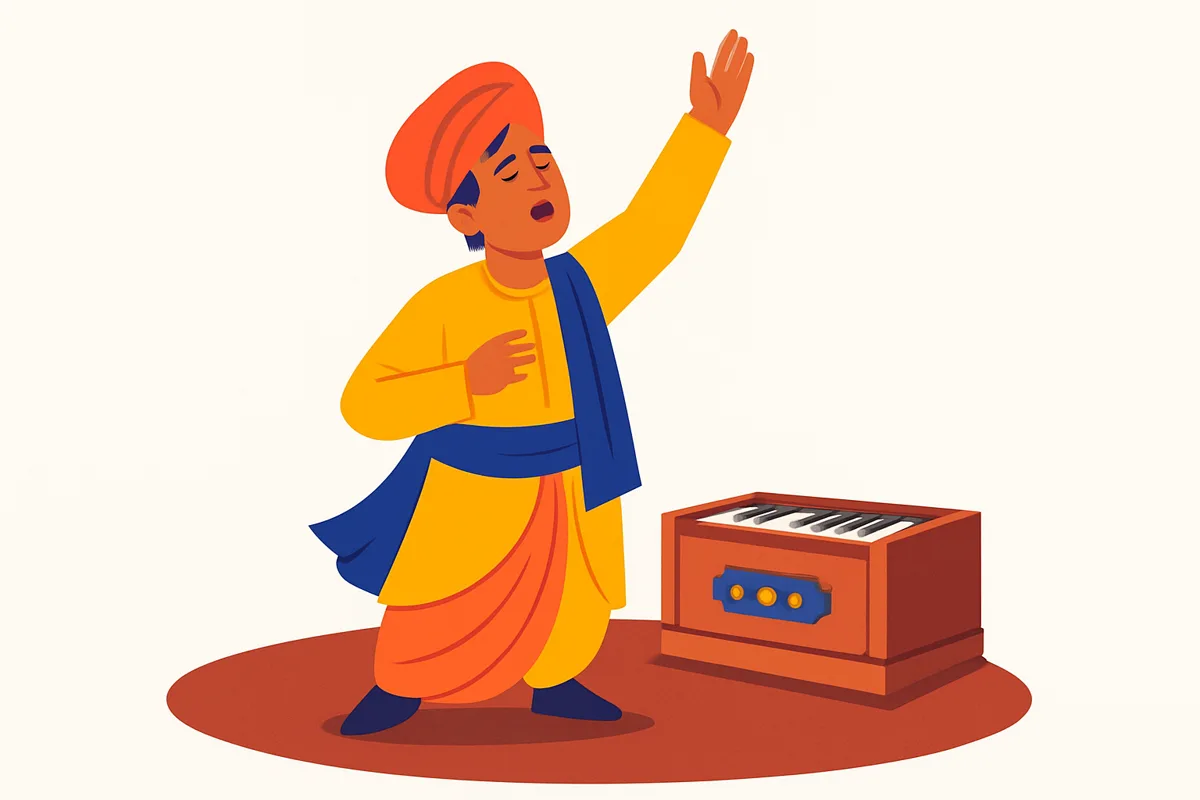
A solo singing item in which one student performs a song from Marathi musical theatre (natyasangeet), scored out of 100 as Marks.
Natyasangeet Vocal Solo asks one singer to present a song drawn from natyasangeet, the sung repertoire of Marathi musical theatre. These are theatre songs written to carry a character’s emotion inside a play, but they are built on classical raga material and are sung as concert pieces in their own right. The singer therefore has to be a vocalist first and an actor second: the voice must show the raga, hold the rhythmic cycle and still convey the feeling the lines were written for.
A typical entry opens with a short unmetered alap-style phrase or a spoken-sung opening line that sets the mood, then moves into the composed verse with its repeated refrain, and often includes a few improvised turns (tans or sargam-like runs) that stay within the raga. Accompaniment is normally a harmonium and a tabla, and entrants should confirm with the organiser what the festival supplies and whether they may bring their own accompanists.
On the university youth festival template that carries it, the item sits in the Music category as an Individual competition open to male and female students together, in a single 17-25 Students age band. It has a seven-minute limit counted per performer, no separate warning bell, and is scored out of 100 as Marks. Language is left open on the template because natyasangeet is traditionally sung in Marathi, and the organiser decides how strictly that is enforced.
Organisers keep it as its own item, apart from classical vocal and light vocal, because it sits between the two: more structured than a light song, more expressive and text-driven than a pure raga presentation. It is a well-loved crowd item on campuses where Marathi theatre is part of the local culture.
Where Natyasangeet Vocal Solo is run
On eTalenter’s current templates this item appears on one inter-collegiate university youth festival template, built from the Mumbai university’s published festival rules, where it is one of the Music items. Natyasangeet itself belongs to Maharashtra’s Marathi theatre tradition, so it is a regional item rather than a national one; festivals elsewhere in India usually fold similar theatre songs into their light vocal or classical vocal items.
- Maharashtra, India
- Mumbai, India
Key facts
- Individual item, one singer on stage.
- Open to male and female students together, one 17-25 Students age band.
- Seven-minute limit per performer; no separate warning bell is set.
- Scored out of 100 as Marks.
- Song must come from the natyasangeet (Marathi musical theatre) repertoire.
- Language is left open on the template; Marathi is the tradition.
On eTalenter, Natyasangeet Vocal Solo is filed under Music and typically scored with Marks. It appears in 1 ready-made event templates — each one can adjust its time limit, age-group assignment and scoring setup independently.
Across the templates that use it, Natyasangeet Vocal Solo is most often entered as an Individual competition, typically scored out of 100, commonly time-limited to around 7 minutes where a limit is set.
What judges look at in Natyasangeet Vocal Solo
What a Natyasangeet Vocal Solo panel is actually weighing up, and where the marks are usually won or lost:
- Raga accuracy: whether the singer stays inside the grammar of the raga the song is built on, including correct notes in the ascent and descent.
- Sur and sruti: how steadily the singer stays in pitch against the drone or harmonium, especially on held notes and long phrases.
- Taal and layakari: keeping the rhythmic cycle accurate when the tabla is present and holding the pulse when singing a free-flowing opening.
- Bhava and diction: whether the emotion of the character comes through in the words, with clear Marathi pronunciation of the lyric.
- Voice quality and control: breath, ease in the upper register and the clean execution of tans and ornaments.
- Choice of song: a piece that suits the singer’s range and shows both melody and drama within the time limit.
Treat these as the judging focus, not a fixed rubric: publish your own weighted criteria for Natyasangeet Vocal Solo under Scoring Setup, or start from the solo song judging criteria guide.
How to prepare for Natyasangeet Vocal Solo
How entrants and their teachers usually get Natyasangeet Vocal Solo right on the day:
- Pick a song whose emotional arc fits seven minutes and cut the verse order to finish inside the limit rather than being stopped mid-line.
- Rehearse with the real harmonium and tabla players, because natyasangeet leans on the interplay between singer and accompaniment.
- Practise the opening phrase on its own: the first few seconds set the raga, and a wavering start costs marks that are hard to recover.
- Learn the meaning of every word, not only the sounds, so the diction and expression match what the character is feeling.
- Mark the places for tans or ornaments in advance and keep them modest; a clean short flourish scores better than an overlong one that slips out of tune.
- Confirm with the organiser whether you may bring your own accompanists and how many, before the entry deadline.
Ready-made event templates that include Natyasangeet Vocal Solo
Open any template to preview it in eTalenter and install it as a live, editable event.
| Template | Category | Score label | Competitions |
|---|---|---|---|
| University of Mumbai Youth Festival | Music | Marks | 1 |
Frequently asked questions
Is Natyasangeet Vocal Solo judged individually or as a team?
Across eTalenter’s templates it’s most often run as an Individual entry, though an organiser can set either participation type when assigning the item to an age group.
What is natyasangeet?
It is the sung repertoire of Marathi musical theatre: songs written for plays that use classical raga material and are performed on stage by singer-actors. In this item the song is sung on its own as a concert piece.
Is Natyasangeet Vocal Solo the same as classical vocal?
No. Classical vocal is judged mainly on how faithfully the singer presents a raga, while natyasangeet adds a theatre song’s words and character, so diction and expression carry real weight alongside the raga.
How long can a Natyasangeet Vocal Solo performance run?
On this template the limit is seven minutes per performer, with no separate warning bell. Entries are scored out of 100.
Does the song have to be in Marathi?
The tradition is Marathi, and the template leaves the language open rather than locking it. The organiser of the event decides how strictly to enforce the language.
Want the full judging picture? Read the solo song judging criteria guide, or browse every music competition item.
Try Natyasangeet Vocal Solo in eTalenter
See every ready-made template that runs Natyasangeet Vocal Solo, and install one as a live event — age groups, rules and scoring included.

Leave a Reply
You must be logged in to post a comment.