
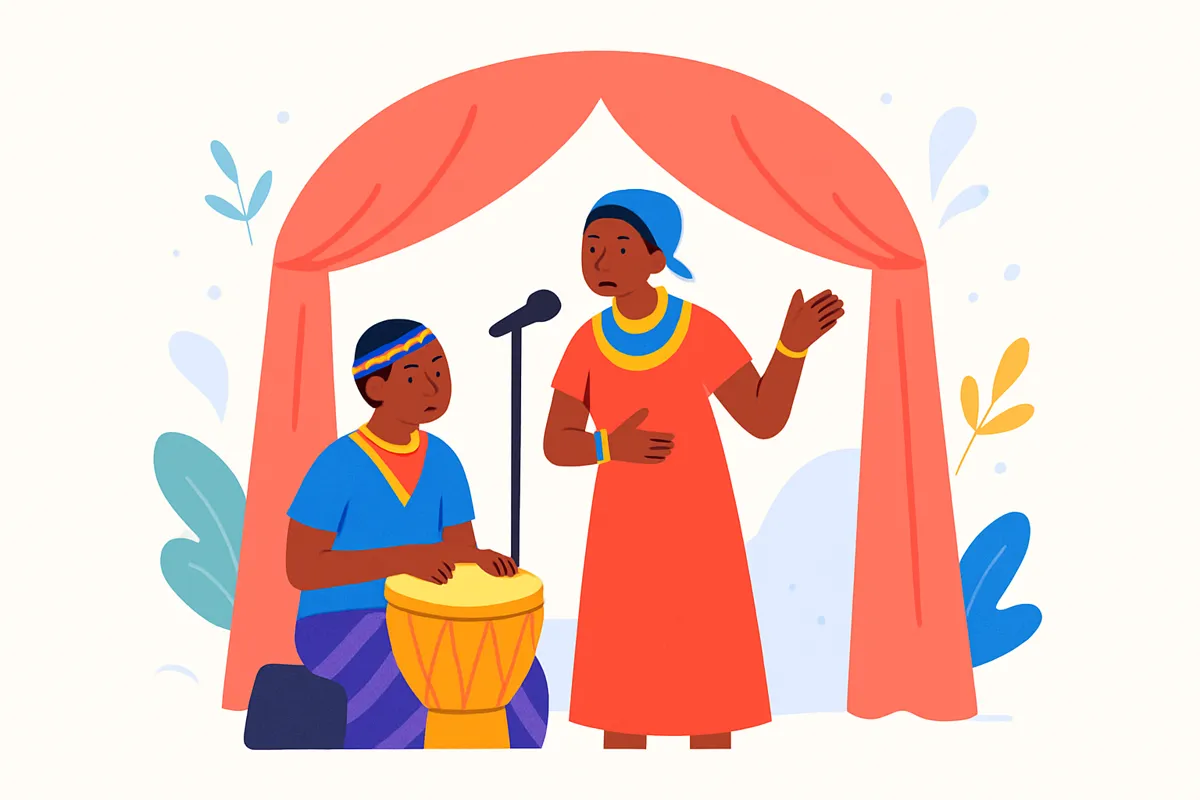
A performance poetry item in which a piece of original or chosen writing is delivered aloud, judged on the words and the way they are spoken rather than on singing or acting, entered by team across five age groups.
Spoken Word is performance poetry: a piece of writing built to be heard rather than read from a page. Where a verse-speaking item asks a team to interpret a poem someone else wrote, spoken word puts the voice and the writing closer together. The piece may be an original, may carry a strong beat or refrain, and usually speaks about something the performers care about, such as school life, family, community or a question that matters to them.
On the eTalenter Kenya national drama and film festival template, Spoken Word sits in the On Stage programme, after Choral Verse. It is entered as a Team item for boys and girls together, in five age groups: Pre-Primary, Primary, Junior School, Secondary and Tertiary. Every class is scored out of 100, the language is listed as English, and the template sets no time limit and does not split the marks into headings. A second template, a national fine arts programme, carries the item as an individual entry in a single age group, with a three-minute limit and a mark out of 100.
A round is simple to stage and demanding to do well. The performer or team walks on, takes a position, pauses, and begins. There are no sets and no accompaniment unless the organiser allows them. Everything the audience takes away comes from the writing, the voice, the rhythm and the stillness between lines. Teams often share lines, repeat a hook together and then drop to a single voice for the line that matters most.
What separates a good entry from a forgettable one is that the piece has something to say and says it in a shape. A clear opening image, a build through two or three turns, and an ending that lands will carry a panel further than clever wording alone. Rhythm and repetition should serve the meaning, and delivery should sound like a person talking to the room rather than a poem being recited.
Organisers run the item because it opens the programme to learners who write as well as perform. It gives young writers an audience, rewards original thinking, and is cheap and quick to stage. Because the template does not fix a time limit, team size or heading split, organisers should publish those in their own notice before entries open.
Where Spoken Word is run
On the eTalenter templates this item appears on two: the Kenya national drama and film festival template, in its On Stage section as a team item, and a national fine arts template, in its Action section as an individual item. Performance poetry and slam-style events run in schools, colleges, youth festivals and arts centres in many countries, but this page describes the item as those templates set it up, so organisers elsewhere should check their own notice for entry type, time limit and judging headings.
- Kenya
Key facts
- Team item on the Kenya template: the group is judged as one, boys and girls together
- Five age groups on the Kenya template, from Pre-Primary to Tertiary, each scored out of 100
- No time limit or heading split is set on the Kenya template; the second template uses an individual entry with a three-minute limit
- The language is listed as English on both templates
- Listed seventh on the Kenya On Stage programme, after Solo Verse and Choral Verse, which are separate items
- Delivered aloud without singing or acting; writing and expressive delivery carry the marks
On eTalenter, Spoken Word is filed under Action, On Stage and typically scored with Marks. It appears in 2 ready-made event templates — each one can adjust its time limit, age-group assignment and scoring setup independently.
Across the templates that use it, Spoken Word is most often entered as an Team competition, typically scored out of 100, commonly time-limited to around 3 minutes where a limit is set.
What judges look at in Spoken Word
What a Spoken Word panel is actually weighing up, and where the marks are usually won or lost:
- The writing: a clear idea, strong images and a shape with a beginning, a turn and an ending, rather than a list of lines
- Voice and delivery: pace, volume, pause and emphasis that sound natural and keep the room listening
- Rhythm and sound: repetition, rhyme or beat used to carry the meaning instead of drowning it
- Clarity and diction: every word reaching the back of the hall, including the quick lines and the quiet ones
- Presence and stillness: a confident walk on, steady eye contact and gesture that is small, purposeful and repeatable
- Team unity where entered as a team: shared lines landing together, handovers clean and no voice crowding another
Treat these as the judging focus, not a fixed rubric: publish your own weighted criteria for Spoken Word under Scoring Setup, or start from the full recitation and poetry judging criteria guide.
How to prepare for Spoken Word
How entrants and their teachers usually get Spoken Word right on the day:
- Start with one thing to say and write toward it; a piece with a single clear point beats one with five half-points
- Read the draft aloud early and often, and cut every line that only sounds clever when written down
- Mark the script for breath, pause and stress, and keep a single marked copy so the whole team rehearses from the same page
- For a team, decide which lines are solo, which are shared and which are unison, and give the strongest line to the voice that carries it best
- Practise the pause before the first word and the held silence after the last; both are part of the performance
- Rehearse in a big room with a listener at the back, and ask them to repeat back any line they could not catch
- Record a run on a phone and listen for rushing, sing-song patterns and words that disappear at the ends of lines
- Check the notice for team size, the time limit and whether props or music are allowed, and rehearse inside those limits
Ready-made event templates that include Spoken Word
Open any template to preview it in eTalenter and install it as a live, editable event.
| Template | Category | Score label | Competitions |
|---|---|---|---|
| AG National Fine Arts Festival | Action | Marks | 1 |
| Kenya National Drama and Film Festival | On Stage | Marks | 5 |
Frequently asked questions
Is Spoken Word judged individually or as a team?
Across eTalenter’s templates it’s most often run as an Team entry, though an organiser can set either participation type when assigning the item to an age group.
Is Spoken Word the same as Solo Verse or Choral Verse?
No. They are separate items on the same Kenya template. Solo Verse is one speaker interpreting verse, Choral Verse is a team speaking a poem in unison and parts, and Spoken Word is performance poetry where the writing and its delivery are judged together.
Can we write our own piece?
The template does not restrict it, and original writing is the usual form for this item. Check the festival notice in case it requires a set theme or a chosen text.
Is it judged individually or as a team?
On the Kenya template it is a team item across all five age groups. The other template that carries it enters one performer at a time.
How long can the piece be?
The Kenya template sets no time limit, so the organiser should publish one. The other template sets three minutes.
Can we use music, props or a backing track?
The templates do not say. Spoken word is normally voice only, so check the festival notice before adding anything.
Want the full judging picture? Read the full recitation and poetry judging criteria guide, or browse every action competition item.
Try Spoken Word in eTalenter
See every ready-made template that runs Spoken Word, and install one as a live event — age groups, rules and scoring included.



Leave a Reply
You must be logged in to post a comment.