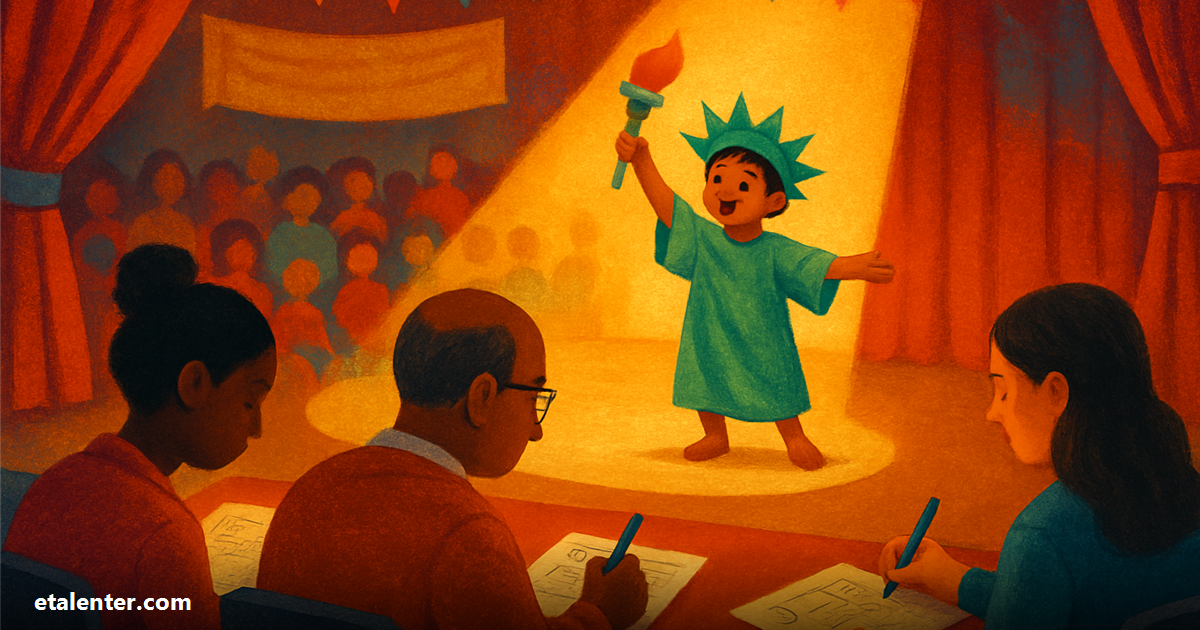
Fancy dress is the item where the marks are most often argued about, because it is the item where the participant did the least of the work. A four-year-old walks on in a costume a parent sat up two nights making, says four rehearsed lines, and a panel has to decide what exactly it is scoring. The criteria for judging a fancy dress competition exist to answer that: they push the marks towards the child on stage and away from the tailoring. This guide gives a sample marking scheme with weightage, a printable fancy dress competition judgement sheet, a deduction table, sample themes you can announce with your rules, and how to judge a fancy dress competition when eighty children are waiting in the wings.
Fancy dress judging criteria by age group
Keep the same six criteria for every age group so results stay comparable, and move the marks as the children get older:
| Criterion | Pre-primary | LP | UP |
|---|---|---|---|
| Characterisation & expression | 25 | 25 | 25 |
| Dialogue / self-introduction | 10 | 20 | 25 |
| Costume, make-up & relevance | 20 | 20 | 15 |
| Confidence & stage presence | 30 | 20 | 20 |
| Props & presentation | 10 | 10 | 10 |
| Theme & originality | 5 | 5 | 5 |
| Total | 100 | 100 | 100 |
Costume never carries the most marks at any age — the child on stage does. Running it for HS? See how to adjust for older groups. Need to print it? Jump to the fancy dress judgement sheet, or the fancy dress competition rules and time limits.
A sample marking scheme for fancy dress (100 marks)
Publish the criteria, the weightage and the time limit with the competition rules, before entries close. For fancy dress this matters more than for any other item, because parents spend money against the rubric — if costume is worth 20 and not 50, they deserve to know that while there is still time to work on the child’s presentation instead.
| Criterion | Weightage | What the judge looks for | What pulls marks down |
|---|---|---|---|
| Characterisation & expression | 25 | The child becomes the character — walk, gesture, face, voice all belong to it | A costume worn while the child stands still; expression that never changes |
| Dialogue / self-introduction | 20 | Clear, audible lines that tell the audience who the character is and why it matters | Inaudible delivery; lines recited at the floor; a script far beyond the child’s age |
| Costume, make-up & relevance | 20 | Costume and make-up that identify the character instantly and suit the age group | An expensive costume unrelated to the lines; make-up so heavy the face is lost |
| Confidence & stage presence | 20 | Composed entry, use of the stage, eye contact with the hall, a clean exit | Clinging to a parent; frozen at the mic; leaving mid-performance |
| Props & overall presentation | 10 | Props actually used in the act; a beginning, middle and end within the time | Props carried and never used; an act that simply stops when the time is up |
| Suitability & originality of theme | 5 | A character within the announced theme, chosen thoughtfully rather than copied | Off-theme entries; the same three characters every year with the same script |
| Total | 100 | ||
Why costume should never carry the most marks
Put costume at 40 or 50 marks and you have quietly announced a competition between households, not children. The family that can hire a professional outfit wins before the child opens their mouth, and every parent in the hall knows it. That is the single most common complaint organizers hear after a fancy dress result, and the rubric is where you prevent it — not the apology afterwards.
Keeping costume at 20 and putting 65 marks on characterisation, dialogue and confidence changes what the panel rewards: a child in a hand-made newspaper costume who holds the stage and speaks clearly can and should beat a rented costume standing silent. Say this in the briefing to judges, and say it in the rules to parents. Some organizers go further and add a line that hired or professionally tailored costumes carry no additional marks — it costs nothing and it visibly levels the item.
Adjust the rubric by age group
Fancy dress runs mostly in the younger age groups — pre-primary and LP, sometimes UP. Keep the same six heads across every group so the tabulation stays comparable, and shift the weightage:
- Pre-primary (3–5 years) — move 10 marks from dialogue into confidence and stage presence. Many children this age manage one sentence, or none. You are rewarding a child who walks on, faces the hall and stays for the full act. Allow a teacher at the side of the stage, and allow it for everyone.
- LP (lower primary) — the standard 25/20/20/20/10/5 scheme works as printed. A short self-introduction is reasonable here, and characterisation starts to become genuinely visible.
- UP (upper primary) — raise dialogue and characterisation to 25 each and drop costume to 15. At this age the child can write or adapt their own lines, and the item becomes closer to a mono act than a costume parade.
- HS and above — if you run fancy dress at all in the higher groups, it is usually themed or satirical. Add message and interpretation at 15 marks, taken from costume and props, and expect a point of view rather than a character introduction.
Sample themes to announce with your rules
An open fancy dress item produces forty superheroes and a scoring problem. Announcing a theme — or two or three, one per age group — spreads the entries, makes the judging comparable, and gives parents something to plan around. Themes organizers commonly use:
- Community helpers and professions — doctor, farmer, postman, nurse, fisherman, teacher. The standard pre-primary theme; simple costumes, easy dialogue.
- Historical and national figures — freedom fighters, poets, scientists, social reformers. Works well for LP and UP, and lends itself to a spoken introduction.
- Characters from books and folk tales — rewards reading, and the child can retell a scene rather than recite facts.
- Nature and environment — trees, rivers, animals, the seasons. Cheap costumes by design, and a natural fit for a message-based act.
- Festivals, occupations and regional characters — useful for community, club and church events where the audience shares a cultural vocabulary.
- Social message — road safety, cleanliness, saving water, kindness. Best for UP and above, where interpretation carries marks.
Whatever you announce, state clearly whether entries outside the theme are disqualified or simply lose the 5 suitability marks. Both are defensible; deciding on the day is not.
Printable fancy dress competition judgement sheet
Print one sheet per judge per participant, or one sheet per judge with a row for each chest number. Fill in the item, age group and theme before the session starts, and make sure every judge has the identical version — a panel scoring on three different sheets produces a result no tabulator can defend.
| Criterion | Max marks | Marks awarded | Judge’s remarks |
|---|---|---|---|
| Characterisation & expression | 25 | ||
| Dialogue / self-introduction | 20 | ||
| Costume, make-up & relevance | 20 | ||
| Confidence & stage presence | 20 | ||
| Props & overall presentation | 10 | ||
| Suitability & originality of theme | 5 | ||
| Less: time / rule deductions | – | ||
| Total | 100 |
Leave space at the foot of the sheet for Item · Age group · Theme · Character · Chest number · Judge’s name · Signature · Date. An unsigned sheet is the first thing an appeal will attack.
Fancy dress competition rules and deductions
These rules and regulations hold across the published fancy dress rules we have checked:
- Individual item — one child, one character.
- Open to boys and girls — none of the competitions below splits fancy dress by gender.
- A short time limit — between 1 and 5 minutes on stage, most often 2.
- Run by age group — for example Junior (ages 4–9) and Senior (10–15) at one Onam competition.
- Not on the Kerala school kalolsavam item list — so a school fancy dress contest sets its own rules. Print the time limit, age groups, theme (if any), dialogue rule and deductions with the notice.
| Competition | Age groups | Time limit |
|---|---|---|
| A Gulf kalotsavam | Groups 1–5 | 2 min |
| A UK Malayali kalamela | Kids to Seniors | 2 min |
| An Onam club competition | Junior 4–9, Senior 10–15 | 2 min |
| A Kerala university youth festival | Students | 3 min |
| A Malayali youth festival | Youth | 3 min |
| A UAE kalotsavam | Categories I–IV | 5 min |
| A Malayali association kalamela | KG to Grade 12 | 5 min |
| A Bible kalotsavam abroad | Sub Junior | 1 min |
Fancy dress disputes are rarely about artistry. They are about the clock, the parent who walked on stage, and the prop nobody warned you about. Put the numbers in the rules and have them applied by the timekeeper or item in-charge, not by the judges — otherwise three judges each deduct for the same overrun and the child is penalised three times over.
| Breach | Suggested deduction | Applied by |
|---|---|---|
| Over the time limit, up to 30 seconds | 2 marks | Stage timekeeper |
| Over the time limit, beyond 30 seconds | 5 marks | Stage timekeeper |
| Parent or helper on stage (outside the permitted age group) | 5 marks | Item in-charge |
| Prompting of dialogue from off stage | 3 marks | Item in-charge |
| Unsafe props — fire, real blades, live animals | Not permitted; act stopped | Item in-charge |
| Character outside the announced theme | Loss of the 5 suitability marks, or as stated in the rules | Panel, by agreement |
How to judge a fancy dress competition with many participants
Fancy dress draws the biggest entry list in the pre-primary and LP sections, because every class can send everyone. Eighty children across two age groups is where fairness quietly breaks: the marks given to chest number 4 and to chest number 76 are not on the same scale, because a panel two hours in has recalibrated without noticing.
Three habits fix most of it. Brief the panel with a reference band before the session — what 20 out of 25 on characterisation looks like against 15 — so the first ten children are not scored on a different standard from the last ten. Keep the backstage queue in draw order and hand the judges only the chest number, never the child’s name or school; in a small school event the panel will recognise faces, and a number on the sheet is still the discipline that keeps the marks honest. And keep the tabulation desk away from the stage, so running totals never colour the marks still to come.
Write the tie-break order into the rules as well. For fancy dress the usual sequence is: higher marks on characterisation, then higher marks on dialogue, then the majority verdict of the panel, then a shared rank with both children placed equal.
Setting these criteria up in eTalenter
On paper this is six criteria multiplied by every participant, every judge, every theme and every age group, in an item where the entry list is often the longest of the day. In eTalenter you set fancy dress up once as a judged Arts competition, enter these criteria with their weightage, and assign it to the age groups and gender categories you actually run, with participation type set to Individual. Every child carries a chest number from the draw; every judge scores the same rubric on their own device; the system totals, averages across the panel, applies your grades and points, rolls points up to houses, classes or units and flags ties for you. From there you review results, assign ranks and awards, publish online or to the podium display, and print certificates and trophy stickers from the same marks — which matters in an item where almost every participant deserves to go home with something.
Read how the panel and tabulation work in our judge scoring and tabulation guide, take the ready tables from the judges’ score sheet template, and see the closely related rubric for spoken items in our recitation and poetry judging criteria.
Frequently asked questions
What are the judging criteria for a fancy dress competition?
A widely used set is characterisation and expression, dialogue or self-introduction, costume and make-up relevance, confidence and stage presence, props and presentation, and suitability to the theme — commonly weighted 25/20/20/20/10/5 out of 100. Whatever you choose, publish the criteria, the weightage and the time limit with the competition rules before entries close.
How much should the costume itself count?
Around 20 marks out of 100, and no more. Beyond that the item stops measuring the child and starts measuring what the family could buy or borrow. Score the costume for how well it identifies the character and suits the age group, not for how much it evidently cost, and state in the rules that hired costumes earn no extra marks.
What are the rules for a fancy dress competition?
Fancy dress is an individual item open to boys and girls, run by age group, with a short time limit on stage — 1 to 5 minutes, most often 2. Everything else is set by the organiser, so the notice should state the time limit, the age groups, any theme, whether dialogue is required, which props are not allowed, and the deduction for each breach. See the rules and deductions table.
What is the time limit for a fancy dress competition?
Usually 2 minutes per child — the limit at a Gulf kalotsavam, a UK kalamela and an Onam competition. Some events allow 3 or 5 minutes, and one gives its youngest group just 1.
Should dialogue be compulsory?
For LP and above, yes — a short self-introduction is what turns a costume parade into a judged item. For pre-primary, make it optional and move those marks into confidence and stage presence, so a child who cannot manage lines is not effectively scored out of 80.
Use this rubric at your next fest
Copy the marking scheme and the judgement sheet above into your rules, or set them up once in eTalenter and let the panel score on their phones while totals, deductions, grades, ranks, house points and certificates come out at the other end. Explore eTalenter’s competition management software, open a live demo and log in as a demo judge to see the scoring screen (no sign-up), message us on WhatsApp, or write to support@etalenter.com and we will configure the judging criteria for every item on your stage schedule.