
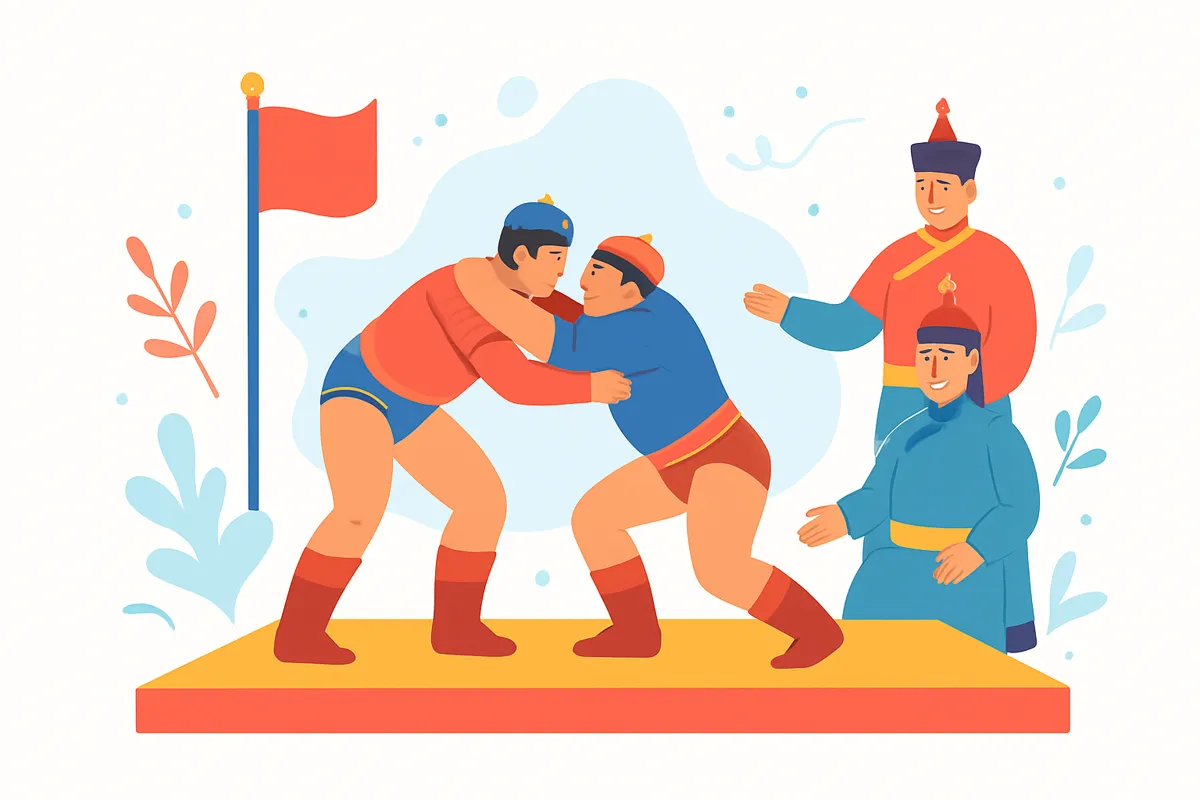
Mongolian standing wrestling, run as a knockout of one-to-one bouts in which a wrestler loses by touching the ground with any part of the body above the knee, with titles awarded by how many rounds a wrestler wins.
Bökh is the traditional wrestling of Mongolia and the best known of the “three manly games” held at the national summer festival, alongside archery and horse racing. Two wrestlers face each other in a standing bout with no weight classes and no ground fighting. A wrestler is beaten when any part of the body above the knee, such as the elbow, back or knee, touches the ground, or when he is thrown or forced down.
At the national level the contest is a single-elimination bracket: each round halves the field until one wrestler is left. Reporting on the national festival describes a bracket of 512 or 1,024 wrestlers over nine or ten rounds, which is why entrants must enrol in advance and usually qualify through smaller local festivals first. Beating an opponent moves you to the next round, so the number of rounds a wrestler wins, not a score, decides the result.
Titles follow the rounds. The state rank system names a wrestler by how far he progresses: the winner of the fifth round is called Nachin (falcon), the seventh round Zaan (elephant), the tournament winner Arslan (lion), and a two-time Arslan becomes Avarga (titan). The same festival also confers the Khartsaga and Garuda titles in between. Each wrestler wears the traditional short jacket and briefs, and winners traditionally perform an eagle-style dance around the ceremonial banner.
In the eTalenter template this item is one Individual entry in an Open (Adult) group of 16 and above, open to both genders, and the panel enters a rating out of 10. The template also carries the real title ladder as its ranks, so a coordinator can record a result as Nachin, Zaan, Arslan or Avarga instead of a plain first, second or third place. The knockout bracket itself is run by the organiser; eTalenter records the entries, the ratings and the resulting ranks.
Organisers run wrestling because it is the centrepiece of the festival: it draws the largest crowds and carries the most prestige for the winner and for the home district that produced him.
Where Wrestling (Bökh) comes from
Bökh is described as one of the oldest sports in Mongolia, with a history running back many centuries. Naadam itself is a long-standing national festival, and wrestling, archery and horse racing have been its core contests. The festival was inscribed on the UNESCO list of intangible cultural heritage in 2010.
Where Wrestling (Bökh) is run
Bökh is the signature wrestling contest at Mongolia’s national Naadam festival, held in the capital each July, and at the many smaller district and provincial Naadams that feed it. Mongolian communities abroad also hold local Naadam days with bökh bouts. In eTalenter’s templates this item appears in one real-world template, the festival template for Mongolia, where it sits beside Archery and Horse Racing.
- Mongolia
- Mongolian communities abroad
Key facts
- Individual item, never a team event
- Standing wrestling with no weight classes and no time-based scoring in the traditional contest
- A bout ends when a wrestler touches the ground above the knee or is thrown
- Single-elimination knockout bracket, nine or ten rounds at national level
- Titles by rounds won: Nachin, Zaan, Arslan, Avarga (the template carries these as ranks)
- Template group: Open (Adult), 16 and above, both genders, rated out of 10
On eTalenter, Wrestling (Bökh) is filed under On Stage and typically scored with Rating out of 10. It appears in 1 ready-made event templates — each one can adjust its time limit, age-group assignment and scoring setup independently.
Across the templates that use it, Wrestling (Bökh) is most often entered as an Individual competition, typically scored out of 10, commonly time-limited to around 10 minutes where a limit is set.
What judges look at in Wrestling (Bökh)
What a Wrestling (Bökh) panel is actually weighing up, and where the marks are usually won or lost:
- Legal takedowns: a clean throw or a forced touch of the ground above the knee ends the bout, so the referee watches the exact moment a wrestler is down more than anything else.
- Balance and footwork: wrestlers who keep a low, steady stance and recover from a tug are the ones who are rarely put down, and the rating reflects that control.
- Grip and technique: a well-timed trip, hook or lift scores better than a lucky fall. Panels look for a chosen technique carried through, not a scramble.
- Conduct and tradition: wearing the correct costume, greeting the opponent and the officials, and performing the victory dance respectfully are part of the occasion and can affect how a wrestler is received.
- Consistency across rounds: because titles are earned by winning round after round, a wrestler who keeps his form late in the bracket is the one who gains rank.
Treat these as the judging focus, not a fixed rubric: publish your own weighted criteria for Wrestling (Bökh) under Scoring Setup, or start from the judge scoring and tabulation guide.
How to prepare for Wrestling (Bökh)
How entrants and their teachers usually get Wrestling (Bökh) right on the day:
- Build leg and core strength first. Bökh is decided by balance, so squats, hip drills and carrying work do more than arm training.
- Drill the three or four throws you trust until they are automatic, rather than learning a long list you cannot finish under pressure.
- Practise falling and recovering. Knowing how to stay on your feet after a stumble, and how to land safely when you lose, protects both the result and the athlete.
- Wrestle against partners of different heights and builds, because the real bracket has no weight classes and the next opponent can be much larger or smaller.
- Plan for the schedule on the day. A long bracket means several bouts with short rests, so train with repeated rounds, not a single hard session.
- Learn the local rules in advance, including how the organiser handles a bout that stalls, and confirm entry and qualification dates early since places are limited.
Ready-made event templates that include Wrestling (Bökh)
Open any template to preview it in eTalenter and install it as a live, editable event.
| Template | Category | Score label | Competitions |
|---|---|---|---|
| Naadam (Mongolia’s Three Manly Games) | On Stage | Rating out of 10 | 1 |
Frequently asked questions
Is Wrestling (Bökh) judged individually or as a team?
Across eTalenter’s templates it’s most often run as an Individual entry, though an organiser can set either participation type when assigning the item to an age group.
How do you win a bökh bout?
You win by making your opponent touch the ground with any part of the body above the knee, for example an elbow, knee or back. The wrestler left standing advances to the next round.
Are there weight classes in Mongolian wrestling?
In the traditional national contest there are no weight classes, so a wrestler can meet an opponent of any size. Organisers using this template may of course add their own divisions.
What do the titles Nachin, Zaan and Arslan mean?
They are state ranks earned by how far a wrestler goes in the tournament: Nachin (falcon) after the fifth round, Zaan (elephant) after the seventh, Arslan (lion) for winning the tournament, and Avarga (titan) for a repeat Arslan.
Can eTalenter run the knockout bracket?
No. The bracket and the bouts are run by the organiser on the day. eTalenter records the entries, the rating for each wrestler and the ranks, using the real title ladder in the template.
Want the full judging picture? Read the judge scoring and tabulation guide, or browse every on stage competition item.
Try Wrestling (Bökh) in eTalenter
See every ready-made template that runs Wrestling (Bökh), and install one as a live event — age groups, rules and scoring included.

Leave a Reply
You must be logged in to post a comment.