
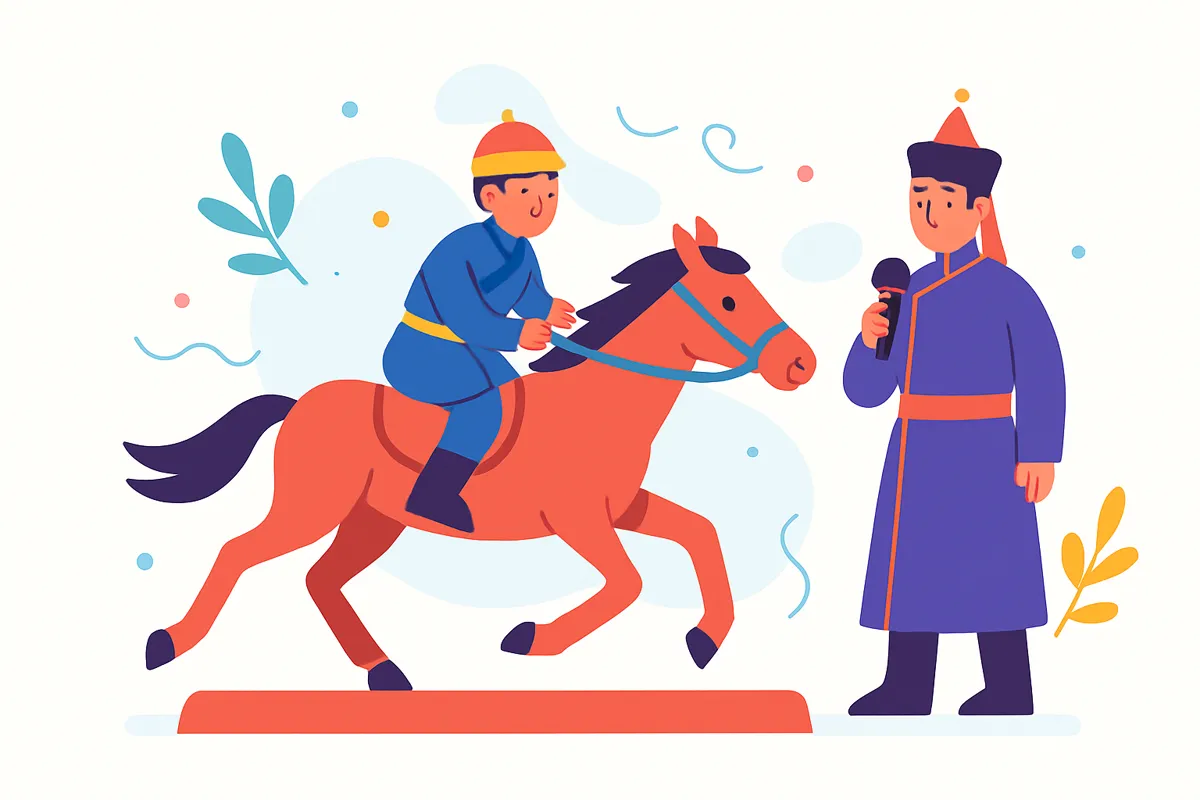
Mongolian long-distance horse racing, a cross-country race over open steppe in which young riders race horses grouped by age and the order of the finishing horses decides the result.
Horse racing is the third of the three manly games at Mongolia’s national summer festival, alongside wrestling and archery. It is not a track sprint. The horses run a long cross-country course over open grassland, and the distance is set by the age class of the horse, so a race for young horses is shorter than one for mature horses.
The riders are traditionally children, light enough to spare the horse over a long course, and the safety of those riders is now a matter of law and public attention. Horses are registered and checked for age before the race, and riders must meet minimum-age, registration, insurance and safety requirements. A festival that runs the item has to take those checks seriously before anything else.
The race itself is simple to follow. The horses are lined up at a distant start, ridden to the finish near the festival ground, and the order in which they cross the line is the result. Tradition honours the leading horses, with the winners praised in song, and the horse that finishes last is also given a blessing, which says something about the spirit of the occasion.
In the eTalenter template this item is one Individual entry in an Open (Adult) group of 16 and above, open to both genders, and the panel enters a rating out of 10. The template does not model riders’ ages or horse age classes, so a coordinator who wants those recorded should use the entry details and group set-up for their own event. The course, the start, the finish timing and the welfare checks are run by the organiser on the day; eTalenter records the entries, the ratings and the final ranking.
Organisers run it because it is the most public of the three contests: it needs open country and a crowd along the course, and it connects a festival to the herding life that the festival celebrates.
Where Horse Racing comes from
Horse racing is part of the long-standing Mongolian tradition of festival contests and is one of the three games of the national festival, which was inscribed on the UNESCO list of intangible cultural heritage in 2010.
Where Horse Racing is run
Horse racing is held at Mongolia’s national festival each July and at the smaller district and provincial festivals that feed it, where herding families bring their horses. Mongolian communities abroad sometimes mark the festival with their own gatherings. In eTalenter’s templates this item appears in one real-world template, the Mongolian festival template, where it sits beside Wrestling (Bökh) and Archery.
- Mongolia
Key facts
- Individual item: each entry is one rider and horse
- A long cross-country race, not a track sprint, with the distance set by the horse’s age class
- Horses are registered and age-checked before the race, and riders must meet safety and insurance requirements
- The finishing order decides the result, with the leading horses honoured in tradition
- Template group: Open (Adult), 16 and above, both genders, rated out of 10
- The course, start and timing are run by the organiser, and the template does not set a time limit
On eTalenter, Horse Racing is filed under On Stage and typically scored with Rating out of 10. It appears in 1 ready-made event templates — each one can adjust its time limit, age-group assignment and scoring setup independently.
Across the templates that use it, Horse Racing is most often entered as an Individual competition, typically scored out of 10, commonly time-limited to around 10 minutes where a limit is set.
What judges look at in Horse Racing
What a Horse Racing panel is actually weighing up, and where the marks are usually won or lost:
- Finishing order: the order in which horses cross the line is the main basis of the rating, so the panel’s score should follow the result on the course.
- Fair start: officials watch that every horse in the class starts together and from the same line, because an uneven start undermines the whole result.
- Registration and age class: a horse must run in the class that matches its verified age, and an entry in the wrong class is not ranked with the others.
- Rider safety and welfare: correct equipment, a rider who meets the minimum-age and insurance rules, and a horse fit for the distance are conditions of running, not optional extras.
- Conduct on the course: obstructing another horse, cutting the course or ignoring officials can cost an entry its placing.
Treat these as the judging focus, not a fixed rubric: publish your own weighted criteria for Horse Racing under Scoring Setup, or start from the judge scoring and tabulation guide.
How to prepare for Horse Racing
How entrants and their teachers usually get Horse Racing right on the day:
- Confirm the age class, distance and course with the organiser early, since rules differ between local festivals and the horse must be entered in the right class.
- Build a horse’s fitness over weeks of steady distance work rather than a few hard gallops, because a long cross-country race rewards stamina over a burst of speed.
- Check that the horse’s registration and age evidence are ready before the day, so the entry is not delayed at the checks.
- Make sure the rider is the right age, properly equipped and covered by the required insurance, and have them practise the start and finish routine with the horse.
- Walk or ride the course beforehand if allowed, and note the ground, turns and any places where a crowd may press in.
- Plan the day for the horse: water, rest after travel and a calm approach to the start, since an unsettled horse loses more than a slightly slower one.
Ready-made event templates that include Horse Racing
Open any template to preview it in eTalenter and install it as a live, editable event.
| Template | Category | Score label | Competitions |
|---|---|---|---|
| Naadam (Mongolia’s Three Manly Games) | On Stage | Rating out of 10 | 1 |
Frequently asked questions
Is Horse Racing judged individually or as a team?
Across eTalenter’s templates it’s most often run as an Individual entry, though an organiser can set either participation type when assigning the item to an age group.
How long is Mongolian horse racing?
It is a long cross-country race and the distance depends on the horse’s age class, so there is no single figure. The organiser sets the course, and the template does not set a distance or time limit.
Who rides the horses?
Traditionally children ride, because they are light, but riders must meet minimum-age, registration, insurance and safety requirements. Organisers should check the current rules before accepting entries.
How is the winner decided?
By the order in which the horses cross the finish line within their age class. The template then records a rating out of 10 for each entry and ranks them.
Can eTalenter time the race?
No. The course, the start and the finish timing are run by the organiser. eTalenter records the entries, the rating for each one and the final ranking.
Want the full judging picture? Read the judge scoring and tabulation guide, or browse every on stage competition item.
Try Horse Racing in eTalenter
See every ready-made template that runs Horse Racing, and install one as a live event — age groups, rules and scoring included.


Leave a Reply
You must be logged in to post a comment.