
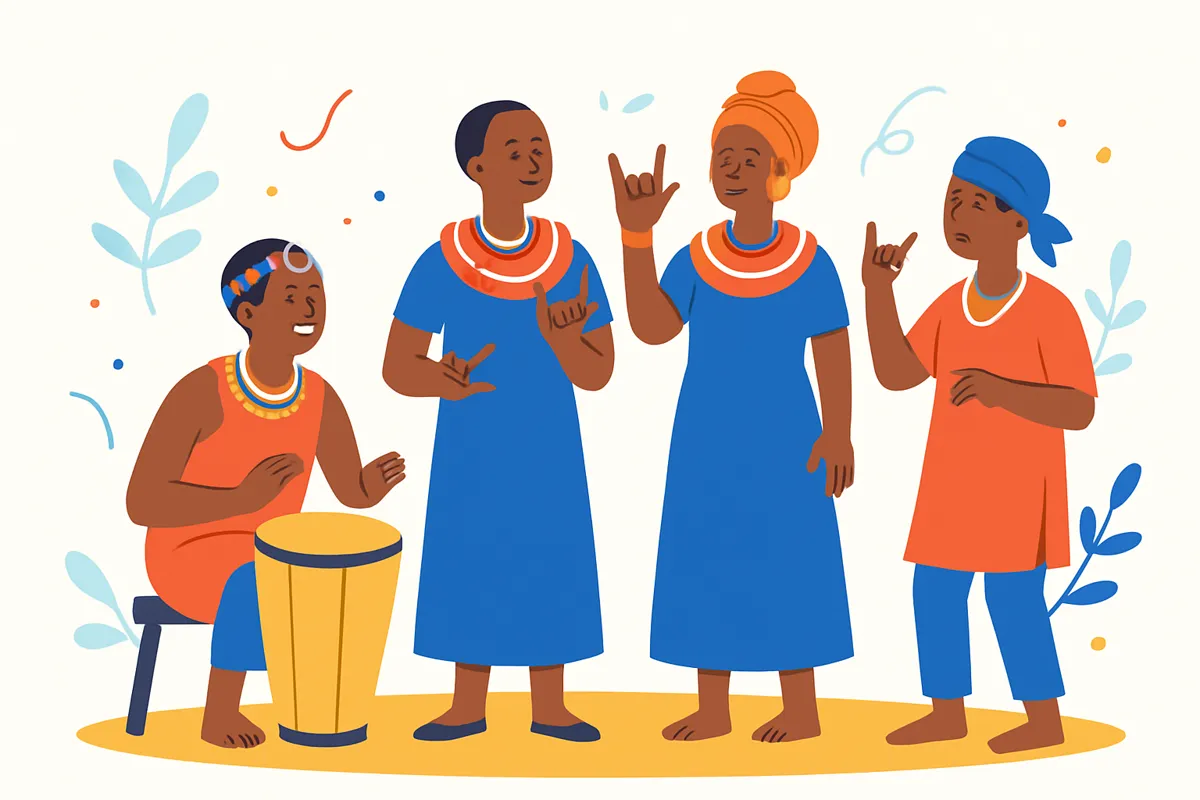
A staged play performed in Kenyan Sign Language by a cast entered as one team, marked out of 100 on the choice and scripting of the play, the acting, the production, costume and decor, and overall achievement.
A Play in Kenyan Sign Language is a full staged drama in which the story is carried in sign rather than in spoken dialogue. The cast performs as one team and is judged as a single piece of theatre: the panel asks whether the script, the signing, the direction and the look of the stage together let an audience follow and believe the story.
On the eTalenter Kenya national drama and film festival template this is the second item on the programme, listed straight after the spoken Play. It is a Team item open to boys and girls together, offered across five age groups: Pre-Primary (3 to 5), Primary (6 to 12), Junior School (13 to 15), Secondary (14 to 18, with overlap allowed) and Tertiary (19 and over). Unlike the spoken Play it has a single strand, so the template carries five classes rather than ten. The language field on the template is simply set to English, which is only the system default; the performance language is Kenyan Sign Language.
The scheme recorded for the template follows the published adjudication scheme for a Play, totalling 100 marks: choice of play and scripting 30, acting 30, production 20, costume and decor 10, and achievement 10. The template carries 100 as the maximum score and leaves the time limit unset, so an organiser should enter the running time and any set-up allowance from their own notice. How a panel applies each heading to signed performance, for example how signing clarity is weighed under acting, is a matter for the panel and the organiser rather than something the template fixes.
Organisers run this class so that deaf and hard-of-hearing performers, and schools that teach through sign, have a place of their own on the drama programme rather than competing in a spoken class. It also lets hearing classmates and families see sign used as a full theatrical language.
Where Play in Kenyan Sign Language is run
On the eTalenter templates this item appears on one: the Kenya national drama and film festival template, in its On Stage section. Sign-language drama classes exist at other festivals too, but this page describes the item as that template sets it up, so entrants elsewhere should check their own notice for time limits, cast size and whether interpreters or voice-over are allowed.
- Kenya
Key facts
- Team item: the whole cast is judged together, boys and girls in the same entry
- Five age groups on the template, from Pre-Primary (3 to 5) up to Tertiary (19 and over)
- One strand only, Kenyan Sign Language, giving five classes in all
- Scored out of 100 in five parts: choice of play and scripting 30, acting 30, production 20, costume and decor 10, achievement 10
- No time limit is set on the template, so the organiser enters their own
- The spoken Play, in English and French, is a separate item on the same template
On eTalenter, Play in Kenyan Sign Language is filed under On Stage and typically scored with Marks. It appears in 1 ready-made event templates — each one can adjust its time limit, age-group assignment and scoring setup independently.
Across the templates that use it, Play in Kenyan Sign Language is most often entered as an Team competition, typically scored out of 100.
What judges look at in Play in Kenyan Sign Language
What a Play in Kenyan Sign Language panel is actually weighing up, and where the marks are usually won or lost:
- Choice of play and scripting (30): a story that can be told clearly through sign and movement, suited to the age and size of the cast; a script written around spoken wordplay that does not translate loses marks here
- Acting (30): believable characters shown through signing, facial expression and body, and actors who stay in character and react even when they are not signing
- Production (20): direction, grouping and use of the stage so that every signer stays visible to the panel and audience, with clean entrances, exits and scene changes
- Costume and decor (10): dress and set that help the story and keep hands and faces clearly visible; busy patterns, masks or props that hide the signing hurt rather than help
- Achievement (10): the overall impression, whether the team did what it set out to do and finished as a complete, confident piece
- Clarity of signing: the whole cast should sign accurately and at a pace the panel can follow, rather than leaving the story to one or two strong signers
Treat these as the judging focus, not a fixed rubric: publish your own weighted criteria for Play in Kenyan Sign Language under Scoring Setup, or start from the full drama & skit judging criteria guide.
How to prepare for Play in Kenyan Sign Language
How entrants and their teachers usually get Play in Kenyan Sign Language right on the day:
- Choose a story with strong action and clear emotions, and agree early who plays each role so signers can build their characters over many rehearsals
- Involve fluent Kenyan Sign Language users in preparing the script and checking the signing, rather than relying on guesses from a dictionary
- Block the play so signers face the audience, never stand behind one another, and keep faces well lit and unobstructed
- Use expression, posture and space as part of the telling, and rehearse transitions between scenes so the story never stalls
- Keep costume plain in a colour that contrasts with skin and background so hands read clearly from the back of the hall
- Rehearse in a large room and from a distance, because signing that reads in a classroom can disappear on a big stage
- Plan how cues will be given, for example light, floor marks or a visual signal from the director, since the cast cannot rely on spoken cues
- Run a full rehearsal before someone unfamiliar with the story and ask what they could not follow
Ready-made event templates that include Play in Kenyan Sign Language
Open any template to preview it in eTalenter and install it as a live, editable event.
| Template | Category | Score label | Competitions |
|---|---|---|---|
| Kenya National Drama and Film Festival | On Stage | Marks | 5 |
Frequently asked questions
Is Play in Kenyan Sign Language judged individually or as a team?
Across eTalenter’s templates it’s most often run as an Team entry, though an organiser can set either participation type when assigning the item to an age group.
Is a Play in Kenyan Sign Language judged as a team or individually?
As a team. It is a Team item on the template, so the cast receives one score.
How is it scored?
Out of 100. The scheme recorded for the template splits the marks into choice of play and scripting 30, acting 30, production 20, costume and decor 10, and achievement 10.
Is there a time limit?
The template does not set one, so the organiser should enter a running time from their own notice.
Is it the same item as the spoken Play?
No. It is its own item on the template, with its own five age-group classes, separate from the English and French spoken Play.
Why does the template show English as the language?
English is just the system default value on the template. The performance itself is in Kenyan Sign Language.
Want the full judging picture? Read the full drama & skit judging criteria guide, or browse every on stage competition item.
Try Play in Kenyan Sign Language in eTalenter
See every ready-made template that runs Play in Kenyan Sign Language, and install one as a live event — age groups, rules and scoring included.


Leave a Reply
You must be logged in to post a comment.