
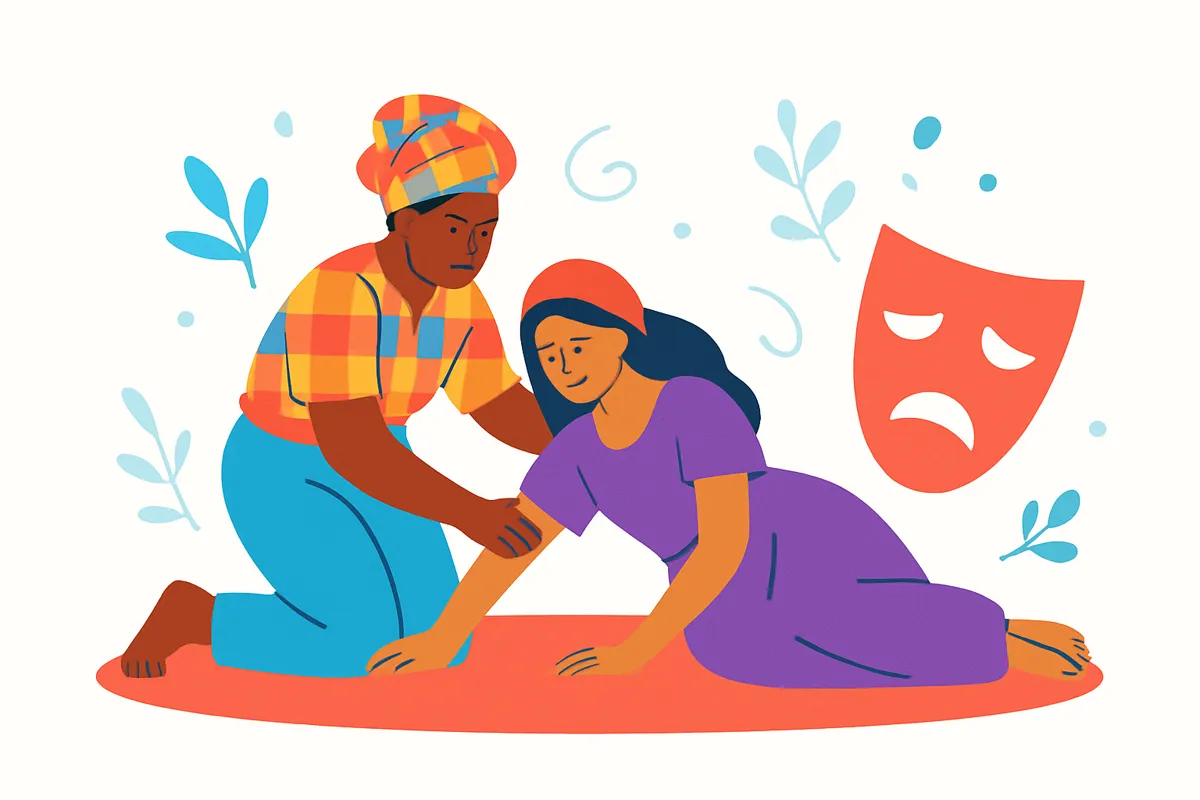
A drama category in a national performing arts festival in Jamaica where a group performs a tragedy, a serious play in which a character’s choice or flaw leads to loss, in four minutes and scored out of 100.
Drama – Tragedy is the fifth genre category in the Drama discipline of the Jamaican national performing arts festival that this template is rebuilt from, after Fantasy, Gospel Drama, Tea Meeting and Farce, and it is the first one that asks a cast to be sad on purpose. A tragedy is a serious play in which something of value is lost. The loss does not arrive by accident: it grows out of what the central character wants, fears or refuses to see, so the audience watches a decision being made and then watches its price being paid. Where a farce lets the trap close and then lets everyone laugh, a tragedy lets it close and leaves the room quiet.
The extract used to build the template lists the category and its limits but prints no definition, no rule on the subject matter, no rule on cast size and no marking table. This page therefore describes what a tragedy normally contains and does not claim to know what the festival requires. An organiser who runs the category should publish their own wording on suitable themes for each age class, on whether scripts may be original or adapted, and on how violence or death may be shown on stage, because those points decide how entries are prepared and how comfortable the audience and the youngest performers will be.
In four minutes a tragedy has to be built like a short fuse. There is room for one clear want, one turning point and one consequence. The opening establishes who the central character is and what they cannot give up: a promise, a family honour, a friendship, a place. A single choice follows, usually the wrong one made for an understandable reason, and the remaining time is spent letting its result land: a door that cannot be reopened, a person who does not come back, an apology that arrives too late. Entries that try to fit a whole life into four minutes tend to rush; entries that choose one afternoon and play it fully tend to be the ones people remember.
On the template the item is offered in all seven classes, from the youngest children (ages 3-6) to adults (20 and over) and the combined class. Every class has the same limits: four minutes with a warning bell at three, a score out of 100, both genders in one list, English as the language. The template records the entry as a team, so the whole cast is entered together; it does not fix a number of actors, so say in your notice what the minimum and maximum cast size is.
Organisers keep a category like this because it is the quiet counterweight on a programme that otherwise leans towards comedy, music and spectacle. It rewards restraint, truthful acting and stillness, which are exactly the skills that are hardest to fake, and it gives a panel a clear way to separate casts who understand why a scene is sad from casts who only look sad.
Where Drama – Tragedy comes from
The word tragedy comes from the Greek tragoidia, usually read as goat-song, and the form was developed in ancient Athens, where playwrights staged stories of heroes brought down by their own choices before large public audiences. The philosopher Aristotle later wrote about what made such plays work, stressing a serious action, a central character the audience cares about and a fall that feels both surprising and inevitable. Those ideas are still the starting point for most teaching of the form today.
Where Drama – Tragedy is run
On eTalenter this item is used in one template, the Jamaican national performing arts festival template, where it is assigned to all seven classes (six age bands from 3-6 up to adults aged 20 and over, plus a combined class) inside the Drama discipline. Tragedy itself is one of the oldest dramatic forms and is staged in school drama clubs, youth theatre festivals, university drama societies and one-act play competitions in many countries, so a cast that has performed a short serious scene elsewhere will recognise the task. Each event sets its own rules on themes, script origin, cast size and time, so read the notice of the event you are entering instead of assuming the limits here.
- Jamaica (the national performing arts festival the template is built from)
Key facts
- A short serious group play in which a character’s choice or flaw leads to loss, with the entry recorded as a team on the template
- Open to both genders in one list, with the language set to English
- Offered in all seven classes, from Class 1 (ages 3-6) to Class 6 (adults, 20 and over) and the combined class
- Four-minute limit with the warning bell at three minutes
- Scored out of 100 on the template; the festival awards medals against published mark bands rather than first, second and third
- The mirror image of the Comedy and Farce categories on the same list: the one that is judged on truthfulness and restraint rather than pace and laughs
- The extract used for the template prints no definition, no rule on themes or cast size and no per-criterion weights, so none are asserted here
On eTalenter, Drama – Tragedy is filed under On Stage and typically scored with Marks. It appears in 1 ready-made event templates — each one can adjust its time limit, age-group assignment and scoring setup independently.
Across the templates that use it, Drama – Tragedy is most often entered as an Team competition, typically scored out of 100, commonly time-limited to around 4 minutes where a limit is set.
What judges look at in Drama – Tragedy
What a Drama – Tragedy panel is actually weighing up, and where the marks are usually won or lost:
- The source does not print this category’s marking table, so what follows is organiser guidance for agreeing yardsticks with the panel, not rules from the source
- A clear want: within the first half minute it is plain what the central character cannot give up, because a loss only hurts if the audience knows what was at stake
- The turning point: one choice is made, visibly and for an understandable reason, so the fall feels earned and not simply announced
- Truthful acting: grief, anger and regret are played from what the character believes in that moment, with no over-acting, no stage crying for show and no winking at the audience
- Stillness and silence: the cast uses pauses, held looks and a slowed pace after the key moment, and does not rush to fill the quiet
- Consequence: the final image or line shows what was lost, so the play ends with the result of the choice and not with a lecture about it
- Voice and diction: soft or broken lines are still audible to the back of the room, because an emotional moment nobody can hear carries no weight
- Staging that serves the mood: simple positioning, one or two meaningful props and careful entrances, with any depiction of harm suggested rather than acted out in detail
- Group discipline: every cast member has a reason to be on stage and something to react to, so the scene feels like a shared moment rather than one lead and a crowd of onlookers
Treat these as the judging focus, not a fixed rubric: publish your own weighted criteria for Drama – Tragedy under Scoring Setup, or start from the full drama & skit judging criteria guide.
How to prepare for Drama – Tragedy
How entrants and their teachers usually get Drama – Tragedy right on the day:
- Ask the organiser in writing which themes are suitable for the age class, whether an original script is allowed, and how death or violence may be shown, and keep the answer with your entry paperwork
- Pick one afternoon, one decision and one loss, such as a promise broken, a secret told or a goodbye missed, and build the whole four minutes around that single moment instead of trying to tell a life story
- Write the plot as three beats: what the character wants, the choice that goes wrong, and the cost. If a scene does not serve one of those three beats, cut it
- Rehearse the ending first. Decide the last image or line, then build backwards so the whole cast knows exactly where the play is heading and does not rush to get there
- Practise the quiet: run the key scene several times with long pauses, no props and no music, so the cast learns that holding a look for three seconds is stronger than another line of dialogue
- Coach each actor to think of something true from their own life that matches the character’s feeling, and play that honestly at half the volume they first want to use
- Keep every voice audible. Have a listener sit at the back of the hall and call out any line they cannot hear, then work on breath and diction until sad, slow lines still carry
- Time the full play aloud and protect the last thirty seconds above everything else. If the play runs past four minutes, cut an earlier explanation scene and leave the consequence untouched
- With the youngest classes choose a gentle, child-sized loss, such as a lost toy or a friend who moves away, and let the sadness come from a simple, honest moment instead of dramatic events
- Agree props and positions in advance and keep them minimal. One meaningful object, such as a letter, a chair left empty or a photograph, is stronger than a crowded set that takes time to arrange
Ready-made event templates that include Drama – Tragedy
Open any template to preview it in eTalenter and install it as a live, editable event.
| Template | Category | Score label | Competitions |
|---|---|---|---|
| JCDC National Performing Arts Festival (Jamaica) | On Stage | Marks | 7 |
Frequently asked questions
Is Drama – Tragedy judged individually or as a team?
Across eTalenter’s templates it’s most often run as an Team entry, though an organiser can set either participation type when assigning the item to an age group.
What is a tragedy in a drama competition?
A serious play in which a central character’s choice, weakness or circumstances lead to a significant loss. The extract used for this template gives no further definition, so check the organiser’s notice for any rules on subject matter.
How is Tragedy different from Drama – Straight Drama?
Both are serious. A straight drama can deal with a problem, a relationship or an issue and end in many ways. A tragedy is defined by its shape: a decision, a fall and a loss that cannot be undone. They are separate categories on the same festival list and entering one does not enter you for the other.
Does a tragedy have to end with a death?
No. The template sets no such rule. A tragic ending can be a broken friendship, a lost chance or a home that cannot be returned to. Ask the organiser whether the notice limits how death or violence may be shown, especially for the younger classes.
Can we perform a scene from a famous play?
The template does not say whether scripts must be original or may be adapted. Ask the organiser, and if an extract is allowed, make sure it can be performed as a complete four-minute piece with a beginning, turning point and end.
How long can it be and how is it marked?
The template sets four minutes with a warning bell at three, and scores out of 100. The festival awards medals against mark bands, and the extract used for the template prints no per-criterion weights for this category, so an organiser using it should agree and publish their own.
Is it entered as a team or as individuals?
The template records it as a team entry in every class, with both genders in one list. It does not fix a number of actors, so ask the organiser for the minimum and maximum cast size.
Want the full judging picture? Read the full drama & skit judging criteria guide, or browse every on stage competition item.
Try Drama – Tragedy in eTalenter
See every ready-made template that runs Drama – Tragedy, and install one as a live event — age groups, rules and scoring included.



Leave a Reply
You must be logged in to post a comment.