
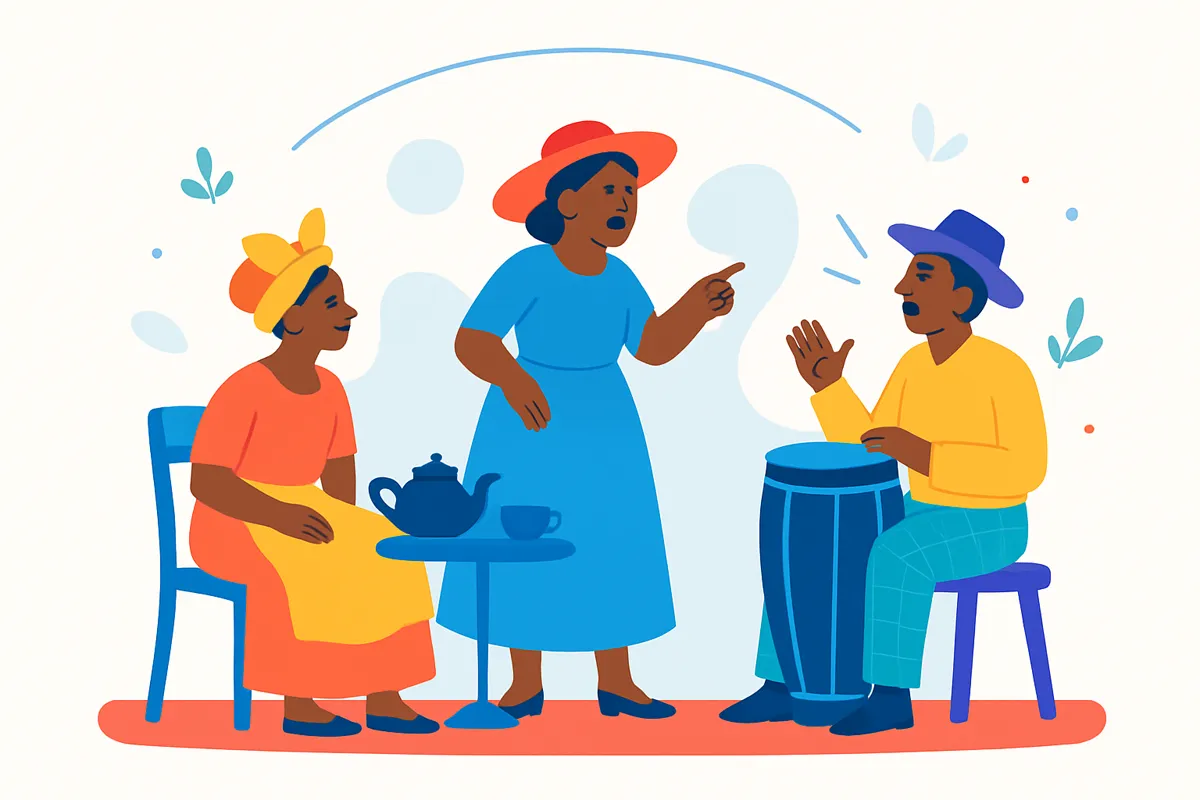
A drama category in a national performing arts festival in Jamaica where a group stages a tea meeting, the community fundraising social with a chairman, speeches, songs and comic turns, in four minutes and scored out of 100.
Drama – Tea Meeting is the third category in the Drama discipline of the Jamaican national performing arts festival that this template is rebuilt from, after Drama – Fantasy and Drama – Gospel Drama. Those two are defined by an imagined setting and by a message. This one is defined by a community custom. A tea meeting is a social evening, traditionally held to raise money for a church, a school or a village hall, at which neighbours gather, share refreshments and are entertained by a programme of speeches, songs, recitations and comic turns presided over by a chairman. The category asks a cast to bring that evening to the stage as a short play.
The extract used to build the template lists the category and its limits but prints no definition, no rule on how closely the play must follow the traditional order of a tea meeting, no rule on dialect and no marking table. This page therefore describes what a tea meeting scene normally contains and does not claim to know what the festival requires. An organiser who runs the category should publish their own wording on script origin, on how much Jamaican speech is welcome, on props such as tables, cups and bells, and on cast size, because those points decide how entries are prepared and how they are compared.
In four minutes the play usually has the shape of a very compressed evening. The chairman opens with a grand welcome in elaborate, over-formal language. Performers are announced one by one and each gives a short turn: a recitation, a song, a speech on a set subject, a comic dialogue. The audience, played by the rest of the cast, reacts throughout, with applause, whispers, heckling and the occasional argument over a long word. Something goes pleasantly wrong, a performer forgets a line or a speech wanders off topic, and the chairman has to restore order before closing with a vote of thanks. The comedy lives in the gap between the grand manner and the everyday people underneath it.
On the template the item is offered in all seven classes, from the youngest children (ages 3-6) to adults (20 and over) and the combined class. Every class has the same limits: four minutes with a warning bell at three, a score out of 100, both genders in one list, English as the language. The template records the entry as a team, so the whole cast is entered together; it does not fix a number of actors, so say in your notice what the minimum and maximum cast size is and whether the cast may also perform the mini-turns inside the meeting.
Organisers keep a category like this because it holds on to a piece of local heritage that is easy to lose. It gives older community members a reason to teach the form to children, it suits mixed-age casts in the combined class, and it puts a comic, audience-facing style of performance on the same programme and the same clock as every other drama entry.
Where Drama – Tea Meeting is run
On eTalenter this item is used in one template, the Jamaican national performing arts festival template, where it is assigned to all seven classes (six age bands from 3-6 up to adults aged 20 and over, plus a combined class) inside the Drama discipline. The tea meeting itself is a community custom rather than a festival invention: churches, schools and community groups in Jamaica and in other English-speaking Caribbean communities hold tea meetings as fundraisers and heritage evenings, and the same style turns up in school concerts and cultural days. Each event sets its own rules on script, dialect, props, cast size and time, so read the notice of the event you are entering instead of assuming the limits here.
- Jamaica (the national performing arts festival the template is built from)
Key facts
- A short group play that stages a tea meeting, the community social evening with a chairman and a programme of turns, with the entry recorded as a team on the template
- Open to both genders in one list, with the language set to English
- Offered in all seven classes, from Class 1 (ages 3-6) to Class 6 (adults, 20 and over) and the combined class
- Four-minute limit with the warning bell at three minutes
- Scored out of 100 on the template; the festival awards medals against published mark bands rather than first, second and third
- Sits beside the other genre categories on the same list (Fantasy, Gospel Drama, Farce, Tragedy, Comedy, Musical) and is the only one built on a named community custom
- The extract used for the template prints no definition, no rule on dialect, props or cast size and no per-criterion weights, so none are asserted here
On eTalenter, Drama – Tea Meeting is filed under On Stage and typically scored with Marks. It appears in 1 ready-made event templates — each one can adjust its time limit, age-group assignment and scoring setup independently.
Across the templates that use it, Drama – Tea Meeting is most often entered as an Team competition, typically scored out of 100, commonly time-limited to around 4 minutes where a limit is set.
What judges look at in Drama – Tea Meeting
What a Drama – Tea Meeting panel is actually weighing up, and where the marks are usually won or lost:
- The source does not print this category’s marking table, so what follows is organiser guidance for agreeing yardsticks with the panel, not rules from the source
- The chairman: a confident, ceremonial presence who runs the evening, introduces each turn and keeps control when it slips, because the whole play hangs on that role being believable and funny
- Contrast of manner: grand, over-formal language set against ordinary village talk, where the humour comes from the gap and not from a performer shouting or pulling faces
- The programme: the turns inside the meeting are short, different from one another and well chosen, so the play moves quickly instead of repeating the same kind of joke
- The audience on stage: the cast members who sit as the audience react in character, with applause, murmurs and heckling, and never freeze or look at the real panel while others perform
- Feel of the occasion: a table, cloth, cups, a bell or a small sign is enough to say tea meeting at once, and the costume suits a community evening instead of a fancy-dress party
- Voice and diction: every line is heard at the back of the room, including the long words, which are pronounced with care so the audience enjoys them rather than strains to catch them
- Timing and pace: laughs are allowed to land, the turns follow each other without gaps, and the play reaches its vote of thanks inside four minutes
- Respect for the form: the play honours a real community custom, and a panel can mark down a cast that treats it as only a joke at the expense of the people who keep it
Treat these as the judging focus, not a fixed rubric: publish your own weighted criteria for Drama – Tea Meeting under Scoring Setup, or start from the full drama & skit judging criteria guide.
How to prepare for Drama – Tea Meeting
How entrants and their teachers usually get Drama – Tea Meeting right on the day:
- Ask the organiser in writing how closely the play must follow the traditional order of a tea meeting, how much Jamaican speech is welcome in an English-language entry, and what cast size is allowed, and keep the answer with your entry paperwork
- Talk to someone who has been to a tea meeting, a grandparent, a church elder or a teacher, and listen to how the chairman actually speaks, what the turns were and what made people laugh
- Write the running order first: opening welcome, three or four turns of about 30 to 40 seconds each, one small mishap, a vote of thanks. Add up the times before you write any dialogue
- Cast the chairman first and give that role to the most confident speaker in the group, then give the rest of the cast two jobs each, one as a performer and one as a member of the audience
- Practise the big words slowly, then at speed, then with laughter in the room. Long words that stumble out in the wrong order lose the joke, so test each one with a listener at the back of the hall
- Keep the set to what the cast can carry in and out in seconds: a small table, a cloth, a bell and a few cups are plenty. Agree where every prop sits before the warning bell at three minutes
- Rehearse the audience reactions as seriously as the turns. Decide who applauds, who whispers and who objects, and give each reaction a cue so it does not step on the performer’s line
- Time the full play aloud with the pauses for laughter, then cut a turn if it runs over; the vote of thanks is the ending and must still be spoken if the middle runs long
- With the youngest classes, build the meeting around short turns the children already know, a rhyme, a short song, a riddle, and let them play the audience with big, clear reactions
- Rehearse recovering from a missed cue: the chairman rings the bell, makes a comment and moves to the next turn, so a slip becomes part of the play and not a stall
Ready-made event templates that include Drama – Tea Meeting
Open any template to preview it in eTalenter and install it as a live, editable event.
| Template | Category | Score label | Competitions |
|---|---|---|---|
| JCDC National Performing Arts Festival (Jamaica) | On Stage | Marks | 7 |
Frequently asked questions
Is Drama – Tea Meeting judged individually or as a team?
Across eTalenter’s templates it’s most often run as an Team entry, though an organiser can set either participation type when assigning the item to an age group.
What is a tea meeting?
A community social evening, traditionally a fundraiser for a church, school or hall, with refreshments and a programme of speeches, songs, recitations and comic turns led by a chairman. In this festival category a team stages it as a short play. The extract used for this template gives no further definition, so check the organiser’s notice for the rules.
Is it a play or a variety show?
It sits in the Drama discipline and the template records it as a team entry, so it should be performed as a short play with characters and a shape. The turns inside the meeting give it a variety-show feel, but the cast stays in character from the welcome to the vote of thanks.
Can we use Jamaican speech?
The template sets English as the language and does not say how much Jamaican speech is welcome. Ask the organiser. If it is allowed, keep it clear enough that the whole room, including the panel, follows every line.
Can the turns inside the meeting include real songs and recitations?
The template does not say. The category is set at four minutes, so any song or recitation counts against the same clock as the acting; ask the organiser whether live or recorded music is permitted and whether the turns must be original.
How long can it be and how is it marked?
The template sets four minutes with a warning bell at three, and scores out of 100. The festival awards medals against mark bands, and the extract used for the template prints no per-criterion weights for this category, so an organiser using it should agree and publish their own.
How is Tea Meeting different from Drama – Skit or Drama – Farce?
Tea Meeting is built on one named community occasion and its cast of recognisable roles, with the chairman at the centre. Skit and Farce are open comic forms with no fixed setting. They are separate categories on the same festival list and entering one does not enter you for the other.
Want the full judging picture? Read the full drama & skit judging criteria guide, or browse every on stage competition item.
Try Drama – Tea Meeting in eTalenter
See every ready-made template that runs Drama – Tea Meeting, and install one as a live event — age groups, rules and scoring included.



Leave a Reply
You must be logged in to post a comment.