
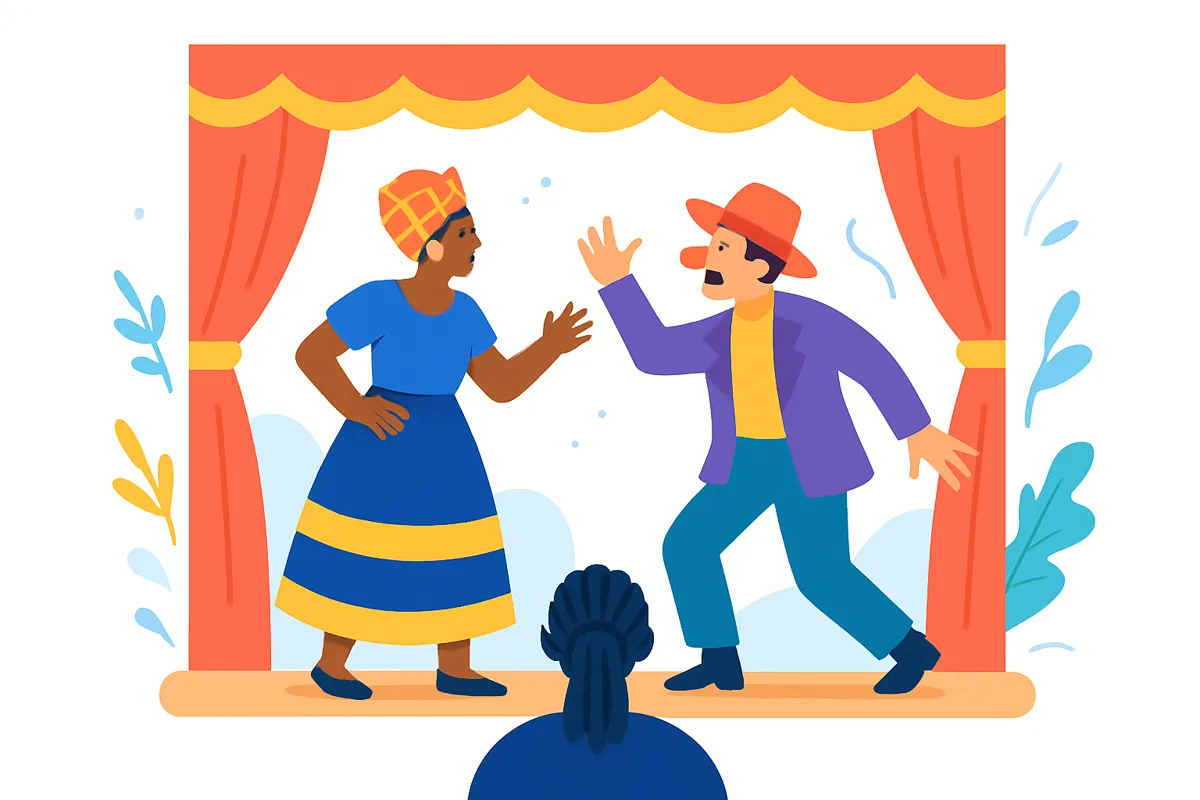
A drama category in a national performing arts festival in Jamaica where a group plays a farce, a fast, deliberately over-the-top comedy of mix-ups and chaos, in four minutes and scored out of 100.
Drama – Farce is the fourth category in the Drama discipline of the Jamaican national performing arts festival that this template is rebuilt from, after Drama – Fantasy, Drama – Gospel Drama and Drama – Tea Meeting. Those three are defined by an imagined world, a message and a community custom. Farce is defined by a style of comedy. A farce is a play in which an ordinary situation spirals into chaos: a lie has to be covered by a bigger lie, a person is mistaken for someone else, a secret is nearly discovered at every entrance, and the cast gets more frantic as the plot tightens. The audience laughs because it can see the trap closing before the characters can.
The extract used to build the template lists the category and its limits but prints no definition, no rule on where the script must come from, no rule on cast size and no marking table. This page therefore describes what a farce normally contains and does not claim to know what the festival requires. An organiser who runs the category should publish their own wording on script origin, on how much physical comedy is acceptable in front of young children, on props and on cast size, because those points decide how entries are prepared and how they are compared.
In four minutes a farce is a very compressed run of cause and effect. A simple premise is set up in the first twenty seconds: two friends have promised to be in two places at once, a visitor arrives too early, a parcel has been swapped. A complication follows, then a second one on top of it, and the characters start to dodge, hide, pretend and bluff. Exits and entrances come fast, someone hears half a sentence and draws the wrong conclusion, and the pace rises until everything collides in one comic knot. A short, neat resolution, or a deliberately ridiculous one, closes the piece before the bell.
On the template the item is offered in all seven classes, from the youngest children (ages 3-6) to adults (20 and over) and the combined class. Every class has the same limits: four minutes with a warning bell at three, a score out of 100, both genders in one list, English as the language. The template records the entry as a team, so the whole cast is entered together; it does not fix a number of actors, so say in your notice what the minimum and maximum cast size is.
Organisers keep a category like this because it rewards something that is hard to teach and easy to see: comic timing and group discipline. A farce only works when every performer hits every cue, so it shows a panel how well a cast has rehearsed, and it gives children and adults an energetic, crowd-pleasing alternative to the more serious genre categories on the same programme and the same clock.
Where Drama – Farce comes from
The word farce comes from the French for stuffing, and was first used for the short comic scenes that medieval performers inserted into religious plays. Later writers built whole comedies on the same ingredients of mistaken identity and escalating confusion, which is why a farce today is recognised by its plot machinery as much as by its jokes.
Where Drama – Farce is run
On eTalenter this item is used in one template, the Jamaican national performing arts festival template, where it is assigned to all seven classes (six age bands from 3-6 up to adults aged 20 and over, plus a combined class) inside the Drama discipline. Farce itself is an international comic form that is performed in school drama clubs, amateur theatre festivals and one-act play competitions in many countries, so a cast that has done a farce elsewhere will recognise the shape. Each event sets its own rules on script origin, props, cast size and time, so read the notice of the event you are entering instead of assuming the limits here.
- Jamaica (the national performing arts festival the template is built from)
Key facts
- A short group play in the farce style, built on mix-ups, bluffs and escalating confusion, with the entry recorded as a team on the template
- Open to both genders in one list, with the language set to English
- Offered in all seven classes, from Class 1 (ages 3-6) to Class 6 (adults, 20 and over) and the combined class
- Four-minute limit with the warning bell at three minutes
- Scored out of 100 on the template; the festival awards medals against published mark bands rather than first, second and third
- Sits beside the other genre categories on the same list (Fantasy, Gospel Drama, Tea Meeting, Tragedy, Comedy, Musical) and is the one defined by pace and plot machinery
- The extract used for the template prints no definition, no rule on script origin or cast size and no per-criterion weights, so none are asserted here
On eTalenter, Drama – Farce is filed under On Stage and typically scored with Marks. It appears in 1 ready-made event templates — each one can adjust its time limit, age-group assignment and scoring setup independently.
Across the templates that use it, Drama – Farce is most often entered as an Team competition, typically scored out of 100, commonly time-limited to around 4 minutes where a limit is set.
What judges look at in Drama – Farce
What a Drama – Farce panel is actually weighing up, and where the marks are usually won or lost:
- The source does not print this category’s marking table, so what follows is organiser guidance for agreeing yardsticks with the panel, not rules from the source
- The premise: it is clear within the first half minute what the characters want and what could go wrong, because a farce the audience cannot follow cannot be funny
- Escalation: each complication makes things worse than the one before, so the play builds towards one big collision and does not simply repeat the same gag
- Playing it straight: the characters believe every word of their own lies and panics, because the humour comes from sincerity under pressure and not from performers winking at the audience
- Timing and pace: lines overlap on cue, entrances and exits are crisp, and pauses are used on purpose just before a reveal, with nothing slowing the middle
- Physical comedy under control: slips, hides, double takes and chases are staged so they are safe, readable from the back of the room and clearly rehearsed, never random shoving
- Voice and diction: fast lines are still every word audible, since a joke that is lost to mumbling at speed is lost altogether
- Group discipline: every cast member knows who is on stage, where they are standing and what they are reacting to, so the stage looks busy without being messy
- The ending: the play reaches a clear, satisfying finish inside four minutes, rather than being cut off by the bell mid-confusion
Treat these as the judging focus, not a fixed rubric: publish your own weighted criteria for Drama – Farce under Scoring Setup, or start from the full drama & skit judging criteria guide.
How to prepare for Drama – Farce
How entrants and their teachers usually get Drama – Farce right on the day:
- Ask the organiser in writing whether the script may be original, how much physical comedy is allowed for the age class, and what cast size is permitted, and keep the answer with your entry paperwork
- Choose one simple premise a child could repeat in a sentence, such as two people who must both pretend they are not at home, and build every complication from that single idea
- Write the plot as a chain: this happens, so that happens, so now this goes wrong. Check that each beat makes the previous one worse, then trim anything that does not
- Plan the entrances and exits on a floor plan first. Mark where every door, chair and hiding place is and who is behind or in front of it at each beat, so nobody collides by accident
- Rehearse slowly for safety, then at full speed. Run the physical moments many times without lines, because slips and chases that are loose in rehearsal become dangerous on a stage
- Give every actor a clear comic job, the bluffer, the one who overhears, the one who never gets told, so the whole cast has something to play and no one is just standing there
- Practise fast lines with a listener at the back of the hall and cut any joke they cannot hear. Speed is for the plot, not for swallowing words
- Time the full play aloud, then cut a complication if it runs past four minutes. The ending must still land, so protect the last twenty seconds above everything else
- With the youngest classes, use a very small cast, a short premise they already find funny, such as a missing shoe or a hungry visitor, and big, clear gestures; do not rely on fast overlap
- Keep props to a few strong items that can be set in seconds, and agree before the performance where each one sits so no one hunts for a hat while the bell is ringing
Ready-made event templates that include Drama – Farce
Open any template to preview it in eTalenter and install it as a live, editable event.
| Template | Category | Score label | Competitions |
|---|---|---|---|
| JCDC National Performing Arts Festival (Jamaica) | On Stage | Marks | 7 |
Frequently asked questions
Is Drama – Farce judged individually or as a team?
Across eTalenter’s templates it’s most often run as an Team entry, though an organiser can set either participation type when assigning the item to an age group.
What is a farce?
A comic play built on an exaggerated situation that gets steadily more tangled: mistaken identity, lies that need bigger lies, near-discoveries and fast entrances and exits. The extract used for this template gives no further definition, so check the organiser’s notice for any rules.
How is Farce different from Drama – Comedy?
Both are funny. A comedy can be gentle and character-led. A farce is driven by plot and pace, with absurd situations and physical action and a rising sense of panic. They are separate categories on the same festival list and entering one does not enter you for the other.
Is it the same as Drama – Skit?
Not exactly. A skit is a short sketch that can be a single joke. A farce is a miniature plot with a set-up, complications and a collision, even in four minutes. Both sit under Drama on this template as separate categories.
Can we use slapstick and falls?
The template does not say. Keep any physical comedy safe and well rehearsed, and ask the organiser whether there are limits for the age class, particularly the younger classes, and whether props such as chairs or tables are provided.
How long can it be and how is it marked?
The template sets four minutes with a warning bell at three, and scores out of 100. The festival awards medals against mark bands, and the extract used for the template prints no per-criterion weights for this category, so an organiser using it should agree and publish their own.
Is it entered as a team or as individuals?
The template records it as a team entry in every class, with both genders in one list. It does not fix a number of actors, so ask the organiser for the minimum and maximum cast size.
Want the full judging picture? Read the full drama & skit judging criteria guide, or browse every on stage competition item.
Try Drama – Farce in eTalenter
See every ready-made template that runs Drama – Farce, and install one as a live event — age groups, rules and scoring included.



Leave a Reply
You must be logged in to post a comment.