
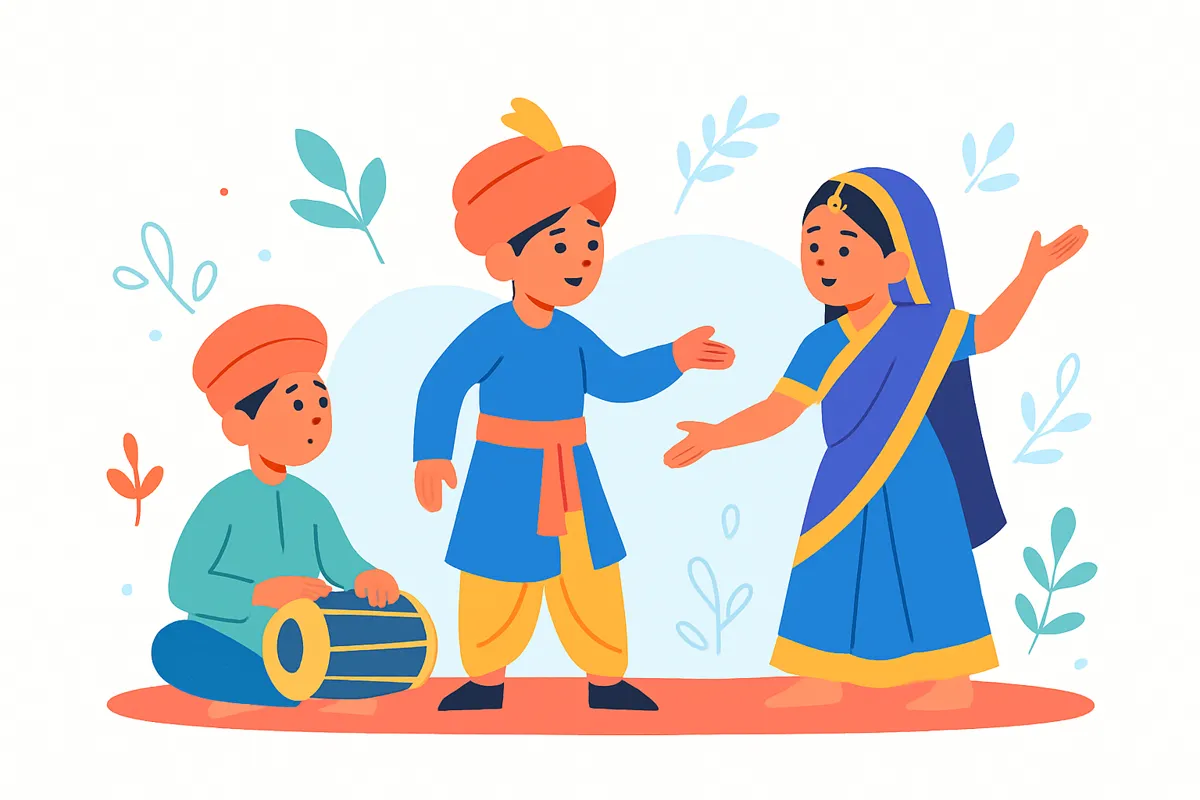
A short play for young performers aged 8 to 16, staged in Marathi by a children’s team and judged as a whole production on story, acting, direction and presentation.
Balnatya means children’s drama. It is a team item in which a group of young performers plays a complete piece before a panel, in Marathi on the template that carries it. Boys and girls take part together, and the template sets the entrant age band at 8 to 16.
On the eTalenter template that holds it, Balnatya is a Team entry for both genders, set up in two groups with the same age band: a general Balnatya group and a separate Divyang Balnatya group for differently-abled children. Each group is its own competition, so a differently-abled children’s troupe is judged against its peers and not against the general field.
A round is a staged performance. The troupe sets up, plays the piece and clears the stage, and the panel scores the production as one piece of work. A good children’s play has a story young performers can believe in, parts sized to each child’s ability, and a message or idea that comes through without being spelt out.
The item sits beside the adult amateur, musical, Hindi, Sanskrit and professional streams of the same state drama contest. Organisers keep the children’s stream separate so that young casts are not measured against experienced adult companies, and so that theatre groups have a reason to grow a junior wing.
Where Balnatya (Children’s Drama) comes from
Balnatya is the Marathi term for children’s theatre: plays written for, and performed by, young people rather than adults acting for a young audience.
Where Balnatya (Children’s Drama) is run
On the eTalenter templates this exact title appears once, on a Maharashtra state drama competition template, as an On Stage team item with Marathi as the language. It is used in two groups there, a general children’s group and a group for differently-abled children, both aged 8 to 16. A school or children’s festival elsewhere would normally run a generic children’s play or skit item under its own rules.
- Maharashtra, India
Key facts
- Team item, boys and girls together
- Age band 8 to 16 on the template, in two groups: Balnatya and Divyang Balnatya (differently-abled children)
- Marathi language on the template
- Judged as one production: story, acting, direction and presentation
- The template’s 10-minute time field is the app default, not a published limit; set the true limit in your own event
- Scored as a rating out of 10 per judge on the template; the real contest publishes no numeric marking scheme
On eTalenter, Balnatya (Children’s Drama) is filed under On Stage and typically scored with Rating out of 10. It appears in 1 ready-made event templates — each one can adjust its time limit, age-group assignment and scoring setup independently.
Across the templates that use it, Balnatya (Children’s Drama) is most often entered as an Team competition, typically scored out of 100, commonly time-limited to around 10 minutes where a limit is set.
What judges look at in Balnatya (Children’s Drama)
What a Balnatya (Children’s Drama) panel is actually weighing up, and where the marks are usually won or lost:
- A story children can carry: a simple, clear plot with a beginning, a turn and an ending, rather than an adult script handed to young actors
- Ensemble acting: every child with a real part, listening to the others, staying in character and speaking so the back row can hear
- Direction and staging: tidy entrances and exits, movement that fills the stage, and no long stretches where children stand without purpose
- Marathi diction and expression: clear, confident speech with natural feeling, not recited lines
- Simple, workable design: costume, props and set that suit the story and can be placed and cleared quickly by a young crew
- Time discipline: finishing inside the organiser’s limit without rushing the final scene
Treat these as the judging focus, not a fixed rubric: publish your own weighted criteria for Balnatya (Children’s Drama) under Scoring Setup, or start from the full drama & skit judging criteria guide.
How to prepare for Balnatya (Children’s Drama)
How entrants and their teachers usually get Balnatya (Children’s Drama) right on the day:
- Pick a story with a clear idea and roles that fit each child’s age and confidence, so no part is too big or too small
- Teach the story before the lines: let the children retell it in their own words, then move to the script
- Rehearse speaking up and facing the audience; young casts lose marks most often on volume and turned backs
- Block the stage with marks the children can remember, and rehearse entrances and exits as carefully as scenes
- Do at least two timed run-throughs against the competition limit and trim lines rather than speeding up
- Keep costume and props simple, safe and easy for children to carry and place
- For a Divyang Balnatya entry, plan accessible staging and cues with the children from the first rehearsal, and confirm any needs with the organiser well before the day
- After a preliminary round, ask for the panel’s remarks and fix the weakest scene before the final
Ready-made event templates that include Balnatya (Children’s Drama)
Open any template to preview it in eTalenter and install it as a live, editable event.
| Template | Category | Score label | Competitions |
|---|---|---|---|
| Maharashtra State Drama Competition (Rajya Natya Spardha, India) | On Stage | Rating out of 10 | 2 |
Frequently asked questions
Is Balnatya (Children’s Drama) judged individually or as a team?
Across eTalenter’s templates it’s most often run as an Team entry, though an organiser can set either participation type when assigning the item to an age group.
What ages can take part in Balnatya?
On the template the age band is 8 to 16. Your own event can set a different range, so confirm it against the competition notice.
What is the difference between Balnatya and Divyang Balnatya?
They use the same item and age band but are separate groups. Divyang Balnatya is for differently-abled children, who are judged against each other rather than the general children’s field.
Is Balnatya the same as a school skit?
Not quite. Balnatya is a full children’s play in Marathi on a state drama contest template, while a skit is usually shorter and set by the rules of a school or festival event.
How long can the play run?
The template shows a 10-minute time field, but that is the app default and not a published limit. Set the real length from your own competition notice.
Is it judged individually or as a team?
As a team. The whole production receives the rating, although a published result may also name craft or acting awards.
Want the full judging picture? Read the full drama & skit judging criteria guide, or browse every on stage competition item.
Try Balnatya (Children’s Drama) in eTalenter
See every ready-made template that runs Balnatya (Children’s Drama), and install one as a live event — age groups, rules and scoring included.

Leave a Reply
You must be logged in to post a comment.