
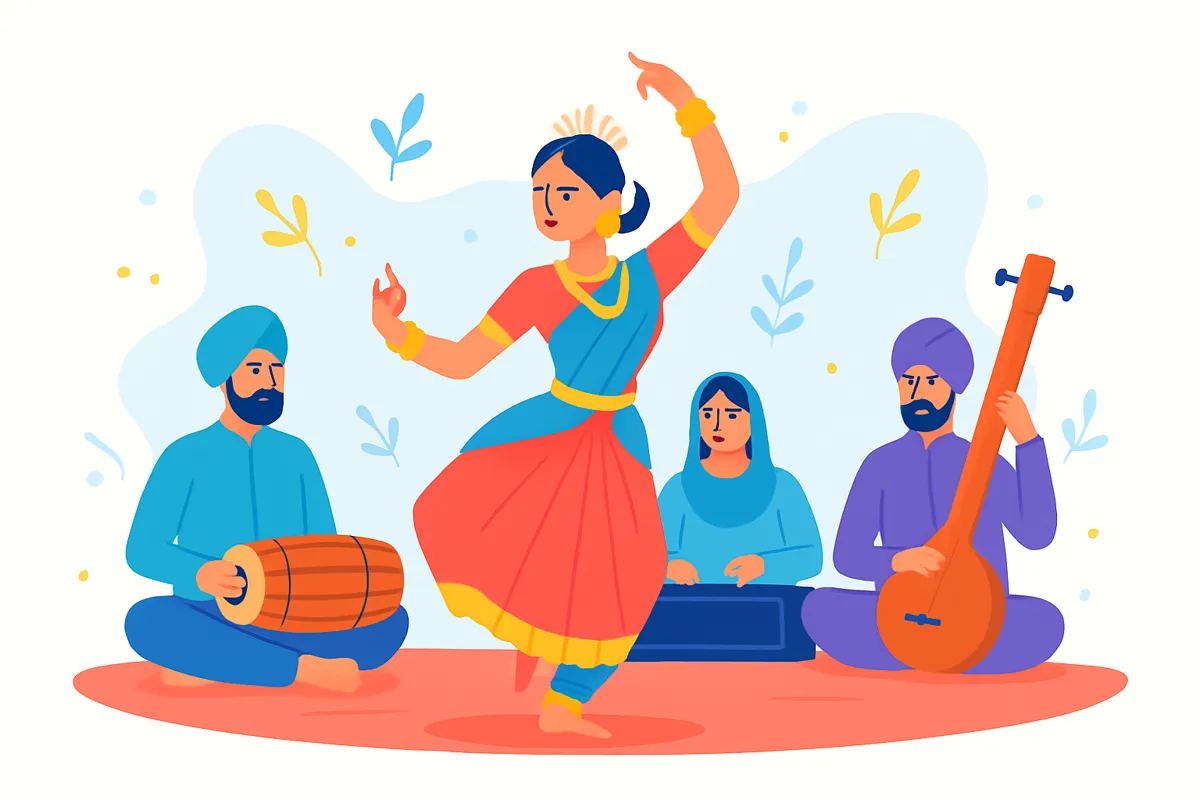
A solo classical dance item at a university youth festival, performed in the entrant’s chosen Indian classical style and marked out of 100 in a fifteen-minute slot.
Indian Classical Dance is the solo classical dance item of an inter-collegiate youth festival. Instead of fixing one style, the item is open to the classical dance traditions of India, so a Bharatanatyam dancer, an Odissi dancer and a Kathak dancer can all enter the same class and are marked against each other on one scale.
On the day, each competitor performs alone on stage for up to fifteen minutes. Most entrants build the slot from one or two pieces of the repertoire they have trained in: a pure-dance section built on rhythm and geometry of movement, followed by a section where the dancer interprets a song or a story through facial expression and hand gesture. Music is usually recorded and handed over to the sound desk before the item starts, so the dancer arrives with a clean, tested track.
The item is open to students of both genders competing together, with a single Students age band running from 17 to 25 years. It is marked out of 100, and the result feeds the college’s total in the festival standings, which is why colleges tend to send their strongest trained dancer rather than a casual entrant.
Organisers like the item because it brings serious traditional training onto a campus stage without a long list of separate style classes. The trade-off is that a panel has to compare very different forms fairly, so the best-prepared entrants make their chosen style obvious from the first minute and keep to the time limit.
Where Indian Classical Dance is run
In this library the item is carried by the University of Mumbai’s inter-collegiate youth festival template, where it sits in the Classical Dance category with a fifteen-minute limit. Universities across India run an equivalent solo classical dance item under similar youth-festival rules, but styles split into separate named classes at many of them, so check the programme of the festival you are entering.
- Maharashtra, India
Key facts
- Individual item: one dancer on stage.
- Open to both genders, competing together in a single class.
- Students age band, 17 to 25 years.
- Time limit of 15 minutes for the performance.
- Marked out of 100.
- Any recognised Indian classical style may be presented; there is no language restriction.
On eTalenter, Indian Classical Dance is filed under Classical Dance and typically scored with Marks. It appears in 1 ready-made event templates — each one can adjust its time limit, age-group assignment and scoring setup independently.
Across the templates that use it, Indian Classical Dance is most often entered as an Individual competition, typically scored out of 100, commonly time-limited to around 15 minutes where a limit is set.
What judges look at in Indian Classical Dance
What a Indian Classical Dance panel is actually weighing up, and where the marks are usually won or lost:
- Technique and footwork: clean, accurate rhythmic movement, correct postures and sharp, controlled transitions are where a classical panel starts. Wobbly lines and rushed steps cost marks fast.
- Taal and rhythm: staying in time with the music and landing the closing beats of each phrase on the count. A dancer who drifts off the beat loses more than one who simply has a simpler piece.
- Abhinaya and expression: facial expression and hand gestures that actually tell the story or carry the mood, not a fixed smile held for fifteen minutes.
- Authenticity of the style: a performance that stays recognisably within one tradition, in its costume, repertoire and movement vocabulary, scores better than a loose mixture.
- Stage use and finish: using the full stage, a confident entry and exit, and ending on time. Overrunning the fifteen-minute slot is a common avoidable loss.
Treat these as the judging focus, not a fixed rubric: publish your own weighted criteria for Indian Classical Dance under Scoring Setup, or start from the full classical dance judging criteria guide.
How to prepare for Indian Classical Dance
How entrants and their teachers usually get Indian Classical Dance right on the day:
- Choose a piece you can perform cleanly, not the hardest one in your repertoire. Judges reward control over ambition.
- Cut your piece to about thirteen minutes in rehearsal so that nerves, a slow entry or a late music cue do not push you over fifteen.
- Prepare the music track in advance, test it on a different speaker, and carry a backup copy. Hand over a clearly labelled file before your turn.
- Record yourself from the front of a hall and watch it with the sound off. If the story is not clear without the music, the expression needs work.
- Plan the costume, jewellery and make-up to match your style and check that nothing will slip or jangle in the middle of a fast sequence.
- Rehearse the entry and the final pose as carefully as the dance, since the first and last thirty seconds shape a panel’s impression.
Ready-made event templates that include Indian Classical Dance
Open any template to preview it in eTalenter and install it as a live, editable event.
| Template | Category | Score label | Competitions |
|---|---|---|---|
| University of Mumbai Youth Festival | Classical Dance | Marks | 1 |
Frequently asked questions
Is Indian Classical Dance judged individually or as a team?
Across eTalenter’s templates it’s most often run as an Individual entry, though an organiser can set either participation type when assigning the item to an age group.
Is Indian Classical Dance the same as Bharatanatyam?
No. Bharatanatyam is one specific style. This item is open to Indian classical styles in general, so a Bharatanatyam dancer can enter, but so can a Kathak or an Odissi dancer.
How long is the performance?
The template sets a limit of 15 minutes for the solo performance, and the item is marked out of 100.
Can a team enter?
No. It is an individual item with one dancer on stage. Group dances are separate items in the festival programme.
Can I use recorded music?
Recorded music is the usual choice for a solo classical item. Confirm the exact arrangements for accompanists and sound with your festival’s rule document before the day.
Want the full judging picture? Read the full classical dance judging criteria guide, or browse every classical dance competition item.
Try Indian Classical Dance in eTalenter
See every ready-made template that runs Indian Classical Dance, and install one as a live event — age groups, rules and scoring included.



Leave a Reply
You must be logged in to post a comment.