
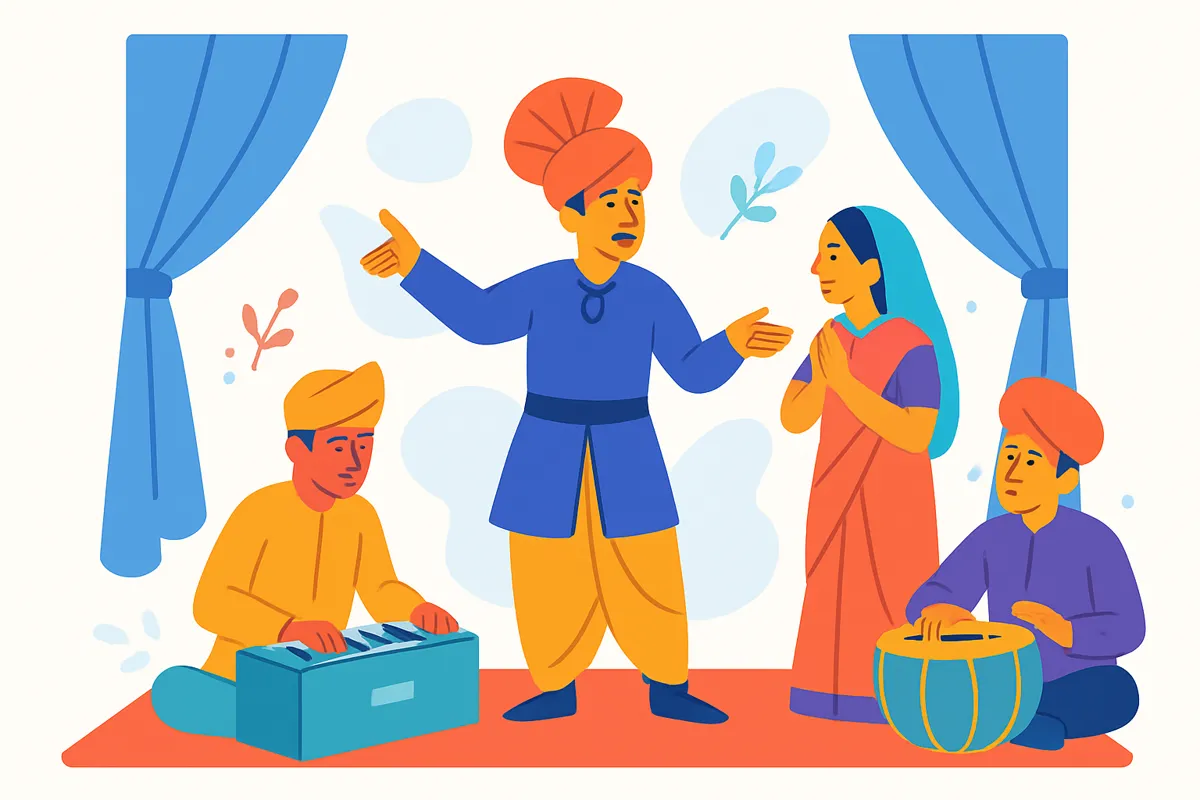
A staged team drama performed in one continuous act in a language other than the festival’s home language, judged on acting, direction and stagecraft.
One Act Play (Any Other Language) is the open-language version of the festival’s regional-language one act play. A cast performs a complete, scripted drama in a single continuous act, but the language is not tied to the host’s home language. Most casts choose English or Hindi, which lets a college drama group whose best scripts and strongest speakers work in another language still take part in the same showpiece session.
In the university youth festival that carries it in this library, the item is a Team event open to both genders in a single Students band of 17 to 25 years. The limit is 30 minutes, the mark is out of 100, and the language field is left open (‘Any/NA’). The sister item at the same festival, One Act Play, is fixed to Marathi, so a company enters whichever matches the language of its script, not both.
A round is judged live, with the company given one slot. The group walks on, plays the whole piece without an interval, and clears the stage. A strong entry is a proper play rather than a stretched skit: a clear situation, characters who want something, a turn in the middle and a real ending. Because a single act has no room for subplots, the best scripts keep to one place and one central conflict, such as a family argument over a sale of land, a hostel room on the night before results, or a village meeting that must reach a decision.
Organisers run an any-language drama item so that the regional-language contest stays fair for casts who work in that language, while students from other language backgrounds are not shut out of the stage. The cost is that the language must be settled before rehearsals begin. A panel has to be able to follow the dialogue, so a play that switches between several languages without a reason can lose clarity and marks.
Where One Act Play (Any Other Language) is run
In this library the item is carried by a single template, a university inter-collegiate youth festival in Maharashtra, where it sits in the Action category beside the Marathi version of One Act Play. Many Indian college festivals run English or Hindi drama alongside a regional-language item, but names, time limits and rules differ from one festival to the next, so check your own programme. The general one act play format, including how other festivals set time and language, is described on the One Act Play page.
- Maharashtra, India (university youth festival)
Key facts
- Team event, open to both genders competing together.
- Single Students band, 17 to 25 years.
- Thirty-minute limit, marked out of 100, with no warning bell set in the template.
- Language is open (‘Any/NA’): any language the panel can follow, agreed before the round.
- The same festival’s Marathi One Act Play is a separate item with its own entries; enter the one that matches your script’s language.
- Ideas, not rules: a hostel room on results night, a panchayat meeting that must vote, a railway platform where a delayed train traps strangers, a family deciding what to do with an inherited shop.
On eTalenter, One Act Play (Any Other Language) is filed under Action and typically scored with Marks. It appears in 1 ready-made event templates — each one can adjust its time limit, age-group assignment and scoring setup independently.
Across the templates that use it, One Act Play (Any Other Language) is most often entered as an Team competition, typically scored out of 100, commonly time-limited to around 30 minutes where a limit is set.
What judges look at in One Act Play (Any Other Language)
What a One Act Play (Any Other Language) panel is actually weighing up, and where the marks are usually won or lost:
- Whole-cast acting: voice, expression and character consistency from every actor, not only the lead roles.
- Fluency in the chosen language: clear diction and natural delivery, so that the panel follows every line without needing a translation.
- Direction: blocking, pace and a story that holds together from the first entrance to the final line.
- A complete single act: a script with a real beginning, development and ending, not a cut-down longer play or a string of sketches.
- Stagecraft: set, props, costume, lighting and sound used with purpose and handled cleanly between cues.
- Ensemble timing and time discipline: cues picked up promptly, and the whole play, with set-up and clear-down where the rules count them, inside the 30 minutes.
Treat these as the judging focus, not a fixed rubric: publish your own weighted criteria for One Act Play (Any Other Language) under Scoring Setup, or start from the full drama & skit judging criteria guide.
How to prepare for One Act Play (Any Other Language)
How entrants and their teachers usually get One Act Play (Any Other Language) right on the day:
- Settle the performance language before casting, and choose actors who can act in it, not just read it. Test this with an unscripted two-minute improvisation.
- Pick or write a script that plays comfortably in about 25 minutes, leaving room for pauses, laughs and scene changes inside the 30-minute limit.
- Build the play around one location and one central conflict. A single act has no space for subplots.
- Rehearse with a stopwatch from the first run-through, and fix entrances, exits and any set changes early so they are quick and quiet.
- Write the lighting and sound cues down, and run them with the real operators at least once before the day.
- Rehearse projection in a large hall: a quiet delivery in a second language is hard for a panel to follow from the back rows.
- Keep the set light enough to carry on and off by the cast alone, then do a full timed run that includes the set-up and the clear-down.
Ready-made event templates that include One Act Play (Any Other Language)
Open any template to preview it in eTalenter and install it as a live, editable event.
| Template | Category | Score label | Competitions |
|---|---|---|---|
| University of Mumbai Youth Festival | Action | Marks | 1 |
Frequently asked questions
Is One Act Play (Any Other Language) judged individually or as a team?
Across eTalenter’s templates it’s most often run as an Team entry, though an organiser can set either participation type when assigning the item to an age group.
Is One Act Play (Any Other Language) the same as One Act Play?
The format is the same: a complete scripted drama in one continuous act. The difference is language. At the festival that carries both, One Act Play is fixed to Marathi, while this item leaves the language open.
Which language should we perform in?
Any language the panel can follow. Most casts pick English or Hindi, and the safest choice is the language your actors speak most naturally. Agree it before rehearsals and keep to it for the whole play.
How long can the play run?
The template sets a 30-minute limit and marks the entry out of 100. Plan a script of about 25 minutes so that pauses and scene changes still fit.
Is it judged individually or as a team?
As a team. The company is scored together as a Team event open to both genders, on acting, direction and stagecraft.
Want the full judging picture? Read the full drama & skit judging criteria guide, or browse every action competition item.
Try One Act Play (Any Other Language) in eTalenter
See every ready-made template that runs One Act Play (Any Other Language), and install one as a live event — age groups, rules and scoring included.


Leave a Reply
You must be logged in to post a comment.