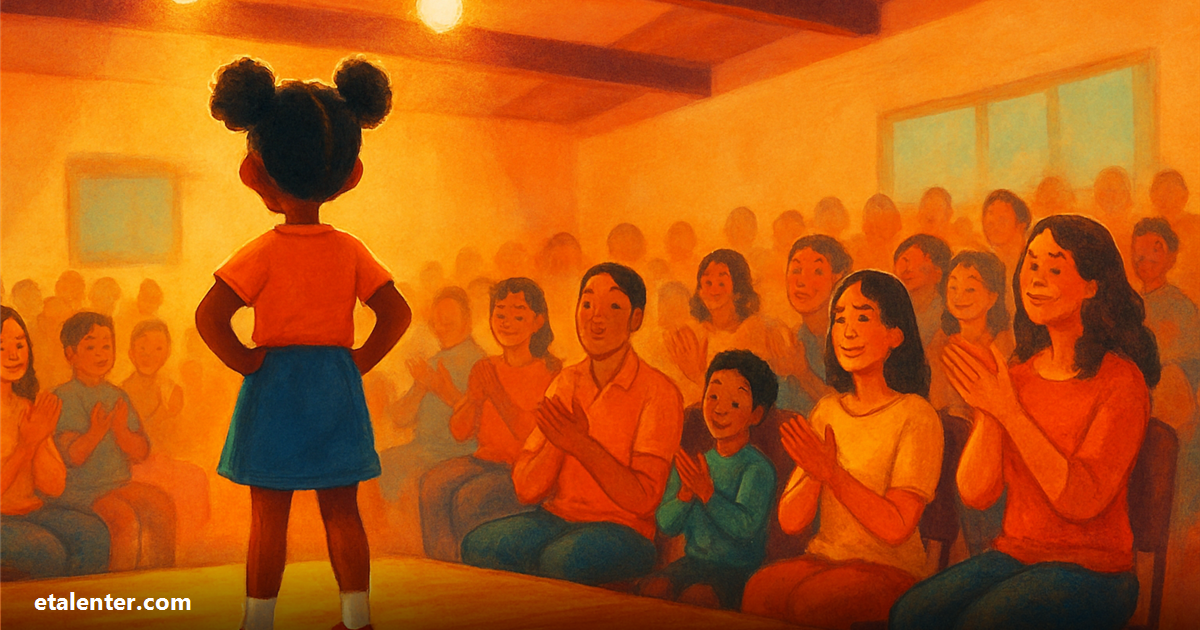
If your child freezes at the edge of the stage, cries before a school competition, or begs to skip the item they practised all week, you are dealing with stage fear — and it is one of the most common and most fixable hurdles in a child’s early years. This is a practical guide for parents and teachers: what actually causes stage fright in children, why pulling them out makes it worse, and the simple, at-home techniques that help a nervous child walk onto a kalolsavam or talent-test stage with a steady voice. You are not trying to erase the nerves — even seasoned performers feel them. You are teaching your child to perform with them.
Why children get stage fear (and why it is normal)
Stage fear is the body’s fight-or-flight response firing at the wrong moment. Facing an audience feels, to a young brain, like facing a threat — the heart races, the mouth goes dry, hands shake and the mind goes blank. It is not weakness or lack of talent. The most common triggers in children are:
- Fear of forgetting — worrying they will blank on the words, steps or lines.
- Fear of judgement — imagining the audience or judges are waiting for them to fail.
- Too little rehearsal in real conditions — practising alone in a room is nothing like standing on a lit stage.
- Pressure to win — when the goal becomes the prize instead of the performance, the stakes feel unbearable.
Understanding the cause matters, because the fix is not “just be brave.” It is preparation, exposure and the right words from the adults around them.
What actually helps: techniques you can practise at home
These are the things that genuinely move the needle, in roughly the order you should use them:
- Rehearse in front of a small, friendly audience. The single most effective step. Have the child perform for grandparents, cousins or a few classmates before the real day. Familiarity with “eyes on me” removes most of the fear.
- Over-prepare the opening. Most stage fright peaks in the first ten seconds. If the first line, first step or first note is automatic, confidence carries the rest. Drill the start until it is effortless.
- Teach one calming breath. A slow breath in and a long breath out, taken once before they begin, physically slows a racing heart. Practise it so it becomes a habit, not a scramble.
- Practise recovering, not just performing. Deliberately let them “forget” a line in rehearsal and teach them to pause, breathe and continue. A child who knows a stumble is survivable stops fearing it.
- Rehearse standing, eyes up. Pick three points at the back of the room to look at. Practising to the floor builds the habit of looking down on the day.
- Visit or picture the stage. If possible, let them stand on the actual stage beforehand. If not, describe it — the lights, the judges’ table, the mic — so nothing is a surprise.
On the day: what parents and teachers should (and shouldn’t) say
Your words in the final hour matter more than a week of practice. Keep them calm and process-focused:
- Say “do your best and enjoy it,” not “you have to win.” Removing the outcome removes most of the pressure.
- Arrive early and settle. A rushed, breathless arrival feeds the panic. Time to see the hall and use the washroom calms everyone.
- Normalise the nerves. “Everyone feels this, even the big performers — it means you care” reframes the racing heart as energy, not danger.
- Praise the effort afterwards, whatever the result. “You got up there and did it” builds the courage to compete again. Never critique on the spot.
The secret weapon: compete more, not less
The instinct to protect a nervous child by withdrawing them almost always backfires — avoidance teaches the brain that the stage really is dangerous. The opposite is true: stage fear shrinks with every performance. Low-stakes, frequent exposure — a class item, a Sunday-school song, a small arts-day competition — builds the calluses that a single high-pressure final never could. Choose age-appropriate events, celebrate participation over placement, and let the child stack up small wins. For the speaking and elocution items specifically, our guide on how to improve public speaking for competitions pairs well with everything here.
This is also where well-run events help. When a competition is organised transparently — fair age groups, independent judges scoring to a rubric, and clear published results — children get honest, encouraging feedback instead of a mystery verdict, which makes the next stage feel safe rather than scary. eTalenter runs exactly this kind of event: online registration, chest numbers, judge scoring and instant results with certificates for every participant — so even the child who did not place walks away with recognition. See how a full arts event runs on our school arts fest software.
Frequently asked questions
At what age can a child start performing on stage?
Children can perform from as young as four or five, starting with simple group items where the crowd feeling gives them safety. Solo performances usually suit slightly older children. The key is age-appropriate expectations and celebrating that they got up at all, not how they placed.
Should I pull my child out if they are too nervous?
Generally no. Withdrawing teaches avoidance and makes the fear grow. It is better to lower the stakes — a smaller event, a group item, or performing for a friendly home audience first — and build confidence gradually. Only step back if the distress is genuinely overwhelming, then rebuild slowly.
How long before stage fear improves?
Most children show noticeable improvement after three or four performances, as the stage stops feeling unfamiliar. Regular, low-pressure opportunities matter far more than one big competition. Consistency beats intensity.
Organising a school arts day, talent test or kalolsavam? Give every child a fair, encouraging stage with online registration, judging and instant results — explore eTalenter, WhatsApp us, or email support@etalenter.com.