
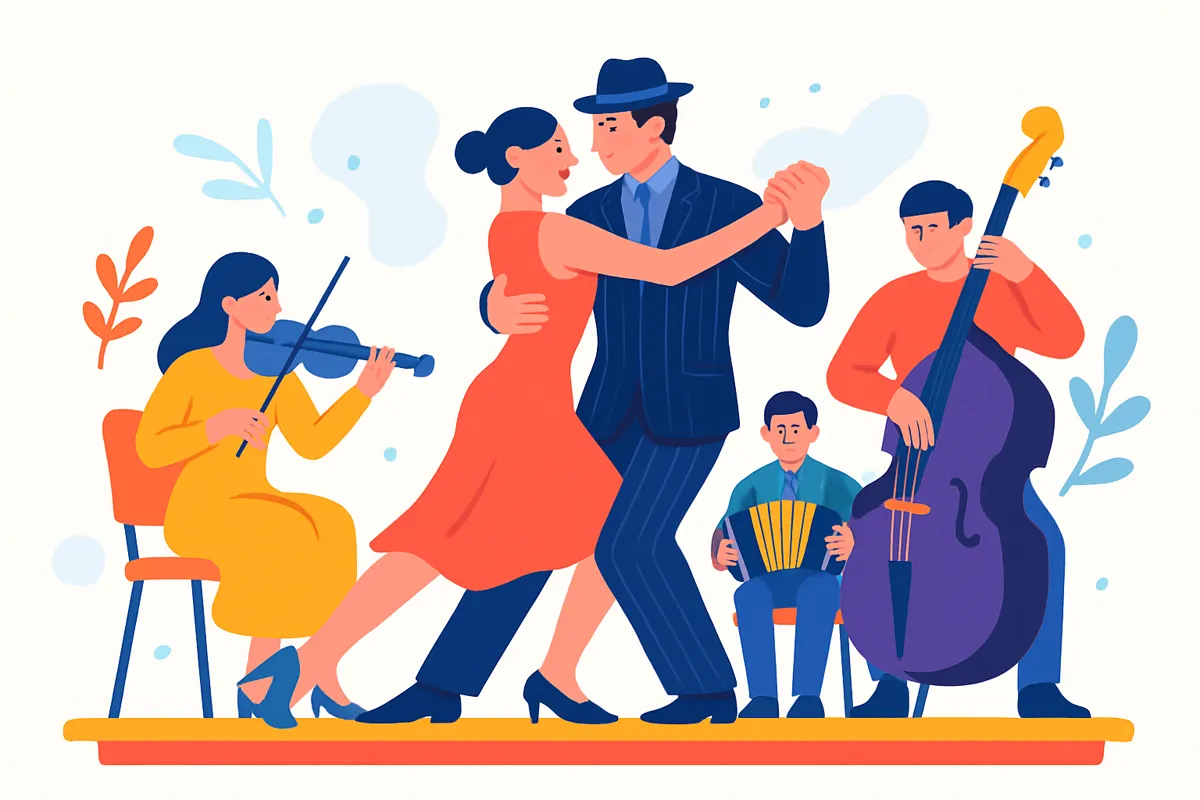
A couples tango category danced to waltz-time music, the flowing three-beat cousin of standard tango, judged on musicality, smooth travelling, connection and graceful turns.
Vals is the tango world’s name for the waltz: couples dance to waltz-time music, with three beats to the bar, while keeping the close embrace and the walking character of tango. The result looks quite different from a ballroom waltz. It is grounded and intimate, with long gliding steps, gentle rise and fall, and turns that spiral around the couple’s shared axis.
A round is a short social-style dance on the floor, not a staged piece. The couple travel together along the line of dance, mixing smooth walking with turning steps, pauses and the occasional playful rhythm change that the music invites. Because the three-beat pulse is continuous, the dance rewards fluid movement and punishes jerky changes of direction.
On this template the item is a Team item for couples, open to both genders, with a ten-minute ceiling and a rating out of 10 from each judge. It sits in the city-level adult group only (entrants aged 18 and over), and it is a category of a Buenos Aires city dance championship format rather than of the world-level championship that format feeds.
Organisers run it because the waltz rhythm shows what a couple can do with flow and phrasing. A pair who shine in slow tango may look stiff in a three-beat dance, and the reverse, so it gives a fuller picture of a couple’s all-round skill.
Where Vals comes from
Waltz-time music arrived in the River Plate region in the nineteenth century and was absorbed into tango culture, where the tango waltz, known locally as the vals criollo, became a lasting part of the repertoire alongside tango and milonga.
Where Vals is run
Vals is danced at tango dance nights across Argentina and Uruguay and in tango communities around the world, usually as a set of waltz pieces between tango and milonga sets. On this template it appears as one of the five categories of a Buenos Aires city dance championship format, and, according to that format’s published rules, it does not qualify entrants for the world-level championship.
- Argentina
- Uruguay
- Tango communities worldwide
Key facts
- Couples item (Team), open to both genders, danced to waltz-time music
- One group on this template: city adult, ages 18 and over
- Each judge rates out of 10 on this template
- Ten-minute ceiling set on the item in the template
- Does not qualify entrants for the world-level championship under the published rules
- Flowing three-beat feel; the quick two-beat item is Milonga
On eTalenter, Vals is filed under On Stage and typically scored with Rating out of 10. It appears in 1 ready-made event templates — each one can adjust its time limit, age-group assignment and scoring setup independently.
Across the templates that use it, Vals is most often entered as an Team competition, typically scored out of 10, commonly time-limited to around 10 minutes where a limit is set.
What judges look at in Vals
What a Vals panel is actually weighing up, and where the marks are usually won or lost:
- Musicality: the couple phrase their steps with the three-beat pulse, using the swing and lift of the waltz rather than treating it as slow tango.
- Flow and travel: smooth, continuous movement along the line of dance, with steps that glide instead of stopping and starting.
- Connection: the embrace stays clear and responsive through turns, so the lead is readable and the follow answers without delay.
- Turns and balance: spiralling turns around a shared axis, controlled rise and fall, and no loss of posture at the end of a turn.
- Variety within the rhythm: pauses, changes of speed and playful rhythmic touches show interpretation; repeating one pattern for the whole round loses credit.
- Floor craft: keeping to the line of dance and their own space, and avoiding other couples, even when the turning is generous.
Treat these as the judging focus, not a fixed rubric: publish your own weighted criteria for Vals under Scoring Setup, or start from judge scoring and tabulation software.
How to prepare for Vals
How entrants and their teachers usually get Vals right on the day:
- Practise to several waltz recordings at different speeds, so an unfamiliar piece on the day does not catch you out.
- Count the three beats aloud while walking until the pulse is automatic, then dance without counting.
- Rehearse turns slowly first, checking that both partners keep their own axis and the embrace does not twist.
- Agree how a change of direction or a pause is signalled, and drill it until the follow responds at once.
- Keep the upper body soft: tension makes a waltz look hurried instead of flowing.
- Dance a full round without stopping to build stamina and consistency across the whole piece.
- Do not add stage figures; this is a social-style category, and showy moves cost more than they gain.
- Check the age on your entry: the group on this template is for ages 18 and over.
Ready-made event templates that include Vals
Open any template to preview it in eTalenter and install it as a live, editable event.
| Template | Category | Score label | Competitions |
|---|---|---|---|
| Mundial de Tango and Campeonato de la Ciudad (Buenos Aires) | On Stage | Rating out of 10 | 1 |
Frequently asked questions
Is Vals judged individually or as a team?
Across eTalenter’s templates it’s most often run as an Team entry, though an organiser can set either participation type when assigning the item to an age group.
Is Vals the same as a ballroom waltz?
No. It shares the three-beat music, but it is danced in tango style, in a close embrace with walking steps and spiral turns, rather than the open rise-and-fall frame of ballroom waltz.
What is the difference between Vals and Milonga?
Both are social-style tango categories, but Vals uses waltz-time music with a flowing three-beat feel and Milonga uses the quick two-beat milonga rhythm.
Is it judged individually or as a couple?
As a couple. Both partners are rated together and receive one result.
Does a Vals result qualify me for the world-level championship?
Not under the published rules of the Buenos Aires format this template follows; the world-level championship has only two categories, Tango de Pista and Tango Escenario.
Want the full judging picture? Read judge scoring and tabulation software, or browse every on stage competition item.
Try Vals in eTalenter
See every ready-made template that runs Vals, and install one as a live event — age groups, rules and scoring included.



Leave a Reply
You must be logged in to post a comment.