

A hard-shoe Irish solo dance to jig music, the most rhythmically demanding of the jig family, judged on strong, clean percussion, timing and a lifted carriage.
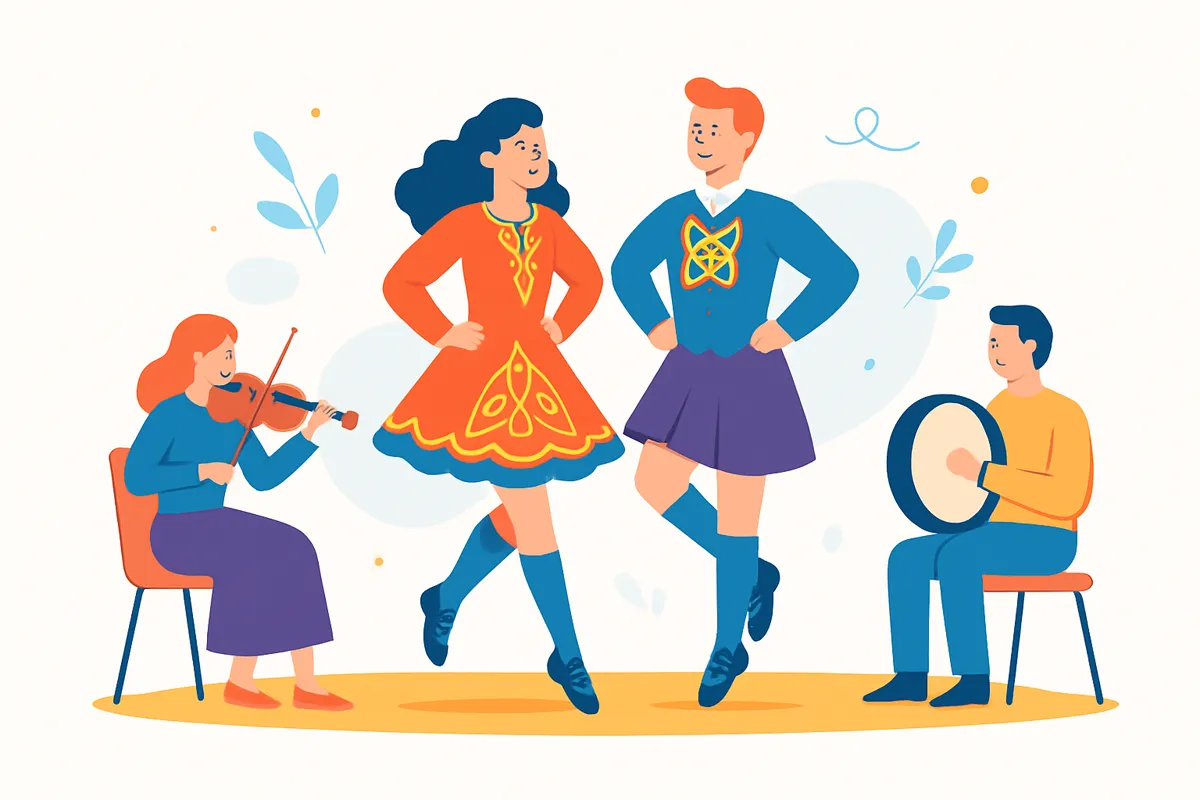
The treble jig is a solo Irish dance performed in hard shoes to jig music. Where the light jig and slip jig are soft-shoe items about flow and elevation, the treble jig is about making the floor part of the music: the heel and toe tips of the shoes produce a stream of sounds, and the dancer is expected to stay upright and controlled while doing it. The word treble refers to the heavy, percussive, rhythm-led style of the steps rather than to a musical register.
A round follows the usual solo format of a feis-style programme. Dancers of the same age group are called to the stage in small groups, step forward one after another and dance their prepared steps to the music set by the organiser while a panel of adjudicators watches and listens. Because every dancer in a group hears the same tune at the same tempo, differences in timing and clarity are easy for the panel to compare.
In the feis format reproduced in this template, the treble jig is an Individual item open to boys and girls together, with age groups from Under 6 up to Under 19 plus a Senior group, and a dancer enters the group matching their age. Each adjudicator marks out of 100, and the template allows up to ten minutes for the item as a whole rather than prescribing a length for each dance.
Organisers include the treble jig because it is the point in the hard-shoe section where technique is exposed most plainly. Loud stamping cannot hide uneven rhythm, so the item rewards dancers who have built precise, repeatable footwork, and it gives spectators a strong, audible centrepiece to the afternoon’s programme.
Where Treble Jig is run
The treble jig is run at Irish dancing competitions called feiseanna, and in this template it comes from a feis syllabus built around age groups and competitive grades, where it sits in the hard-shoe block alongside the single jig and hornpipe. It also turns up in Irish cultural festivals, dance-school showcases and diaspora events where pupils of a dance school enter as soloists.
- Ireland
- Irish dance communities worldwide
Key facts
- Individual item, boys and girls together on this template
- Age groups from Under 6 to Under 19, plus a Senior group
- Hard-shoe solo danced to jig music, built on strong, rhythmic steps
- Marked out of 100 by each adjudicator; the template sets a ten-minute item ceiling
- Competitive grade is separate from age group, so a dancer can be in a higher grade than classmates the same age
- Distinct from the single jig, which is the lighter hard-shoe jig, and from the soft-shoe light jig and slip jig
On eTalenter, Treble Jig is filed under On Stage and typically scored with Marks. It appears in 1 ready-made event templates — each one can adjust its time limit, age-group assignment and scoring setup independently.
Across the templates that use it, Treble Jig is most often entered as an Individual competition, typically scored out of 100, commonly time-limited to around 10 minutes where a limit is set.
What judges look at in Treble Jig
What a Treble Jig panel is actually weighing up, and where the marks are usually won or lost:
- Rhythm and timing: heavy beats must fall exactly on the music, with no rushing through the busy passages and no dragging at the ends of phrases.
- Quality of sound: each tip and heel strike should be sharp and distinct, and the panel listens for clean, evenly weighted beats rather than sheer volume.
- Technical precision: steps are clearly formed with crossed, turned-out feet and exact placement, so complicated combinations look deliberate rather than scrambled.
- Posture and carriage: a lifted chest, level shoulders and still, straight arms while the legs work hard; a tense or flailing upper body costs marks quickly.
- Stamina and consistency: the last steps should be as clean and as well timed as the first, which separates a prepared dancer from one who has only learned the opening.
- Presentation and finish: confident use of the stage, a steady pace across the sequence and a clean finish on the final beat.
Treat these as the judging focus, not a fixed rubric: publish your own weighted criteria for Treble Jig under Scoring Setup, or start from the full folk dance judging criteria guide.
How to prepare for Treble Jig
How entrants and their teachers usually get Treble Jig right on the day:
- Learn the sound before the speed: drill each new step slowly with the shoes on until every strike is even, then raise the tempo in small increments.
- Record audio of your practice and listen back; uneven weights and late beats are far easier to hear than to feel.
- Build stamina with run-throughs of the whole sequence back to back, so the final steps stay as crisp as the first.
- Practise to the exact tune and tempo that will be used, counting phrase lengths so each step ends cleanly on the musical phrase.
- Keep a mirror or film check on posture: arms still, shoulders level and head lifted while the feet do the work.
- Warm up ankles, calves and feet before stepping on stage, and check the shoe fittings and tips well before the day.
- Rehearse stepping out and finishing on cue, in a line with two or three other dancers, since spacing and starting together are part of the performance.
Ready-made event templates that include Treble Jig
Open any template to preview it in eTalenter and install it as a live, editable event.
| Template | Category | Score label | Competitions |
|---|---|---|---|
| Feis – Irish Dancing (CLRG) | On Stage | Marks | 15 |
Frequently asked questions
Is Treble Jig judged individually or as a team?
Across eTalenter’s templates it’s most often run as an Individual entry, though an organiser can set either participation type when assigning the item to an age group.
What is the difference between a treble jig and a single jig?
Both are hard-shoe jigs, but they are separate items with their own steps. The treble jig is the heavier, more rhythmically complex of the two, while the single jig has a lighter, lilting feel.
Is the treble jig danced in hard shoes or soft shoes?
Hard shoes. The sounds made by the shoes are part of what the adjudicators listen for.
Is the treble jig judged individually or as a team?
Individually. Dancers may take the stage in small groups for practical reasons, but each is marked on their own performance out of 100.
How long is a treble jig round?
This template sets a ten-minute ceiling on the item as a whole, and the organiser sets the number of bars danced on the day.
Want the full judging picture? Read the full folk dance judging criteria guide, or browse every on stage competition item.
Try Treble Jig in eTalenter
See every ready-made template that runs Treble Jig, and install one as a live event — age groups, rules and scoring included.


Leave a Reply
You must be logged in to post a comment.