
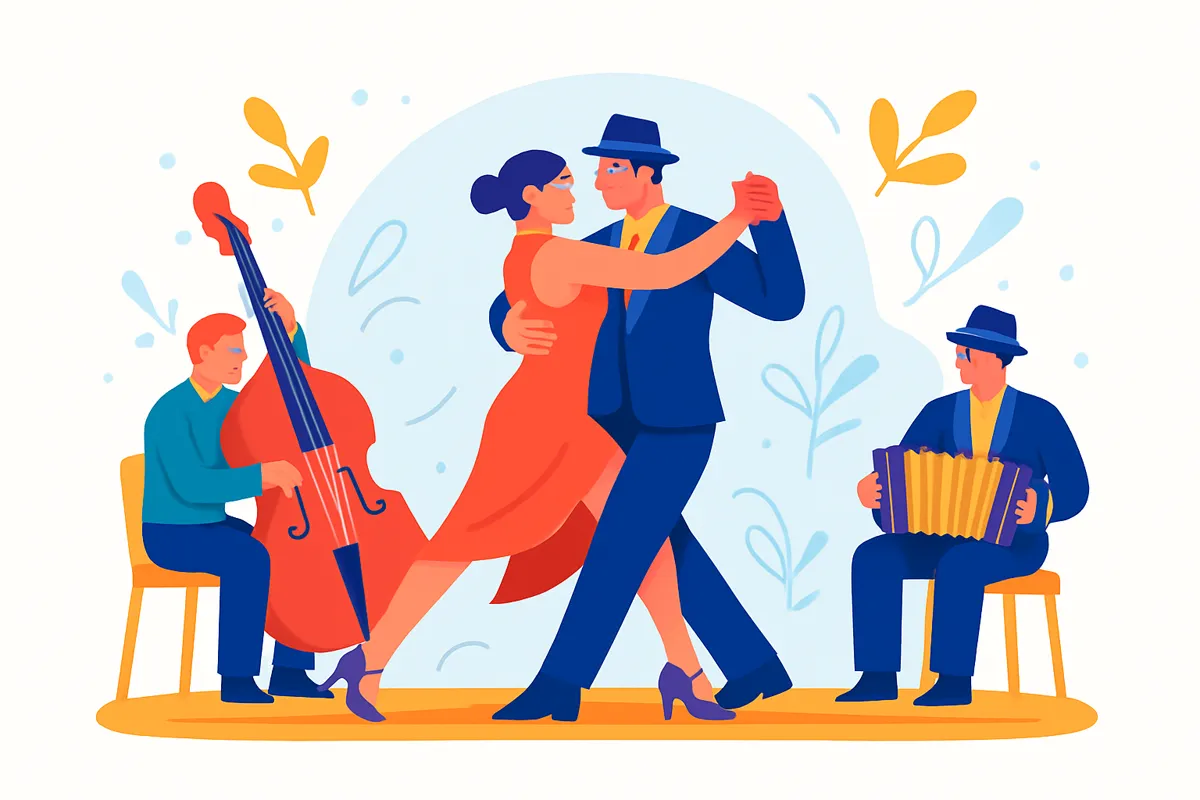
A couples competition in social-style tango danced on the floor, where pairs improvise to live-feeling tango music and are judged on connection, musicality, floor craft and the authenticity of the embrace.
Tango de Pista, literally “floor tango”, is the competitive form of the tango that couples dance in the milongas of Buenos Aires. It is improvised: the pair share a close embrace, walk, turn and pause together, and the leader chooses each step as the music unfolds. Nothing is choreographed in advance, which is what separates it from the staged item, Tango Escenario.
A round is built around the floor itself. Several couples are called onto the dance floor together and dance to the same tango tracks, moving anticlockwise around the room as they would at an ordinary social dance. The panel walks the edge of the floor, watching each pair against the others, so couples have to share space, avoid collisions and still show their best dancing.
On this template Tango de Pista is a Team item for couples, open to both genders, with an adult group for entrants of 18 and over and a Senior group for couples where both partners are 55 or over. Each judge rates out of 10, and the template allows up to ten minutes for the item. The result belongs to the couple, never to one partner alone.
Organisers run it because it brings in dancers from social tango communities who would never enter a staged show, and because the shared floor makes a lively, well-attended round for an audience.
Where Tango de Pista comes from
Tango grew up in the port districts around the Río de la Plata, in Argentina and Uruguay, in the late nineteenth century, and the social dance on the floor is its original form.
Where Tango de Pista is run
Floor-tango rounds run at tango championships and festivals, in milonga competitions and in dance-school showcases, most often in Argentina and wherever tango communities are active. On this template the item sits inside a Buenos Aires tango championship format, where it is the main floor category and is also offered in an adult and a Senior division.
- Argentina
- Uruguay
- Tango communities worldwide
Key facts
- Couples item (Team), open to both genders, improvised social tango on a shared floor
- Adult group for 18 and over; Senior group where both partners are 55 or over
- Real championship rounds narrow the field through qualifying, quarter-final, semi-final and final
- Each judge rates out of 10 on this template; the highest and lowest scores can be dropped as a trimmed mean
- Ten-minute ceiling set on the item in the template
- Staged, choreographed tango is a separate item, Tango Escenario
On eTalenter, Tango de Pista is filed under On Stage and typically scored with Rating out of 10. It appears in 1 ready-made event templates — each one can adjust its time limit, age-group assignment and scoring setup independently.
Across the templates that use it, Tango de Pista is most often entered as an Team competition, typically scored out of 10, commonly time-limited to around 10 minutes where a limit is set.
What judges look at in Tango de Pista
What a Tango de Pista panel is actually weighing up, and where the marks are usually won or lost:
- Connection and embrace: the couple dance as one body, with a clear, comfortable lead and response and no gap between the partners.
- Musicality: steps and pauses land on the beat and phrase of the tango, and the couple respond to changes in the music rather than dancing over it.
- Walk and technique: a clean, grounded walk, controlled turns and balanced posture from both partners, not only the leader.
- Floor craft: the pair move with the line of dance, give other couples room and recover from near collisions without losing flow.
- Improvisation and authenticity: the dance looks like social tango, with varied, spontaneous phrasing, and not like rehearsed stage choreography or show-style tricks.
- Elegance and presence: composure, a calm line and a shared sense of enjoyment through the whole round.
Treat these as the judging focus, not a fixed rubric: publish your own weighted criteria for Tango de Pista under Scoring Setup, or start from judge scoring and tabulation software.
How to prepare for Tango de Pista
How entrants and their teachers usually get Tango de Pista right on the day:
- Practise with unfamiliar tracks, because the music is not chosen by the couple and a memorised routine will not survive it.
- Drill the walk first: steady steps, shared weight changes and a quiet upper body earn more than ambitious figures.
- Rehearse dancing among other couples, so floor craft and line-of-dance habits are automatic on the day.
- Keep figures small and well timed; large or acrobatic moves take space from other pairs and tend to lose marks for authenticity.
- Decide in advance how the pair will recover from a collision or a missed step, and rehearse that recovery as well.
- Check the age and eligibility conditions early, including the Senior rule that both partners must have reached 55.
- Warm up together before the round so the embrace and balance are settled before the music starts.
Ready-made event templates that include Tango de Pista
Open any template to preview it in eTalenter and install it as a live, editable event.
| Template | Category | Score label | Competitions |
|---|---|---|---|
| Mundial de Tango and Campeonato de la Ciudad (Buenos Aires) | On Stage | Rating out of 10 | 4 |
Frequently asked questions
Is Tango de Pista judged individually or as a team?
Across eTalenter’s templates it’s most often run as an Team entry, though an organiser can set either participation type when assigning the item to an age group.
Is Tango de Pista the same as Tango Escenario?
No. Pista is improvised social tango danced on a shared floor, while Escenario is a staged, choreographed performance. They are separate items on this template, each with its own entry.
Is Tango de Pista judged individually or as a couple?
As a couple. Both partners are rated together, so one weaker partner lowers the result for the pair.
Can I choreograph my routine in advance?
Floor tango is meant to be improvised to the music played, so a fixed routine is not what the panel is looking for. Staged choreography belongs in Tango Escenario.
What is the Senior group?
On this template the Senior group is for couples where both partners are 55 or over, separate from the adult group of 18 and over.
Want the full judging picture? Read judge scoring and tabulation software, or browse every on stage competition item.
Try Tango de Pista in eTalenter
See every ready-made template that runs Tango de Pista, and install one as a live event — age groups, rules and scoring included.


Leave a Reply
You must be logged in to post a comment.