
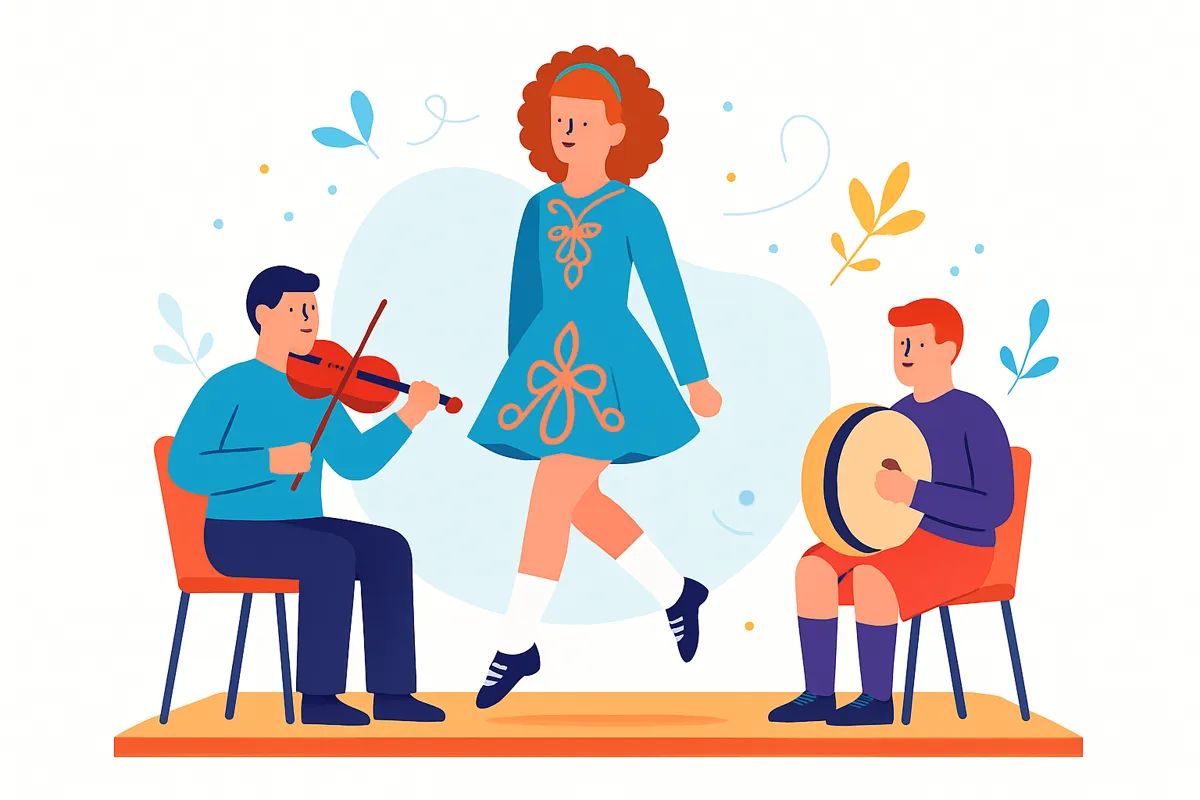
A graceful Irish solo dance in 9/8 time, performed in soft shoes high on the toes and judged on elevation, line and flowing rhythm.
The slip jig is a solo Irish dance in 9/8 time, danced in soft shoes. The tune has three groups of three beats to the bar, which gives it a gliding, rolling feel quite unlike the bounce of the light jig or the drive of the reel. The steps are built to match: flowing, elevated movements danced high on the toes, with long lines through the legs and a sense of floating over the floor. It is often described as the most lyrical of the soft-shoe dances, and a dancer who rushes it or bounces through it loses the character of the music.
A round runs like the other solo items in a feis-style programme. Dancers of the same age group are called to the stage in small groups, commonly two or three at a time, and each group dances the prepared steps in turn while a panel of adjudicators watches from the front. The organiser sets the tempo and the number of bars, so every dancer is judged to the same music and the panel can compare like with like.
In the feis format reproduced in this template, the slip jig is an Individual item open to boys and girls together, with separate age groups from Under 6 up to Under 19 plus a Senior group. A dancer competes in their own age group, which is separate from the competitive grade they have reached. Each adjudicator marks the dancer out of 100.
Organisers run the slip jig because it shows something the other soft-shoe items do not: sustained control. The 9/8 rhythm leaves little room to hide a wobble, a flat foot or a rushed step, so it is a natural test of balance, stamina on the toes and musical phrasing, and it gives the soft-shoe section of the programme a calmer, more graceful contrast to the reel and light jig.
Where Slip Jig is run
The slip jig is run at Irish dancing competitions called feiseanna, and in this template it comes from a feis syllabus built around age groups and competitive grades, where it sits in the soft-shoe section beside the reel and light jig. Beyond feiseanna it appears at Irish cultural festivals, school and community dance shows and diaspora events where a dance school enters its pupils.
- Ireland
- Irish dance communities worldwide
Key facts
- Individual item, boys and girls together on this template
- Age groups from Under 6 to Under 19, plus a Senior group
- Danced in 9/8 time in soft shoes, with a prepared sequence of steps
- Marked out of 100 by each adjudicator
- Competitive grade is separate from age: dancers move up by results, not birthdays
- Not to be confused with the light jig (6/8, soft shoe) or the hard-shoe single and treble jigs
On eTalenter, Slip Jig is filed under On Stage and typically scored with Marks. It appears in 1 ready-made event templates — each one can adjust its time limit, age-group assignment and scoring setup independently.
Across the templates that use it, Slip Jig is most often entered as an Individual competition, typically scored out of 100, commonly time-limited to around 10 minutes where a limit is set.
What judges look at in Slip Jig
What a Slip Jig panel is actually weighing up, and where the marks are usually won or lost:
- Rhythm and the 9/8 feel: steps should flow in three groups of three beats with a smooth, rolling quality; a bouncy or choppy delivery sounds like a light jig danced to the wrong music.
- Elevation and toe work: the dancer stays high on the toes with a lifted body, and any dropping of the heels or sinking into the floor is quickly visible.
- Line and turnout: long, stretched legs, pointed feet and turned-out knees, held through the step rather than only at the end of it.
- Timing: every step starts and finishes with the musical phrase, and drifting ahead of or behind the beat costs marks.
- Posture and carriage: an upright, lifted body with still, straight arms; swinging or tense arms stand out against the controlled legs.
- Grace and stage use: smooth travel across the space, even coverage of the stage and a clean finish on the last beat.
Treat these as the judging focus, not a fixed rubric: publish your own weighted criteria for Slip Jig under Scoring Setup, or start from the full folk dance judging criteria guide.
How to prepare for Slip Jig
How entrants and their teachers usually get Slip Jig right on the day:
- Count the 9/8 bar out loud as three groups of three until the rolling feel is automatic, before adding any steps.
- Build toe strength and balance away from the dance with slow rises and holds, since the slip jig is danced high on the toes for the whole round.
- Drill each step slowly to a metronome and raise the tempo only once the landing is quiet and the timing stays clean.
- Film each practice and check heel height, turnout and arm position; these faults are far easier to see on video than to feel.
- Rehearse the exact step sequence and bar count the organiser sets, and practise ending on the last beat rather than guessing the finish.
- Practise in a line of two or three dancers on a stage floor in the shoes you will wear, since spacing, pace and grip all change on the day.
Ready-made event templates that include Slip Jig
Open any template to preview it in eTalenter and install it as a live, editable event.
| Template | Category | Score label | Competitions |
|---|---|---|---|
| Feis – Irish Dancing (CLRG) | On Stage | Marks | 15 |
Frequently asked questions
Is Slip Jig judged individually or as a team?
Across eTalenter’s templates it’s most often run as an Individual entry, though an organiser can set either participation type when assigning the item to an age group.
What time signature is a slip jig?
The slip jig is in 9/8 time. That is different from the light jig, which is in 6/8, and from the reel, which is in 4/4.
Is the slip jig danced in hard shoes or soft shoes?
Soft shoes. Hard shoes are used for items such as the hornpipe and set dances; the slip jig is a light-shoe dance.
Is a slip jig the same as a light jig or a single jig?
No. They are separate items in the programme: the slip jig is the 9/8 soft-shoe dance, the light jig is the 6/8 soft-shoe dance, and the single jig is a hard-shoe item with its own steps.
Is the slip jig judged individually or as a team?
Individually. Dancers may take the stage two or three at a time for practical reasons, but each is marked on their own performance out of 100.
Want the full judging picture? Read the full folk dance judging criteria guide, or browse every on stage competition item.
Try Slip Jig in eTalenter
See every ready-made template that runs Slip Jig, and install one as a live event — age groups, rules and scoring included.


Leave a Reply
You must be logged in to post a comment.