
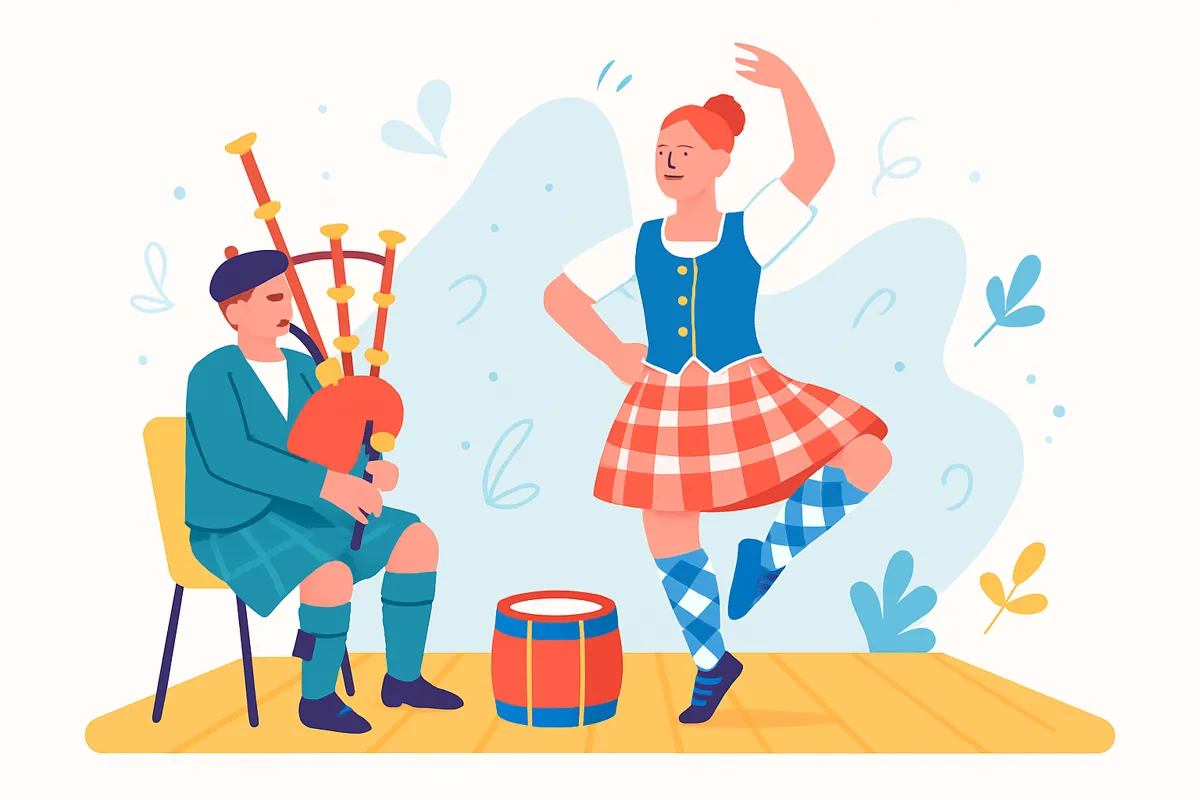
A solo Scottish National dance carried in every grade of the Highland dancing championship template, judged on timing to the music, clean technique and a steady, well-presented bearing.
Scotch Measure is a solo dance in the Highland dancing championship template, where it sits with the National dances rather than the four formal Highland dances. The rule book behind the template names Irish Jig, Scottish Lilt and Village Maid as examples of National dances and adds that there are others; Scotch Measure is one of the dances the template lists beside them. For an organiser it is simply another timed solo with its own draw, its own placings and its own line on the score sheet.
A round is the same shape as every solo in the championship. The announcer calls a dancer to the floor, the dancer takes the opening position, the music starts and the dancer performs the dance through to the final bar before leaving the floor. The template does not describe the steps, the tune, the tempo or the costume, so this page does not either; those belong to the dancer’s teacher and the governing rules, and an event organiser only needs the draw, the panel and the marks.
Marking follows the rule book’s single scheme for every dance: a maximum of 100 marks, split Timing 10, Technique 80 and General Deportment 10. In Championships and Scottish National Dance Premierships the judges give six clear placings. In the lower grades, a top-three result counts towards moving up, which is why the same dance comes round again and again during a season.
The template carries Scotch Measure in Beginners, Novice, Intermediate and Premier. The Primary grade, for dancers under seven, may enter only Pas de Basque, Pas de Basque and High Cuts, the Highland Fling and the Sword Dance, so a dancer meets Scotch Measure after turning seven. Because grades rather than ages organise the day, one event can have a seven-year-old Beginner and an adult Premier dancer on the same programme, each in their own grade and each marked on the same 100-mark sheet.
Where Scotch Measure comes from
The rule book behind the template lists Scotch Measure among the dances without giving any history for it, so no date, author or story is claimed here.
Where Scotch Measure is run
On eTalenter this dance appears in one template only, the Highland dancing championship template, where it runs in Beginners, Novice, Intermediate and Premier. National dances are danced at Highland games, festivals and championships in Scotland and in Scottish dance communities overseas, including Canada, the United States, Australia and New Zealand. This page covers only the item as the template carries it: a graded solo progression with no age bands.
- Scotland, United Kingdom
Key facts
- A solo dance, recorded as Individual and open to both genders
- Filed with the National dances in the template, a separate group from the four Highland dances
- Four grades carry it: Beginners, Novice, Intermediate and Premier; Primary does not dance it
- Marked out of 100: Timing 10, Technique 80 and General Deportment 10
- Six clear placings are given in Championships and Scottish National Dance Premierships
- The ten-minute ceiling on the template is an app default, because the rules print no time limit for this dance
On eTalenter, Scotch Measure is filed under On Stage and typically scored with Marks. It appears in 1 ready-made event templates — each one can adjust its time limit, age-group assignment and scoring setup independently.
Across the templates that use it, Scotch Measure is most often entered as an Individual competition, typically scored out of 100, commonly time-limited to around 10 minutes where a limit is set.
What judges look at in Scotch Measure
What a Scotch Measure panel is actually weighing up, and where the marks are usually won or lost:
- Technique, worth 80 of the 100 marks: accurate foot and leg positions, crisp finishes to each movement and no blurred or rushed transitions between steps
- Timing, worth 10 marks: starting with the music, holding the beat through the whole dance and arriving at the closing position on the final note
- Evenness across the dance: a panel rewards the dancer whose first and last repeats look equally well drilled, so stamina and concentration count as much as the opening steps
- Spatial accuracy: using the floor sensibly, keeping a tidy track and finishing in the same area the dance began, without drifting towards the judges or the edge
- General deportment, worth 10 marks: upright carriage, a composed walk on and off, grade-appropriate dress and a calm, pleasant expression
- Placing within the grade: when technique is close, small details such as a sharper finish or steadier posture separate first from fourth, and in lower grades they decide who earns a placing towards promotion
Treat these as the judging focus, not a fixed rubric: publish your own weighted criteria for Scotch Measure under Scoring Setup, or start from the full folk dance judging criteria guide.
How to prepare for Scotch Measure
How entrants and their teachers usually get Scotch Measure right on the day:
- Start with the music: have the dancer count the phrases aloud against the tune until the number of bars left in the dance is known without thinking
- Break the dance into short sections and perfect each in isolation before linking, since most faults sit at the joins between steps
- Film a weekly run-through and review it twice with the teacher, once watching only feet and once watching only posture and timing
- Practise the walk on, the opening position and the closing pose as part of every run, because deportment marks are the cheapest to win and the first to be forgotten
- Rehearse on a surface like the competition floor and in the shoes and outfit of the day, so nothing is unfamiliar when the music starts
- Build stamina with a full-length run followed by a second run straight after, so the last repeat stays as clean as the first
- After each event, keep one written correction from the adjudicator’s comments and make it the single focus of the next fortnight’s practice
Ready-made event templates that include Scotch Measure
Open any template to preview it in eTalenter and install it as a live, editable event.
| Template | Category | Score label | Competitions |
|---|---|---|---|
| Highland Dancing Championship (RSOBHD) | On Stage | Marks | 4 |
Frequently asked questions
Is Scotch Measure judged individually or as a team?
Across eTalenter’s templates it’s most often run as an Individual entry, though an organiser can set either participation type when assigning the item to an age group.
Is Scotch Measure a Highland dance?
No. The rule book behind the template names four Highland dances: the Highland Fling, the Sword Dance (Ghille Callum), Seann Triubhas and the Strathspey and Reel of Tulloch. Scotch Measure is carried with the National dances, which the rule book introduces with Irish Jig, Scottish Lilt and Village Maid as examples and then says there are others.
Which grades can enter Scotch Measure?
Beginners, Novice, Intermediate and Premier. Primary, for dancers under seven, is limited to Pas de Basque, Pas de Basque and High Cuts, the Highland Fling and the Sword Dance, so a Primary dancer cannot enter it.
How is Scotch Measure scored?
Out of 100 marks: Timing 10, Technique 80 and General Deportment 10. The template records the same 100-mark maximum in every grade that dances it, and Championships and Premierships use six clear placings.
Does a result in Scotch Measure help a dancer move up a grade?
The rule book moves dancers up by top-three finishes in grade competitions, and each dance is its own competition, so a first, second or third place here counts as one of those results. The exact number and mix of results needed is set by the governing rules, not by this page.
Want the full judging picture? Read the full folk dance judging criteria guide, or browse every on stage competition item.
Try Scotch Measure in eTalenter
See every ready-made template that runs Scotch Measure, and install one as a live event — age groups, rules and scoring included.



Leave a Reply
You must be logged in to post a comment.