

The first and simplest dance in Highland dancing competition, a short solo built on the pas de basque step and entered by the youngest dancers.
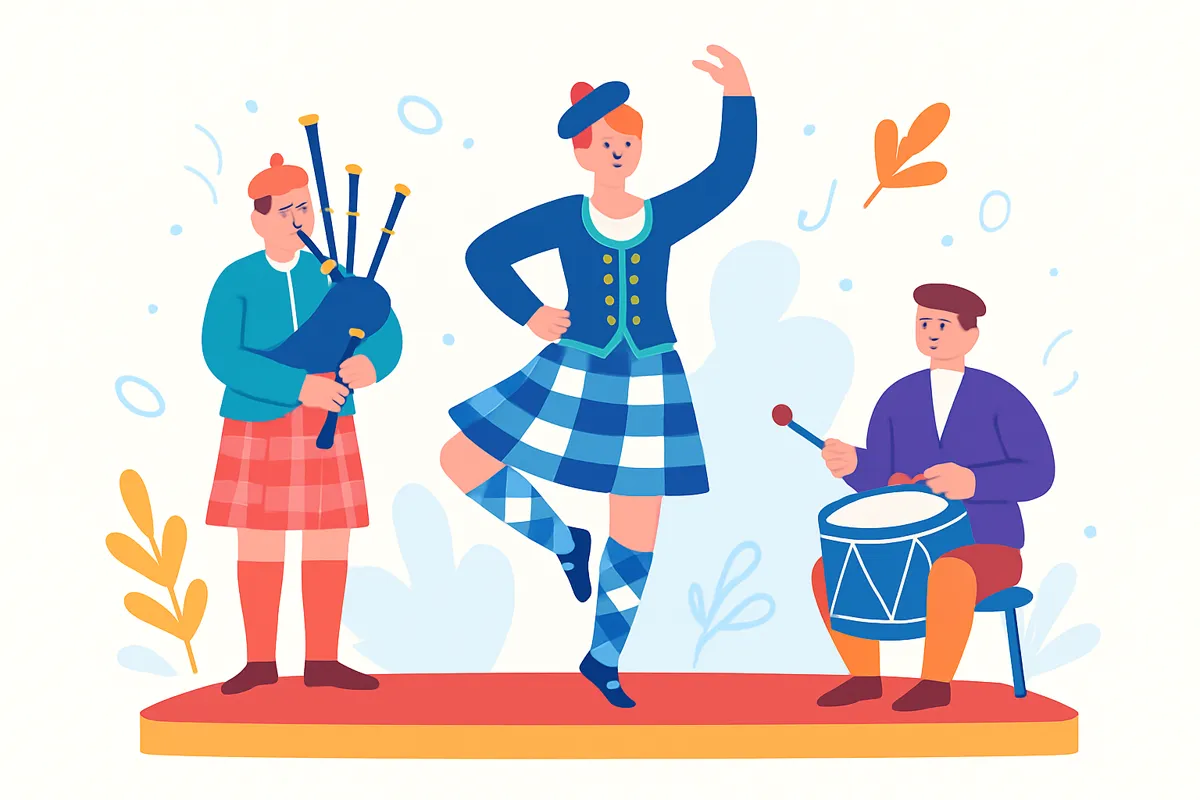
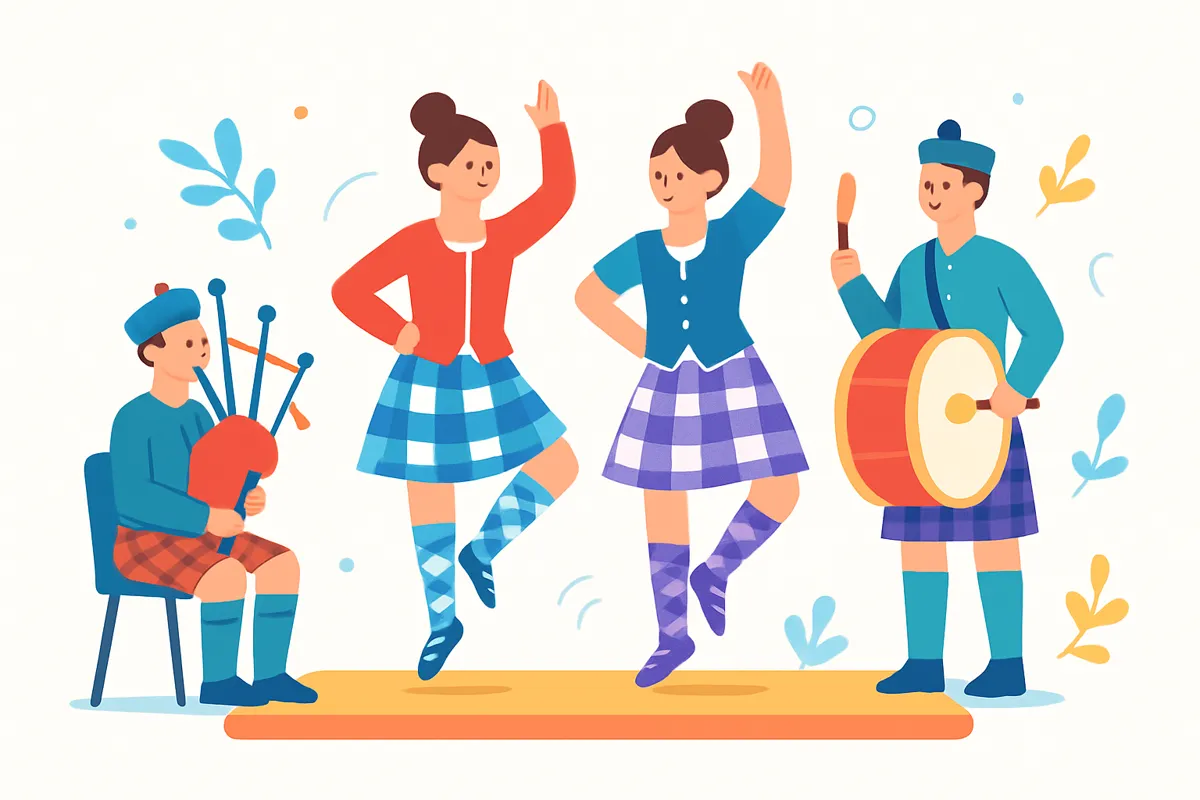
Pas de Basque is the entry-level dance of Scottish Highland dancing competition. It is built around the pas de basque step, a light, travelling step in which the dancer springs from one foot to the other with the working foot lifted and pointed, repeated on both sides until the dance is complete. Where the better-known Highland Fling or Sword Dance ask for many different steps, this dance asks for one step danced well, which is why it is the first dance a beginner is taught and the first one a panel sees.
In the Highland dancing championship template the item belongs to the Primary grade, the lowest of five progression grades (Primary, Beginners, Novice, Intermediate and Premier). Primary is the only grade with an age cap: a child may compete there until their seventh birthday and then moves up to Beginners. The template records the item as Individual, open to both genders, and the rules limit Primary to just four dances: this one, Pas de Basque and High Cuts, Highland Fling and Sword Dance. Pas de Basque is the plainest of the four.
A round is very short. The dancer is called to the floor, takes the opening position, and starts on the first note of the music, dancing the step on each side for the length of the tune. The adjudicator watches the feet, the carriage of the body, the arms and whether every movement lands on the beat, and the dancer leaves on the final note. Several children usually dance in the same round, so a calm entrance and a clean finish matter as much as the steps.
Organisers run it as a separate item because very young dancers should be compared with each other and not with experienced competitors, and because the dance is a fair test of the foundations that every later Highland dance depends on: balance, turnout, pointed toes and counting the music. It also gives a family a gentle first experience of a competition, since the rules ask organisers not to award trophies in Primary, so the focus stays on learning and on the adjudicator’s comments.
Where Pas de Basque comes from
The name is French for “Basque step”, and the step itself is shared by several European dance traditions, including ballet and country dancing. Highland dancing adopted it as the basic travelling step of the form, and the short competition dance built from it is the simplest of the set dances taught to children.
Where Pas de Basque is run
On eTalenter Pas de Basque appears in one template only, the Highland dancing championship template, where it is the first item of the Primary grade. Highland dancing competitions are held at games and festivals across Scotland and in Scottish communities in Canada, the United States, Australia, New Zealand and South Africa; this page describes only the item as that template carries it, with its progression-grade structure rather than age bands.
- Scotland, United Kingdom
Key facts
- A solo dance, recorded as Individual and open to both genders
- Offered in the Primary grade only, for dancers under seven; at their seventh birthday a dancer becomes a Beginner
- One of four dances Primary may enter, alongside Pas de Basque and High Cuts, Highland Fling and Sword Dance
- Published marking is out of 100 per dance: Timing 10, Technique 80 and General Deportment 10
- Organisers must not award trophies in Primary
- The template carries a ten-minute ceiling, an app default because the rules print no time limit for this dance
On eTalenter, Pas de Basque is filed under On Stage and typically scored with Marks. It appears in 1 ready-made event templates — each one can adjust its time limit, age-group assignment and scoring setup independently.
Across the templates that use it, Pas de Basque is most often entered as an Individual competition, typically scored out of 100, commonly time-limited to around 10 minutes where a limit is set.
What judges look at in Pas de Basque
What a Pas de Basque panel is actually weighing up, and where the marks are usually won or lost:
- Technique, worth 80 of the 100 marks: a clean spring from foot to foot, the working foot lifted and the toes pointed, with turnout kept on both sides
- Timing, worth 10 marks: every spring landing on the beat of the music, neither rushing the start nor trailing behind at the end
- General deportment, worth 10 marks: an upright, lifted body, steady head, arms held in the correct position and a tidy, confident walk on and off
- Evenness between the two sides: a step that is crisp on the right foot and heavy on the left loses marks, so both sides must match
- Finishing on the last note: stopping in the closing position exactly with the music shows control and is easy for a panel to see
Treat these as the judging focus, not a fixed rubric: publish your own weighted criteria for Pas de Basque under Scoring Setup, or start from the full folk dance judging criteria guide.
How to prepare for Pas de Basque
How entrants and their teachers usually get Pas de Basque right on the day:
- Practise the one step slowly until the toes point every time, then add the music; speed comes after cleanliness
- Count aloud, “one and two and”, while dancing so each spring is tied to the beat, and practise to a recording at the exact tempo you will dance to
- Work both sides equally, and film a short clip to check that the left and right steps look the same
- Keep arms and head as tidy as the feet, because deportment marks are lost for a dropped chin or loose hands
- Rehearse the whole routine with the walk on, opening position and final pose in competition clothes and shoes, so nothing is new on the day
- After each event read the adjudicator’s comments, pick one correction such as steadier timing, and work only on that before the next competition
Ready-made event templates that include Pas de Basque
Open any template to preview it in eTalenter and install it as a live, editable event.
| Template | Category | Score label | Competitions |
|---|---|---|---|
| Highland Dancing Championship (RSOBHD) | On Stage | Marks | 1 |
Frequently asked questions
Is Pas de Basque judged individually or as a team?
Across eTalenter’s templates it’s most often run as an Individual entry, though an organiser can set either participation type when assigning the item to an age group.
Is Pas de Basque the same as Pas de Basque and High Cuts?
No. They are two separate dances in the template. Pas de Basque and High Cuts adds high cuts to the basic step and is the next dance a child usually learns, so the two are entered and judged as different items.
Who can enter Pas de Basque?
In the template it sits in the Primary grade, which is for dancers under seven. A competitor stays in Primary until their seventh birthday and then becomes a Beginner, so older dancers would enter a different grade.
How is Pas de Basque scored?
The published scheme is 100 marks per dance: Timing 10, Technique 80 and General Deportment 10. The template records the item with a 100-mark maximum, so the panel can enter one mark per dancer.
Are trophies given in Primary?
The rules say organisers must not award trophies in Primary. Results can still be recorded and shared on eTalenter, but a festival following the rules would use certificates or comments instead of cups.
How long will a child dance for?
The rules print no time limit for this dance. The template carries a ten-minute ceiling as an app default, but the dance itself is short, so check the festival notice for what the music and round length will be.
Want the full judging picture? Read the full folk dance judging criteria guide, or browse every on stage competition item.
Try Pas de Basque in eTalenter
See every ready-made template that runs Pas de Basque, and install one as a live event — age groups, rules and scoring included.

Leave a Reply
You must be logged in to post a comment.