

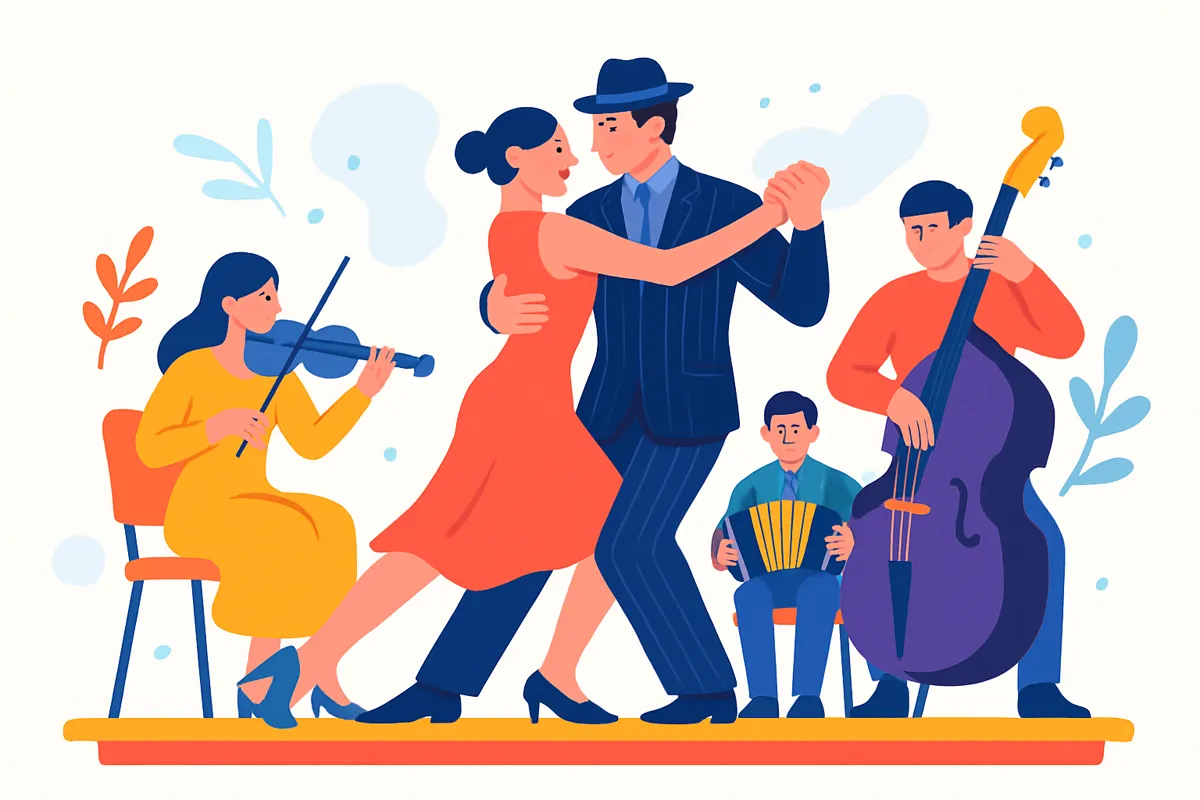
A couples tango category danced to milonga music, the quick, light, playful cousin of slow tango, judged on rhythm, musicality, connection and a crisp, lively footwork.
Milonga is both the name of a dance night and of a style of tango music. As a competition category it means the second: couples dance to milonga music, which is faster and more playful than the slow, brooding music of standard tango, with a bright two-beat feel that invites quick steps, sudden pauses and a smiling attitude.
A round is a short social-style dance on the floor, not a staged piece. The couple stay in embrace, travel with the line of dance and play with the rhythm: fast walking, small syncopated steps, tight turns and traces of footwork that match the accents in the music. Because the tempo is quick, the lead has to stay clear and the follower has to respond instantly, or the dance falls apart.
On this template the item is a Team item for couples, open to both genders, with a ten-minute ceiling and a rating out of 10 from each judge. It sits in the city-level adult group only (entrants aged 18 and over), and it is a category of a Buenos Aires city dance championship format rather than of the world-level championship that format feeds.
Organisers run it because the lighter tempo shows a different side of a couple from the slow categories: the same dancers can look calm in close-embrace tango yet show wit and precision in milonga.
Where Milonga comes from
Milonga music developed in the River Plate region of Argentina and Uruguay and is one of the older rhythms that tango grew alongside; the faster, lighter dance style that goes with it is a long-established part of the tango repertoire.
Where Milonga is run
Milonga is danced at tango dance nights across Argentina and Uruguay and in tango communities around the world, usually in sets of three or four pieces. On this template it appears as one of the five categories of a Buenos Aires city dance championship format, and, according to that format’s published rules, it does not qualify entrants for the world-level championship.
- Argentina
- Uruguay
- Tango communities worldwide
Key facts
- Couples item (Team), open to both genders, danced to milonga music
- One group on this template: city adult, ages 18 and over
- Each judge rates out of 10 on this template
- Ten-minute ceiling set on the item in the template
- Does not qualify entrants for the world-level championship under the published rules
- Faster and lighter than Tango de Pista; the waltz-time item is Vals
On eTalenter, Milonga is filed under On Stage and typically scored with Rating out of 10. It appears in 1 ready-made event templates — each one can adjust its time limit, age-group assignment and scoring setup independently.
Across the templates that use it, Milonga is most often entered as an Team competition, typically scored out of 10, commonly time-limited to around 10 minutes where a limit is set.
What judges look at in Milonga
What a Milonga panel is actually weighing up, and where the marks are usually won or lost:
- Rhythm and tempo: the couple keep a crisp, steady pulse at speed and use the accents of the music instead of dancing against them.
- Connection: the embrace stays clear and responsive when the pace rises, with the lead readable and the follow immediate.
- Footwork and syncopation: small, precise steps, quick changes of weight and playful rhythmic touches earn credit; heavy or sloppy steps lose it.
- Musicality and play: pauses, speed changes and a light, cheerful attitude show that the couple are enjoying the music rather than running through steps.
- Floor craft: the couple keep to the line of dance and their own space even at a quick tempo, and avoid colliding with other pairs.
- Posture and balance: an upright axis and controlled turns keep fast dancing elegant rather than frantic.
Treat these as the judging focus, not a fixed rubric: publish your own weighted criteria for Milonga under Scoring Setup, or start from judge scoring and tabulation software.
How to prepare for Milonga
How entrants and their teachers usually get Milonga right on the day:
- Practise to many milonga recordings at different speeds, so a fast or unfamiliar piece on the day does not surprise you.
- Drill walking and weight changes at tempo with a metronome until the steps stay small and exact.
- Work on lead and follow clarity at speed: agree how a pause or a change of direction is signalled, and rehearse it.
- Keep the embrace light and the upper body relaxed, since tension makes fast dancing look rushed.
- Practise on a crowded floor or with several couples in a small space to build floor craft at pace.
- Do not mix in stage figures; this is a social-style category, and showy moves cost more than they gain.
- Check the age on your entry: the group on this template is for ages 18 and over.
Ready-made event templates that include Milonga
Open any template to preview it in eTalenter and install it as a live, editable event.
| Template | Category | Score label | Competitions |
|---|---|---|---|
| Mundial de Tango and Campeonato de la Ciudad (Buenos Aires) | On Stage | Rating out of 10 | 1 |
Frequently asked questions
Is Milonga judged individually or as a team?
Across eTalenter’s templates it’s most often run as an Team entry, though an organiser can set either participation type when assigning the item to an age group.
Is Milonga the same as Tango de Pista?
No. Tango de Pista is the general floor-tango category danced to standard tango music, while Milonga is danced to the faster, lighter milonga music and is a separate item.
What is the difference between Milonga and Vals?
Both are social-style tango categories, but Milonga uses the quick two-beat milonga rhythm and Vals uses waltz-time music with a flowing three-beat feel.
Is it judged individually or as a couple?
As a couple. Both partners are rated together and receive one result.
Does a Milonga result qualify me for the world-level championship?
Not under the published rules of the Buenos Aires format this template follows; the world-level championship has only two categories, Tango de Pista and Tango Escenario.
Want the full judging picture? Read judge scoring and tabulation software, or browse every on stage competition item.
Try Milonga in eTalenter
See every ready-made template that runs Milonga, and install one as a live event — age groups, rules and scoring included.

Leave a Reply
You must be logged in to post a comment.