
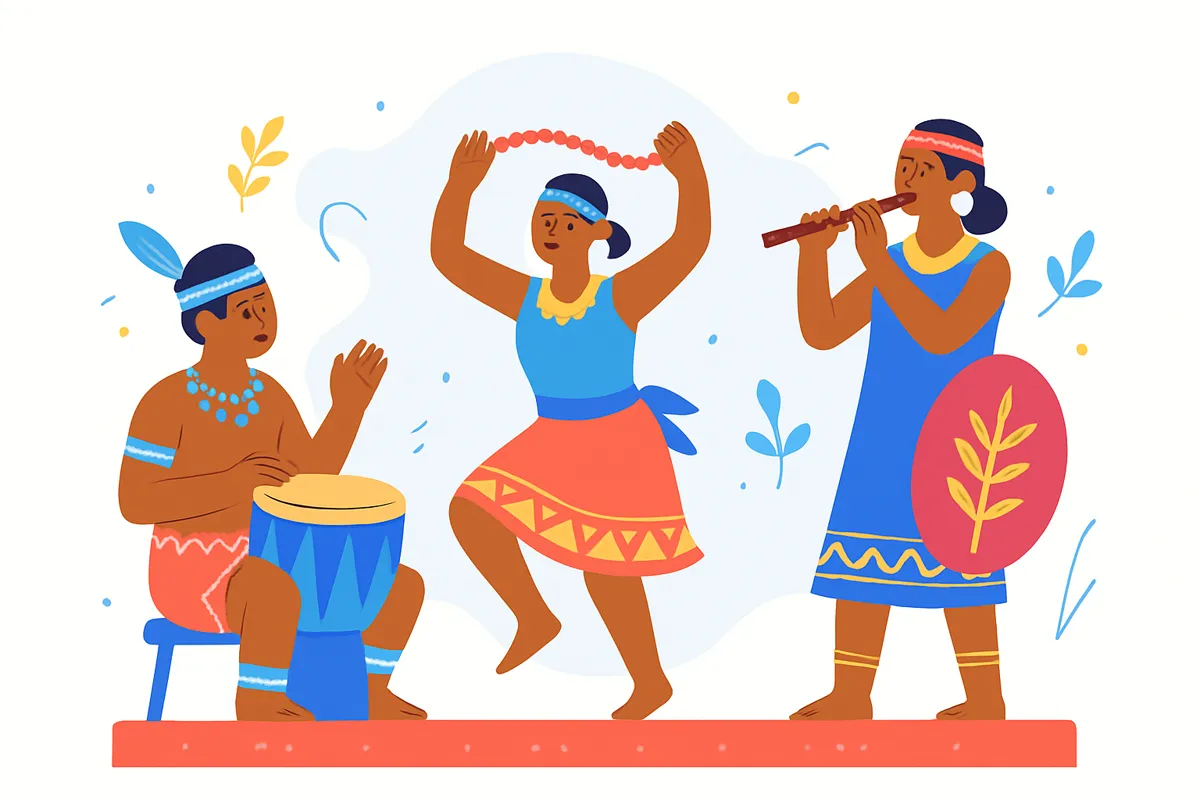
A performing-arts section for the traditions of South Africa’s indigenous peoples, covering dance, music, theatre and storytelling, entered by young performers in three school-age categories.
Indigenous Arts is a section for art performed by indigenous peoples. The festival that runs it names the San and the Nama as the indigenous peoples of South Africa in the strict sense, and adds that cultures which migrated south from the sixteenth century onwards are now also treated as indigenous. In practice that opens the section to a wide range of living community traditions, and the disciplines it names are indigenous dance, music, theatre and storytelling.
The section is not a single fixed performance like a solo song or a recitation. It is a family of traditions, and an entry is a young performer presenting a piece from one of them: a dance, a piece of music, a short piece of theatre or a told story. The festival’s published overview does not list the permitted forms, group sizes or time limits, because those sit in a dedicated part of its prospectus that is available only to registered entrants. An organiser using this item should therefore write those rules into the entry notice rather than assume them.
On eTalenter the item is an Individual item open to both genders, offered in three categories: Entry Level, Junior (Grades 4 to 7) and Senior (Grade 8 and above). Each is scored out of 100 on the template’s working scale. If your event welcomes group performances, set the participant type for the category to match your own rules before you open entries.
Organisers run a section like this for reasons beyond competition. The festival states its aims plainly: to help young people rediscover their roots, to raise awareness of indigenous performing practices, to give community activities a platform, to build skills and self-esteem, and to improve performance standards by setting adjudication standards for these practices. Preserving and promoting indigenous languages is part of the stated purpose, so a good Indigenous Arts class makes room for the language a piece is performed in.
Where Indigenous Arts comes from
The festival added Indigenous Arts as a section in its 2016 prospectus, following an Indigenous Arts Development Project run in 2015 with support from a national lottery body.
Where Indigenous Arts is run
On eTalenter this item appears in one template, the one modelled on South Africa’s national eisteddfod, where it runs in all three entry categories. It is described by that festival’s own prospectus and is specific to South African indigenous traditions as that festival defines them. Other festivals run indigenous or traditional-culture classes under their own names and rules, so treat this page as a description of one festival’s section and check an organiser’s own notice before applying it elsewhere.
- South Africa
Key facts
- An Individual item, open to both genders, offered in the Entry Level, Junior (Grades 4 to 7) and Senior (Grade 8 and above) categories
- The named disciplines are indigenous dance, music, theatre and storytelling
- The festival’s public overview sets no time limit, group size or repertoire list; those rules are in a registration-gated prospectus part, so the template sets no time limit
- Scored out of 100 on the template’s working scale; the festival’s own awards are Diploma, Gold, Silver and Bronze (with a Junior Diploma for Grades 0 to 3), judged against general yardsticks rather than an Indigenous-Arts-only mark sheet
- Promoting and preserving indigenous languages is one of the section’s stated aims
- Added to the festival’s prospectus in 2016
On eTalenter, Indigenous Arts is filed under On Stage and typically scored with Marks. It appears in 1 ready-made event templates — each one can adjust its time limit, age-group assignment and scoring setup independently.
Across the templates that use it, Indigenous Arts is most often entered as an Individual competition, typically scored out of 100.
What judges look at in Indigenous Arts
What a Indigenous Arts panel is actually weighing up, and where the marks are usually won or lost:
- Authenticity of the tradition: the piece should clearly belong to a real indigenous practice and be presented as such, not a loose imitation or a costume dressed over a generic routine
- Skill and control in the chosen discipline: footwork and body rhythm in dance, tone and timing in music, voice and presence in theatre and storytelling
- Knowledge and understanding: an entrant who can say where the piece comes from, what it means and who traditionally performs it shows the depth the festival’s criteria reward
- Initiative and creativity within the tradition: the festival’s own award wording credits some initiative, so a thoughtful arrangement or retelling earns more than a copy of a recording
- Language and communication: where a piece is sung, spoken or told, clear delivery in the language of the tradition and a way for the audience to follow the meaning
- Presentation: costume, instruments and staging that are appropriate to the tradition, handled respectfully and comfortably
Treat these as the judging focus, not a fixed rubric: publish your own weighted criteria for Indigenous Arts under Scoring Setup, or start from judge scoring and tabulation software.
How to prepare for Indigenous Arts
How entrants and their teachers usually get Indigenous Arts right on the day:
- Choose a tradition the entrant has a genuine connection with, or has learned from a community teacher or elder, and be ready to say where it comes from
- Ask for the rules first: the festival publishes the section’s detailed rules only to registered entrants, so an organiser should confirm time, group size and permitted forms in writing
- Rehearse in the language of the piece and learn what every word or line means, so the performance is understood and not only memorised
- Keep the piece inside the time the event sets by timing a full run-through, including entry and exit, with the instruments or props that will be used on the day
- Prepare the instruments and costume early and test them in the performance space; a drum that has gone slack or a costume that restricts movement costs marks quickly
- Prepare two or three sentences of introduction about the tradition, in plain words, so an adjudicator who does not know it can follow what they are about to see
- After the event, read the written comments with the entrant and a teacher, and use them to decide which part of the piece to deepen before the next season
Ready-made event templates that include Indigenous Arts
Open any template to preview it in eTalenter and install it as a live, editable event.
| Template | Category | Score label | Competitions |
|---|---|---|---|
| National Eisteddfod of South Africa (NEA) | On Stage | Marks | 3 |
Frequently asked questions
Is Indigenous Arts judged individually or as a team?
Across eTalenter’s templates it’s most often run as an Individual entry, though an organiser can set either participation type when assigning the item to an age group.
What counts as Indigenous Arts?
The festival that runs the section describes it as art performed by indigenous peoples, naming indigenous dance, music, theatre and storytelling. It names the San and the Nama as the indigenous peoples in the strict sense and notes that cultures which migrated south from the sixteenth century are now also considered indigenous.
Is there a time limit for an Indigenous Arts performance?
The festival’s public overview does not state one; the detailed rules are in a part of its prospectus that registered entrants can download. The eTalenter template sets no time limit of its own, so an organiser should state the limit in the entry notice.
Can a group enter Indigenous Arts?
The template carries it as an Individual item. The festival’s public overview does not say how many performers an entry may include, so if your event allows group performances, confirm that rule and set the participant type to match before opening entries.
How is Indigenous Arts judged?
The festival awards Diploma, Gold, Silver or Bronze against general yardsticks of skill, knowledge, understanding and initiative. The public pages do not publish a separate Indigenous Arts mark sheet, and the template scores the item out of 100 as a working scale.
Want the full judging picture? Read judge scoring and tabulation software, or browse every on stage competition item.
Try Indigenous Arts in eTalenter
See every ready-made template that runs Indigenous Arts, and install one as a live event — age groups, rules and scoring included.

Leave a Reply
You must be logged in to post a comment.