
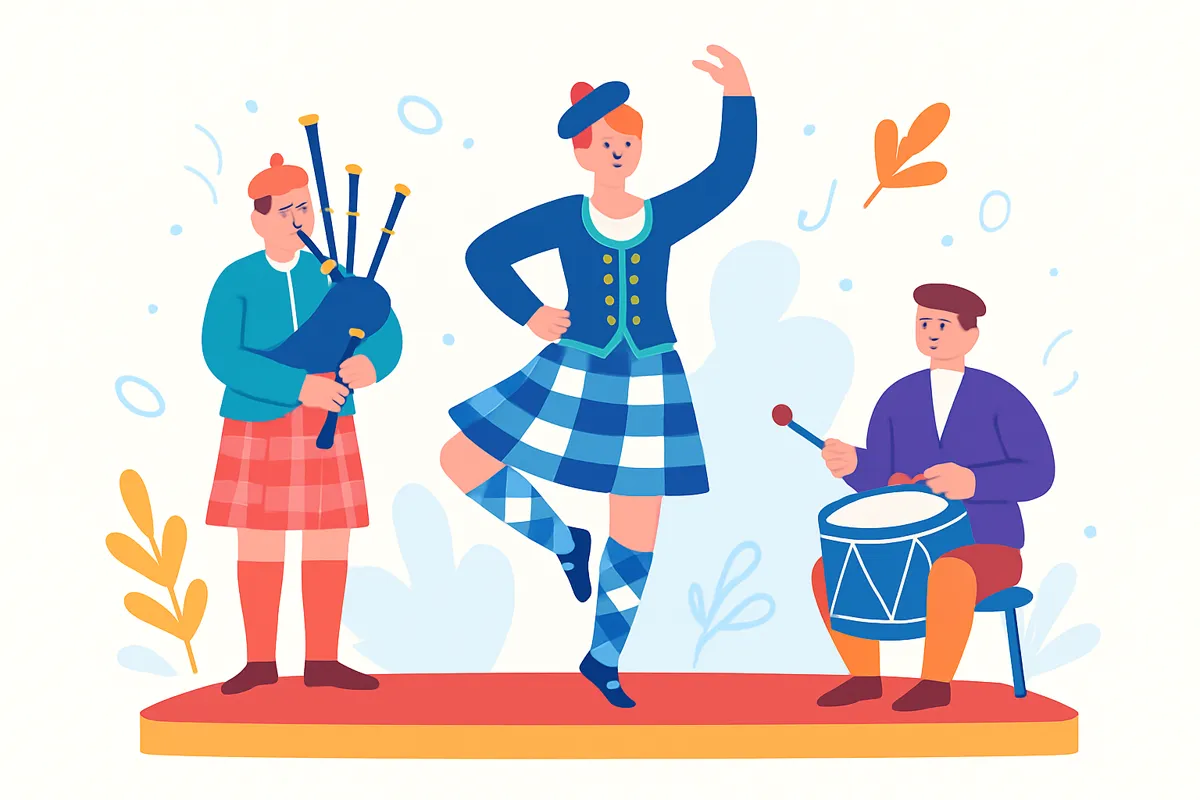
The best-known Highland dance, a solo danced almost on the spot to a lively tune, and the third dance a young Primary competitor can enter.
The Highland Fling is a solo Scottish dance and the one most people picture when they think of Highland dancing. It is a dance of energy and control: the dancer keeps to a small patch of floor, the feet working quickly and precisely while the arms are held in set positions above or beside the body. Because there is so little travelling, there is nowhere to hide an untidy step; the whole dance is judged on how clean, high and well timed each movement is.
In the Highland dancing championship template the Fling is one of the four Highland dances, together with the Sword Dance (Ghille Callum), Seann Triubhas and the Strathspey and Reel of Tulloch, as distinct from the lighter National dances such as the Scottish Lilt or Village Maid. It is also open to the youngest competitors: the rule book the template is built from lets the Primary grade, for children under seven, enter just four dances, Pas de Basque, Pas de Basque and High Cuts, Highland Fling and Sword Dance. The same item then appears again in the Beginners, Novice, Intermediate and Premier grades, so one dancer can meet it at every stage of their progression.
A round follows the pattern of the other solo dances. The dancer is called to the floor, takes the opening position, starts on the first note of the music and finishes on the closing note, usually alongside a few other competitors dancing at the same time. The adjudicator watches footwork, timing, posture and the arms, and awards a mark out of one hundred, with Timing worth 10, Technique 80 and General Deportment 10. In the Championships the judges go on to give six clear placings; the template records the same one-hundred-mark maximum for the item in every grade.
Organisers run it as its own item because it is the benchmark dance of a Highland programme. Teachers use it to show how far a dancer has come, and spectators use it to judge the standard of the whole event. In the youngest grade there are no trophies, which keeps the focus on learning the dance; in the higher grades a first, second or third place in a grade competition counts towards moving up to the next grade.
Where Highland Fling comes from
Tradition says the Highland Fling was first danced by a victorious clansman on the spot, even on the small round shield known as a targe, to celebrate a win; the story is widely told, though it is folklore rather than a documented record. What is certain is that it grew out of the Scottish Highlands and has long been the dance by which Highland dancing is recognised.
Where Highland Fling is run
On eTalenter the Highland Fling appears in one template only, the Highland dancing championship template, where it is carried in all five progression grades from Primary to Premier. Highland dancing competitions are held at games and festivals across Scotland and in Scottish communities in Canada, the United States, Australia, New Zealand and South Africa; this page describes only the item as the template carries it, a graded progression rather than age bands.
- Scotland, United Kingdom
Key facts
- A solo dance, recorded as Individual and open to both genders
- One of the four Highland dances, alongside the Sword Dance (Ghille Callum), Seann Triubhas and the Strathspey and Reel of Tulloch
- Offered in all five grades of the template: Primary (under seven), Beginners, Novice, Intermediate and Premier
- Published marking is out of 100: Timing 10, Technique 80 and General Deportment 10
- Danced largely on one spot, so accuracy and height matter more than distance travelled
- No trophies are awarded in Primary; in the Championships the judges give six clear placings
- The template carries a ten-minute ceiling, an app default because the rules print no time limit for this dance
On eTalenter, Highland Fling is filed under On Stage and typically scored with Marks. It appears in 1 ready-made event templates — each one can adjust its time limit, age-group assignment and scoring setup independently.
Across the templates that use it, Highland Fling is most often entered as an Individual competition, typically scored out of 100, commonly time-limited to around 10 minutes where a limit is set.
What judges look at in Highland Fling
What a Highland Fling panel is actually weighing up, and where the marks are usually won or lost:
- Technique, worth 80 of the 100 marks: pointed toes, a turned-out leg, a springy hop and steps that reach the same height on every repeat
- Staying on the spot: the Fling is not a travelling dance, so drifting across the floor or landing away from the starting mark shows loose control
- Timing, worth 10 marks: each step landing exactly with the music, starting on the first note and finishing on the last without a stop or a rush
- Arm positions, which belong to the technique mark: raised or set arms held shapely and the same on both sides, never drooping as the dancer tires
- General deportment, worth 10 marks: an upright, lifted carriage, steady head and a calm face from the walk on to the final pose
- Matching the two sides: a step that looks sharp on one foot and heavy on the other costs marks, so left and right must be equally strong
Treat these as the judging focus, not a fixed rubric: publish your own weighted criteria for Highland Fling under Scoring Setup, or start from the full folk dance judging criteria guide.
How to prepare for Highland Fling
How entrants and their teachers usually get Highland Fling right on the day:
- Build the dance in small pieces: learn and polish one step at a time before joining them, and only then dance the whole thing to music at the competition tempo
- Practise on a marked spot, such as a floor tile or a line of tape, and check at the end of each run that the feet are still where they started
- Work the hop and the pointed foot with simple strengthening, such as calf raises and slow rises onto the toes, because a tired dancer drops the foot and the height goes first
- Film a run from the front and compare the left and right sides, then fix the weaker side with extra slow repetitions rather than only dancing faster
- Run the whole dance twice in a row in practice so there is stamina left for the final step, where marks are most often lost
- Dress rehearse in the kilt, shoes and hair that will be worn on the day, including the walk on and the opening position, so nothing is new in the ring
- Read the adjudicator comments after every event, choose one correction, and work only on that before the next competition
Ready-made event templates that include Highland Fling
Open any template to preview it in eTalenter and install it as a live, editable event.
| Template | Category | Score label | Competitions |
|---|---|---|---|
| Highland Dancing Championship (RSOBHD) | On Stage | Marks | 5 |
Frequently asked questions
Is Highland Fling judged individually or as a team?
Across eTalenter’s templates it’s most often run as an Individual entry, though an organiser can set either participation type when assigning the item to an age group.
What is the Highland Fling?
It is a solo Scottish Highland dance performed largely on one spot, with fast, precise footwork and set arm positions. It is one of the four Highland dances in the template, and is judged on technique, timing and deportment.
Is the Highland Fling a Highland dance or a National dance?
The rule book behind the template names it as one of the four Highland dances, with the Sword Dance (Ghille Callum), Seann Triubhas and the Strathspey and Reel of Tulloch. National dances, such as the Scottish Lilt and Village Maid, are listed separately.
Can young children enter the Highland Fling?
Yes. In the template it is one of only four dances the Primary grade may enter, and Primary is for dancers under seven. At their seventh birthday a dancer becomes a Beginner and can dance it again in that grade.
How is the Highland Fling scored?
The published scheme is 100 marks per dance: Timing 10, Technique 80 and General Deportment 10. The template records the item with a 100-mark maximum in every grade so the panel can enter one mark per dancer.
Does the Highland Fling have trophies in the youngest grade?
The rules say organisers must not award trophies in Primary. Results can still be recorded and shared on eTalenter, but a festival following the rules would use certificates or comments instead of cups.
Want the full judging picture? Read the full folk dance judging criteria guide, or browse every on stage competition item.
Try Highland Fling in eTalenter
See every ready-made template that runs Highland Fling, and install one as a live event — age groups, rules and scoring included.

Leave a Reply
You must be logged in to post a comment.