
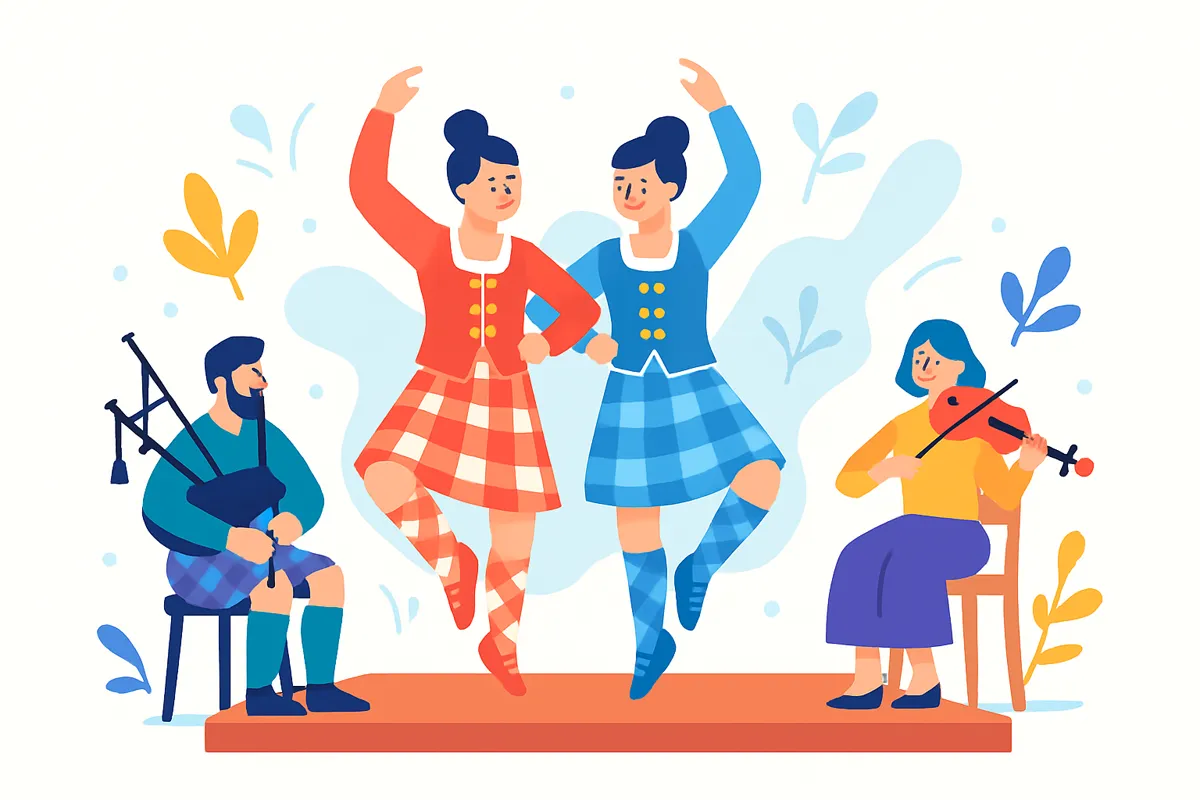
A solo dance item in the Scottish Highland tradition, entered individually and judged on technique, timing, posture and the character of each dance.
Highland dancing is the solo competitive dance form that grew out of the dances of the Scottish Highlands and became a fixture of Highland games and Gaelic festivals. It is danced on the balls of the feet with a lifted, upright carriage, the arms held in set positions and the footwork built from precise steps such as springs, shedding, high cuts and pointed toes. The best-known dances are the Highland Fling, the Sword Dance, the Seann Triubhas and the Highland Reel or Strathspey, each with its own rhythm, steps and character. Some dances are strong and athletic, others light and flowing, and a competitor is expected to show the difference.
In the Scottish Gaelic festival template Highland Dancing is the nineteenth item of the On Stage programme, listed after the instrumental run and ahead of Cogadh nan Comhlan (Battle of the Bands). It is offered across ten bands: P1-P3, P4-P5 and P6-P7 for primary classes, 11-12 (Secondary), 13-15 Years and 16-18 Years, then Senior Ladies, Senior Men, Senior Mixed and Senior Open. Every entry is recorded as Individual, both genders are admitted in every band, and no spoken language applies. The template records a rating out of 10 with a 100-mark maximum and a ten-minute ceiling.
A round is short and exact. Dancers are called onto the floor in numbered groups or one at a time, take their opening position, and begin on the first note of the music. The adjudicator watches the feet, the arms, the carriage of the body and the match between the movement and the beat, and writes comments on a sheet for each dancer. A strong entry holds its shape from the first bar to the last, finishes on the final beat and keeps its character when the steps get difficult. The template’s Evidence records that no marking scheme is published for the programme, so the 100-mark maximum is the app default and not a printed split by criterion.
Organisers run Highland Dancing because it is one of the most recognisable parts of Scottish culture and a natural meeting point between the music and dance items of a Gaelic programme. A young dancer can enter the lowest band with a single simple dance, while older dancers use the senior bands to show stamina, control and polish. Keeping it as its own item means dancers are compared with other dancers, on equal terms, and not against singers or players.
Where Highland Dancing comes from
Highland dancing developed from the traditional dances of the Scottish Highlands and was shaped into its modern competitive form at the Highland games of the nineteenth and twentieth centuries. Many of its dances carry older stories, such as the Sword Dance and its link to a warrior’s victory, but the competition form, with set steps and set standards, is more recent.
Where Highland Dancing is run
On the eTalenter templates Highland Dancing appears in one template only, the Scottish Gaelic festival template, where it sits among the On Stage items beside the singing, piping and instrumental classes. A separate template covers the stand-alone Highland dancing championship, with its own progression structure, and is not described here. Beyond these templates, Highland dancing is competed at games and festivals across Scotland and in Scottish communities in Canada, the United States, Australia, New Zealand and South Africa; this page describes only the item as the Scottish Gaelic template carries it.
- Scotland, United Kingdom
Key facts
- A solo item, so every entry is recorded as Individual
- Ten bands: P1-P3, P4-P5, P6-P7, 11-12 (Secondary), 13-15 Years and 16-18 Years, then Senior Ladies, Senior Men, Senior Mixed and Senior Open
- Every band admits both genders in the template, including the bands named Senior Ladies and Senior Men
- No spoken language is set, because the class is danced
- Rating out of 10 with a 100-mark maximum and a ten-minute ceiling; these are app defaults, as the source publishes no marking scheme and the template ships no Grade bands
- Listed as its own item, separate from the stand-alone Highland dancing championship template, which has its own grades and rules
On eTalenter, Highland Dancing is filed under On Stage and typically scored with Rating out of 10. It appears in 1 ready-made event templates — each one can adjust its time limit, age-group assignment and scoring setup independently.
Across the templates that use it, Highland Dancing is most often entered as an Individual competition, typically scored out of 100, commonly time-limited to around 10 minutes where a limit is set.
What judges look at in Highland Dancing
What a Highland Dancing panel is actually weighing up, and where the marks are usually won or lost:
- Technique: toes pointed, feet turned out and landing quietly on the balls of the feet, with the springs, cuts and shedding steps in their set form
- Timing: every step landing on the beat of the music, with no rushing in the easy bars or drifting behind in the hard ones
- Posture and carriage: an upright, lifted body, steady head and shoulders, and arms held in the correct positions from start to finish
- Character: the Fling, Sword Dance and Reel each look different, so the dancer’s expression and energy must fit the dance performed
- Accuracy of the steps: each step in the order and on the number of repeats that the dance requires, with no steps missed or invented
- Presentation: a calm walk-on, a clean opening position, a confident finish on the final note and neat, correct dress for the band
Treat these as the judging focus, not a fixed rubric: publish your own weighted criteria for Highland Dancing under Scoring Setup, or start from the full folk dance judging criteria guide.
How to prepare for Highland Dancing
How entrants and their teachers usually get Highland Dancing right on the day:
- Choose the dance that suits your level and learn its steps in the correct order before working on speed or height
- Practise the footwork slowly in front of a mirror, checking that toes are pointed and heels are lifted, and speed up only when the slow version is clean
- Count the music aloud while you dance so that each step is tied to the beat, and practise with a recording at the exact tempo you will dance to
- Build stamina and balance with short daily drills, such as holding positions and repeating one step many times, because tired legs show in the last bars
- Check your arm positions and head carriage as carefully as your feet, since marks are lost for loose hands or a dropped chin
- Rehearse the whole entrance, opening position, dance and exit in your competition outfit and shoes, so nothing is new on the day
- After each event read the adjudication sheet, pick one correction such as sharper toes or steadier timing, and work on that alone before the next one
Ready-made event templates that include Highland Dancing
Open any template to preview it in eTalenter and install it as a live, editable event.
| Template | Category | Score label | Competitions |
|---|---|---|---|
| Royal National Mod (Scotland) | On Stage | Rating out of 10 | 10 |
Frequently asked questions
Is Highland Dancing judged individually or as a team?
Across eTalenter’s templates it’s most often run as an Individual entry, though an organiser can set either participation type when assigning the item to an age group.
Is Highland dancing the same as Scottish country dancing?
No. Highland dancing is a solo discipline of set, technical steps judged against a standard. Scottish country dancing is a social, group dance form. On eTalenter the template lists Highland Dancing as an individual item.
Is Highland Dancing a team event?
No. The template records every entry as Individual. Group dances and formation items are separate and are not covered by this page.
Are boys and girls judged together?
The template admits both genders in every band, including the bands named Senior Ladies and Senior Men. If your festival wants those two senior bands kept to one gender, say so in its notice and set the entries up to match.
Does it have to be a recorded track or a live piper?
The template does not set a music rule, so the festival notice decides. Check it before you enter, and ask the organiser how the music will be provided if the notice is silent.
Do I have to wear a kilt?
Highland dancing is traditionally danced in Highland dress, but the template does not set a dress rule. The festival notice decides, so check it before you buy anything for the day.
How long will I dance for?
The template carries a ten-minute ceiling for the item. A single dance is normally much shorter, and the festival notice may set a limit for each band, so check it before you choose what to prepare.
Want the full judging picture? Read the full folk dance judging criteria guide, or browse every on stage competition item.
Try Highland Dancing in eTalenter
See every ready-made template that runs Highland Dancing, and install one as a live event — age groups, rules and scoring included.


Leave a Reply
You must be logged in to post a comment.