
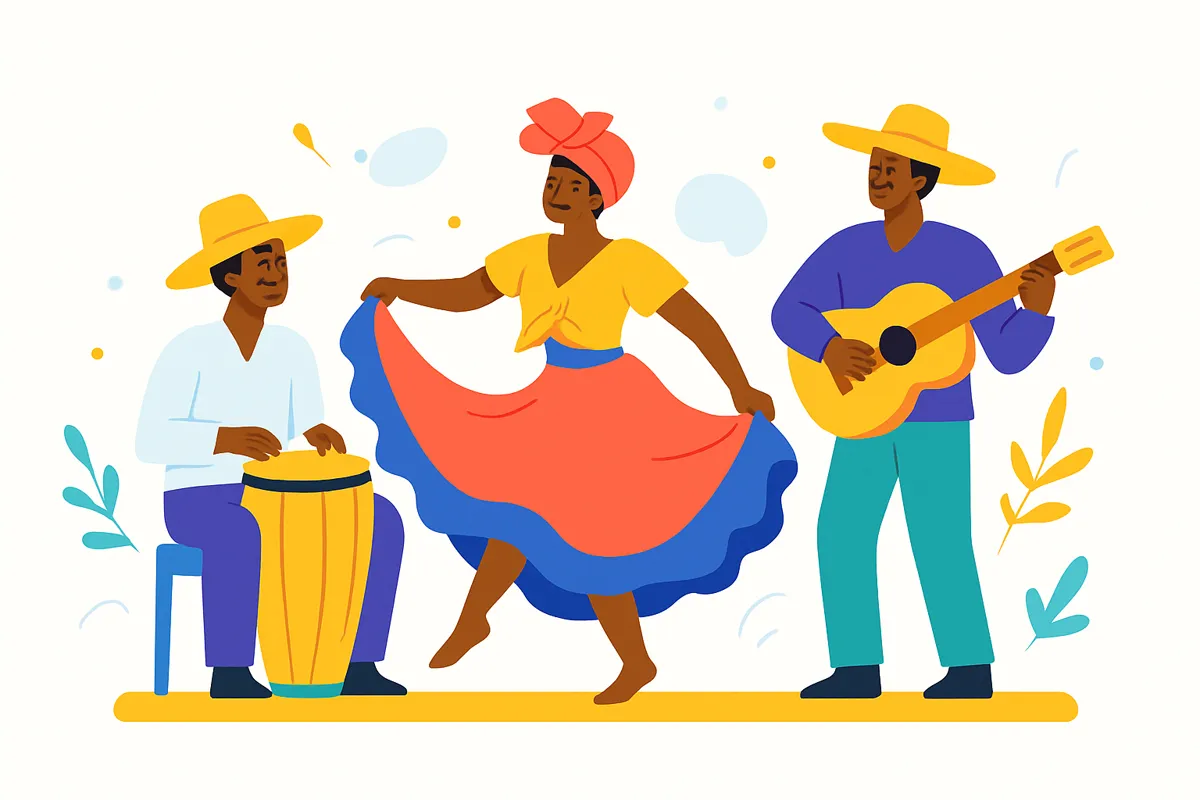
A team dance item in a national performing arts festival in Jamaica, where a group builds a short piece in which movement and music are made to work as one.
Dance – Movement and Music is the first of the eighteen dance categories in the Jamaican national performing arts festival that this template is rebuilt from. It is entered by a team, not a solo dancer, and the title tells you what the panel is looking for: a short piece in which the movement is built around the music and the music is heard in the movement, rather than steps laid over a track that could just as easily be any other.
On the template the item runs for up to four minutes, with the warning bell at three, and is marked out of 100 for every class from the youngest children to adults. The festival’s own handbook, which the template follows, lists the item among the dance categories; the extract used to build the template does not print a definition of the category or its marking weights, so this page does not invent either. What an organiser can safely say is the shape of the entry: one team, one piece, one piece of music, inside the time limit.
A typical entry starts with the team choosing a piece of music it can respond to physically: a clear pulse, a change in energy, a phrase that can be answered with a lift, a turn or a pause. The choreography then follows the music’s shape. Younger classes tend to show simple, clear responses to rhythm and mood, while older classes and adult teams have room for layered patterns, changes of formation and contrasts between loud and quiet passages.
Organisers run an item like this because it opens the dance programme to teams who are not tied to a named style. A school, a community group or a youth club can enter without having to present ballet, jazz or a folk form, and the festival still gets a fair way to compare teams on musicality and control.
Because the festival is run in stages, a team that wins its parish round moves on to the later rounds with the same piece. That makes the first performance matter: the piece has to be finished, rehearsed and within the time limit before the first audition, not after it.
Where Dance – Movement and Music is run
On eTalenter this item is used in one template, the Jamaican national performing arts festival template, where it is assigned to all seven age classes (six age bands from 3-6 up to adults aged 20 and over, plus a combined class). It is a dance-discipline item inside a festival that also runs drama, music, speech and traditional folk forms. Other festivals run movement-to-music or creative-movement classes under their own names and rules, so check the notice of the event you are entering rather than assuming the same limits.
- Jamaica (the national performing arts festival the template is built from)
Key facts
- A Team item: one group performs one piece, entered as a team in every age class
- Open to both genders in a single list, with the language set to English
- Offered in all seven classes: Class 1 (3-6), Class 2 (7-9), Class 3 (10-12), Class 4 (13-15), Class 5 (16-19), Class 6 (adults, 20 and over) and the combined class
- Time limit of four minutes, with the warning bell at the three-minute mark
- Scored out of 100 in the template; the festival’s parish rounds use a 100-point scale, with medals at published mark bands, not first, second and third
- The extract used for the template prints no per-criterion weights for this category, so none are asserted here
On eTalenter, Dance – Movement and Music is filed under On Stage and typically scored with Marks. It appears in 1 ready-made event templates — each one can adjust its time limit, age-group assignment and scoring setup independently.
Across the templates that use it, Dance – Movement and Music is most often entered as an Team competition, typically scored out of 100, commonly time-limited to around 4 minutes where a limit is set.
What judges look at in Dance – Movement and Music
What a Dance – Movement and Music panel is actually weighing up, and where the marks are usually won or lost:
- The source does not print this category’s marking table, so what follows is organiser guidance for agreeing yardsticks with the panel, not rules from the source
- Musicality: whether the movement follows the music’s pulse, phrasing and changes of mood, with accents hit on the beat rather than a beat late
- Use of the music as a whole: a team that responds to the quiet passages as well as the loud ones earns more than one that dances at the same level of energy throughout
- Unity and spacing: whether the team moves together when it should, holds its formations and uses the whole floor instead of crowding one corner
- Quality of movement: control, posture and clean finishes to each shape, with the difficulty set to what the class can really do
- Staging and finish: a clear start position, a purposeful end and a piece that fits the time limit without being cut off by the bell
Treat these as the judging focus, not a fixed rubric: publish your own weighted criteria for Dance – Movement and Music under Scoring Setup, or start from the full group dance judging criteria guide.
How to prepare for Dance – Movement and Music
How entrants and their teachers usually get Dance – Movement and Music right on the day:
- Pick music with a clear structure the team can hear: an introduction, a lift in energy, a change of section and a close, so the choreography has something to follow
- Count the piece out loud before it is danced, and have every team member know where the changes fall, so nobody relies on watching the person beside them
- Build the piece to three and a half minutes in rehearsal, because the warning bell sounds at three and the limit is four; a piece that regularly runs long is not ready
- Choose steps the youngest and least experienced member can do well: a simple movement done together beats a hard one done raggedly, particularly in the lower classes
- Rehearse the entrance and the exit as carefully as the dance, since the first and last ten seconds shape how the panel remembers the piece
- Record a run-through and watch it with the sound off: if the movement alone does not suggest the music, the link between the two is not yet strong enough
- Carry the music in more than one format and check it on the festival’s equipment before the performance, so a technical fault does not cost the team its slot
Ready-made event templates that include Dance – Movement and Music
Open any template to preview it in eTalenter and install it as a live, editable event.
| Template | Category | Score label | Competitions |
|---|---|---|---|
| JCDC National Performing Arts Festival (Jamaica) | On Stage | Marks | 7 |
Frequently asked questions
Is Dance – Movement and Music judged individually or as a team?
Across eTalenter’s templates it’s most often run as an Team entry, though an organiser can set either participation type when assigning the item to an age group.
Is Dance – Movement and Music judged as a team or individually?
As a team. It is a Team assignment in every age class on the template, so the group is entered, scored and placed as one unit.
How long can the piece be?
The template sets a four-minute limit with the warning bell at three minutes. Any rule beyond that is for the organiser to set and publish.
Is it the same as a creative folk dance or a modern dance item?
No. The festival lists creative folk, modern or contemporary, ballet, jazz and other dance categories separately; this item is the one that centres on how a team fits movement to music, without tying the entry to a named style.
Which age classes can enter?
All of them: Class 1 (3-6), Class 2 (7-9), Class 3 (10-12), Class 4 (13-15), Class 5 (16-19), Class 6 (adults aged 20 and over) and the combined class that mixes the age bands.
How is it scored?
The template scores it out of 100. The festival awards medals against mark bands rather than first, second and third places, and the extract used for the template does not print this category’s per-criterion weights, so an organiser using the template should set and publish their own.
Want the full judging picture? Read the full group dance judging criteria guide, or browse every on stage competition item.
Try Dance – Movement and Music in eTalenter
See every ready-made template that runs Dance – Movement and Music, and install one as a live event — age groups, rules and scoring included.


Leave a Reply
You must be logged in to post a comment.